
Freightos launches Freightos AI; makes India first market for pilots
The decision to start with India is rooted in what Freightos sees as an unusually strong appetite among Indian forwarders to control their own technology journey.
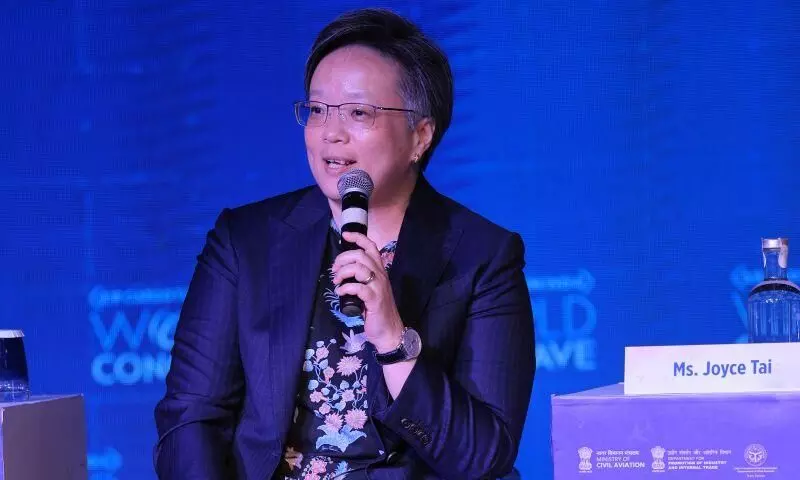
The announcement was made by Joyce Tai, Executive Vice President of Worldwide Partnerships at Freightos, during the Air Cargo Forum India (ACFI) World Conclave 2026 in Delhi on Thursday (August 13, 2026).
The global freight pricing, booking, and procurement platform Freightos has announced the launch of Freightos AI, an artificial intelligence platform designed to help freight forwarders automate repetitive tasks, consolidate fragmented data, and make faster, data-backed decisions, with India chosen as the first market for customer pilots.
The announcement was made by Joyce Tai, Executive Vice President of Worldwide Partnerships at Freightos, during the Air Cargo Forum India (ACFI) World Conclave 2026 in Delhi on Thursday (August 13, 2026). “Today is our first time announcing the future launch of Freightos AI,” Tai said, describing India as the company’s first site for the announcement and rollout.
Freightos AI will initially be developed and rolled out through Freightos for Forwarders (formerly WebCargo), the company’s suite of digital solutions for freight forwarders, but the company intends to expand the technology across other segments of the freight industry as it matures.
Freightos AI is being built around three broad areas, said Tai in an exclusive interaction. The first is agentic AI, where repetitive forwarding activities such as rate ingestion, rate uploading, and rate cleansing, as well as functions such as quotation and sales assistance, can be handled by AI agents. The second is AI-assisted decision-making, where the system provides intelligence while a forwarder searches for rates, builds quotations, and books shipments.
The third is a longer-term ambition around agents communicating with other agents and systems. Tai pointed to Model Context Protocol (MCP) as a potential successor to the role APIs have played in connecting digital systems. The objective is to enable AI agents from different systems to understand each other’s context, roles, and responsibilities and work together, rather than create another layer of technological silos.
Freightos is also taking a deliberately selective approach to the initial rollout. “We are going to carefully work with at least 30 organisations to try our solution,” she said, noting that the company expects each organisation to have different requirements and potentially a different version of how agentic AI should be deployed. The company expects India to see some initial successful rollouts as early as the fourth quarter, subject to the pilot and onboarding process.
The decision to start with India is also rooted in what Freightos sees as an unusually strong appetite among Indian forwarders to control their own technology journey. “India has the highest percentage of people who want to build at least their front end,” Tai said. “We can empower them through data. So we can be the middleware. We can be the orchestration layer.”
But Freightos is deliberately avoiding the conventional AI launch playbook. Tai said the company has spent more than 10 months working quietly on the initiative. “We are not rushed to be the first to do AI or talk about AI,” she said, adding that the company wants to work with customers and build the technology around how individual organisations actually operate.
That approach reflects Freightos’ view that AI adoption in forwarding cannot be separated from the underlying state of digitalisation. Tai described companies as being at different stages of a digitalisation journey, with some still operating with disconnected spreadsheets and documents, while others have connected systems and are now looking at how multiple intelligent systems can work together.
“For India, we want to say that if you are still taking baby steps about digitisation, like you are in phase zero, it's fine. Don't freak out about AI,” Tai said. “As soon as you have some data foundation, you can choose to turn on AI. Let AI help you with better decision-making.”
The data foundation is central to Freightos’ proposition.
Tai argues that the biggest problem facing the industry is not a lack of AI tools, but the fragmentation of the data those tools need to work effectively. “Freight forwarders often have customer information, buying and selling rates, and operational data spread across different systems, laptops, and documents.”
Once the relevant data is connected, Tai said, the system can bring information together and surface recommendations at the point where decisions are being made. For example, while preparing a quotation, Freightos AI could bring together shipment information, market conditions, congestion, surcharges, and customer history. “All the data was coming together, but if you don't have the preparation and data foundation, nothing will come to you. You are working with an empty box,” Tai said.
The product demonstration provided by Freightos shows how that concept translates into the forwarder’s daily workflow. A shipment request can be entered manually or through a customer's email, after which the system pulls together origin, destination, dimensions, and weight and presents available rates in one view. It can compare spot, contract, and promotional rates, while also displaying validity, transit time, total price, routing, schedules, and aircraft details.
The system then builds the door-to-door quotation, including pickup, origin handling, freight, destination handling, and final delivery. Its AI quote assistant can estimate the probability of winning the business and suggest terms based on customer history, although Freightos stresses that the human remains in control. “Suggestions only. You review, you decide. Nothing is ever sent without you.”
The product demonstration points to one of the more immediate applications: keeping an AI eye on quotations after they have been sent. Freightos AI agents can monitor whether a customer has opened a quote, whether it is nearing expiry, or whether market conditions have changed, then alert the forwarder and draft a follow-up for approval.
For Freightos, however, the larger story is not simply faster quoting. It is about moving freight forwarding from disconnected digital tools towards an environment in which data, decision-making and eventually AI agents can operate together.
Tai said Freightos wants to meet companies wherever they are in that journey rather than push every customer towards the most advanced technology immediately. “If you are not ready for it, AI is going to compound the complexity and chaos for your organisation,” she said.