
Airport handling and visibility emerge as CAR-T logistics gaps
Pharma leaders call for better airport handling, real-time tracking and accountability to protect time-sensitive CAR-T shipments.
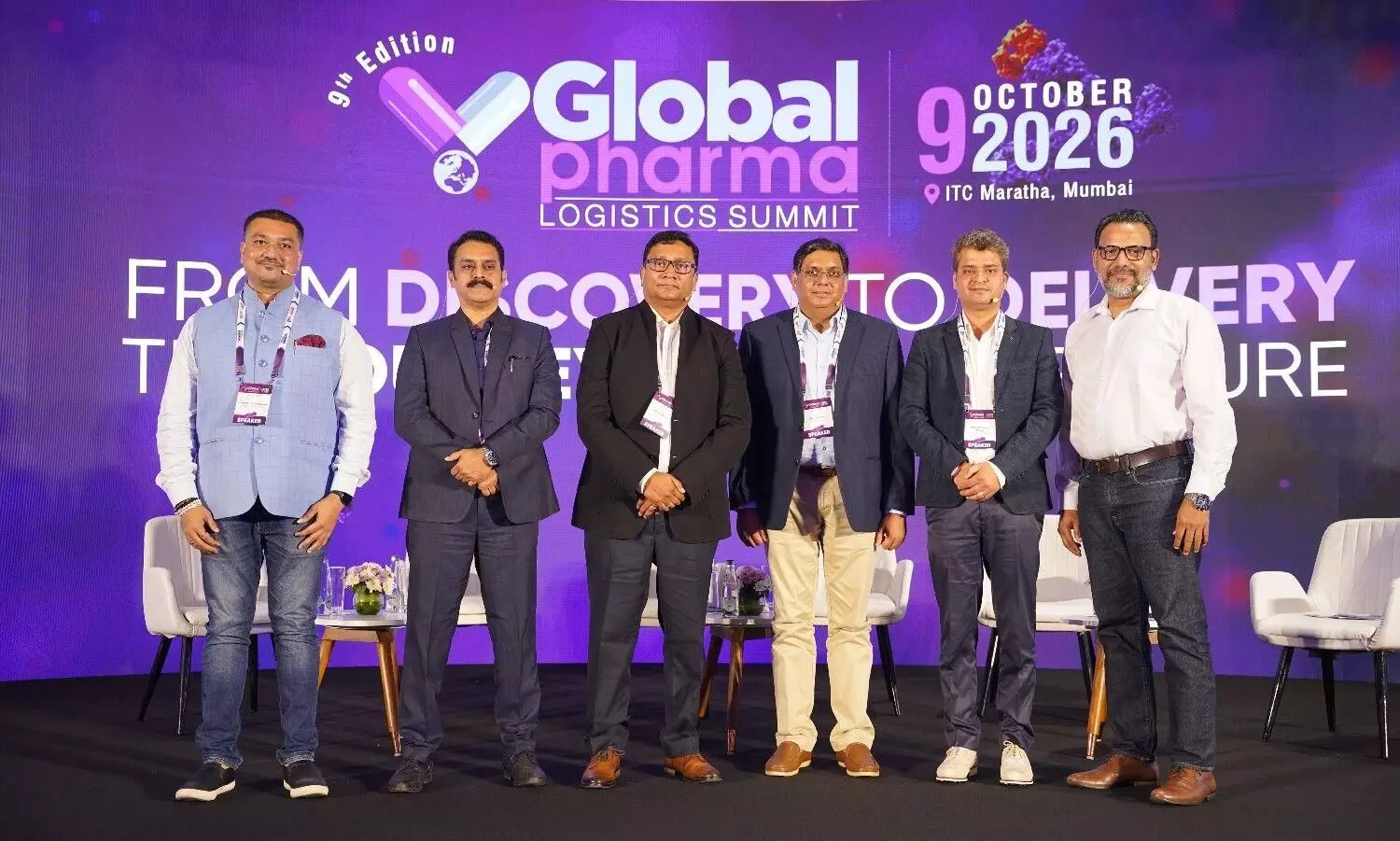
L to R: Chandan Shirbhayye, Aragen Life Sciences; Kaifeel Shaikh, Indoco Remedies; Manoj Singh, MSN Air Service; Shirish Arya, ImmunoACT; Mukesh Kumar Regar, Immuneel Therapeutics and Reji John, Editor at STAT Publishing Group.
Most medicines travel in one direction. They leave a factory and reach a patient. CAR-T therapy works differently. It starts inside the patient, travels to a laboratory and returns as a treatment made from the patient's own cells.
That round trip makes every shipment unlike anything else in pharma logistics. The cargo is living tissue. There is one patient, one product and no spare. A delay or a temperature failure does not mean a replacement batch. It means a person with advanced cancer waits longer for a treatment that took weeks to make.
The discussion took place during Business Session 1, titled “What it takes to go beyond generics and build supply chains for biopharma”, at the ninth edition of Global Pharma Logistics Summit (GPLS) 2026 at ITC Maratha, Mumbai, on October 9. The panel featured Shirish Arya, Co-founder and Director of Corporate Strategy and Business Development at ImmunoACT; Mukesh Kumar Regar, Specialist SCM and Logistics at Immuneel Therapeutics; Chandan Shirbhayye, Vice President and Head of Supply Chain and Operational Excellence at Aragen Life Sciences; Kaifeel Shaikh, Vice President of EXIM, Global Logistics and Domestic Distribution at Indoco Remedies; and Manoj Singh, Group Chief Executive Officer of MSN Air Service. The session was moderated by Reji John of STAT Publishing Group.
India is now doing this, but only two companies in the country, ImmunoACT and Immuneel Therapeutics, hold CDSCO certification for CAR-T cell therapy. Arya said ImmunoACT has treated 1,000 patients so far. Not one of those treatments failed because of logistics, he said. Behind that record sits a chain of hospitals, couriers, airports and ground handlers that most patients never see. This is how that chain works, and where it is still fragile.
A treatment built from the patient's own cells
T-cells are a type of white blood cell. Arya explained that they are a natural cancer-fighting cell. In a healthy body, they keep potential tumour cells in check. In a person with cancer, they stop recognising the tumour as a threat. CAR-T therapy retrains them. The cells are isolated from the patient, modified genetically so that they express a protein that helps them recognise the cancer, multiplied and then infused back.
The treatment is generally considered for patients whose cancer has advanced or returned after other options, Arya said. Once a doctor commits to CAR-T, there is little room to change course. The patient is conditioned for infusion while the cells are still being made, so the schedule on both sides has to hold.
The journey has two shipments. The first carries the patient's own cells. They are collected at a hospital and, preferably within 24 hours, sent to the manufacturing facility at 2 to 8°C. In the laboratory, the cells are isolated, activated and modified using a viral vector. They are then multiplied from millions into billions. Manufacturing takes seven to eight days in a controlled environment. The product then spends about ten days in quality testing, held at minus 80 degrees Celsius. Around the 18th day, Arya said, his team goes back to its logistics partner to plan the return trip.
The second shipment is the finished therapy. It travels back to the hospital at minus 80°C . By then the patient has been through conditioning treatment timed around its arrival, which leaves little room for delay.
The scale of the network is large for a single product. ImmunoACT runs one laboratory in Mumbai. Samples reach it from about 150 hospitals, from Trivandrum in the south to Kashmir in the north and Guwahati in the east. The cells and the finished product move by road and by air, and often by several modes in a single journey. Arya named Marken as the company's primary logistics partner. He also credited the vaccine industry for laying the foundation on which this kind of logistics was built.
Rehearsing every route before the first shipment
Regar, who works in supply chain and logistics at Immuneel Therapeutics, said the entire journey from hospital to manufacturing site and back is handled by a third-party logistics provider. The manufacturer cannot hand it over and walk away. Immuneel works with its partners to find and remove risks before they reach a patient.
The main tool is the dry run. Before the company ships from any new hospital or location, it runs a complete rehearsal with no patient involved. The aim is to find the pain points. Regar said the team maps the route in detail. That covers the hospital and ward, the collection site, the exit point from the hospital, the vehicle, the person who takes the shipment to the airport and the flight it will travel on.
Every plan also carries a contingency. If the first flight is cancelled, or something goes wrong at the hospital that nobody controls, the team already has a Plan B and a Plan C. The reason is simple, Regar said. The patient must not suffer.
Handling inside the box matters as much as the route. A cryoshipper can be tilted or exposed to thermal and physical shock. Immuneel places a tilt indicator on the shipper that turns from green to red if someone mishandles it. It does not prevent rough handling, but it shows that it happened and helps the team trace where.
Airport security is another concern. Regar said X-ray screening can destroy the product. To keep a cryoshipper out of a normal cargo X-ray, Immuneel works with airlines and airport authorities on the documentation and explanations they need, so the shipment is treated differently from ordinary freight.
The company also tracks two things that matter for a therapy made for one person. Chain of identity means the right patient gets the right therapy. Chain of custody means only authorised people can take or hand over the shipment. Regar said Immuneel has trained hospital staff and logistics partners on both, and has written procedures with its partners for every check-in and handover.
The approach has held up in urgent international cases too. Regar described a shipment from the Middle East that moved from a patient's collection on a Sunday to a flight out of Oman on Monday and clearance in India the next day, all within 48 hours.
His conclusion is that when the manufacturer, the hospital and the logistics partner control every step, the process itself becomes the product. Hospitals trust it for that reason.
Where the airport becomes part of the therapy
Singh, whose company MSN Air Service provides ground and cargo handling at airports, said the industry has long treated an airport as a transit point. For cell and gene therapies, he argued, it has to be seen as a critical point.
Singh broke the airport stage into five places where risk enters. The first is acceptance. The handler has to check that the shipment has arrived in the right condition, that the packaging has been inspected and that no delay or temperature excursion has occurred on the way in. The second is offloading and staging, where cargo can be exposed while it waits. The third is build-up, where the unit is made ready and a temperature record has to be kept and shared with the customer. The fourth is the move from the controlled area towards the aircraft. The fifth is the airside, where a flight delay, a ramp issue or an offload decision can leave cargo waiting.
At several of these stages, Singh said, the industry does not monitor minor exposures. It does not always check whether staged cargo is sitting in the correct temperature zone, and it does not always give customers visibility of excursions.
He does not see the main problem as a lack of cold rooms. Infrastructure at Indian airports has improved over the past decade, helped by certifications such as GDP and CEIV. The weak spot, Singh said, is where responsibility passes from one party to another. "It is all about accountability between two control environments." His fix is a single owner who holds time, temperature and visibility data in one account. That removes any doubt about who was responsible when something goes wrong.
Arya described the same gap from the manufacturer's side. Inside ImmunoACT, staff, facilities and processes are documented and audited by regulators such as the CDSCO. Once the product leaves the building, that control ends. The company relies on a data logger, and if it shows no excursion, the shipment is considered fine. Arya said his team does not know what happens at the airport, how much agitation the shipment faces or how X-ray machines treat it. "That's a blind trust that we have."
His proposal borrows from pharma itself. Manufacturers publish studies on shelf life as a matter of routine. Arya wants logistics providers to publish validated, peer-reviewed studies on what their handling does to product quality and where it can improve. He also wants customs and airport staff to understand the hazard levels and time sensitivity of these molecules.
The ingredients face the same risks
CAR-T therapy is only one part of a wider move into biologics, and the same fragility runs upstream. Arya said the culture media and reagents his team uses come from global suppliers, each with its own shelf life and storage condition. Some can sit at room temperature. Others need 20 degrees or 2 to 8 degrees. All of them have to be managed.
Shirbhayye, who heads supply chain and operational excellence at Aragen Life Sciences, said that biologics change the nature of supply chain work. Indian contract research, development and manufacturing organisations have mostly worked on small molecules, which are chemically synthesised and typically stay stable for two to three years. Biologics are different. "We are dealing with living systems." Materials are sensitive to temperature, air, light and even physical stress. That puts pressure on shelf life, inventory and batch management.
Sourcing adds a second layer of risk. Shirbhayye said 90 to 95 per cent of the materials and consumables used in biologics manufacturing in India are imported, from cell culture media and resins to single-use bags and hardware. Manufacturers are often tied to the original equipment maker even for consumables. Backorders on items such as single-use bioreactors and chromatography resins can run to six to nine months, compared with two to three months quoted to global competitors. He said Aragen loses projects because of that delay.
He also gave an example of how a shipment can fail without anyone noticing at the time. A supplier was sending cell culture material to India through a transit point in Europe. A strike at the airport meant the cold integrity material could not be refilled. The data logger recorded an excursion. The company ran tests, and the material had not degraded as much as feared, but the result could have gone the other way. A logger, in other words, records what went wrong. It does not stop it.
Shirbhayye's ask is better end-to-end visibility, extending beyond the metros, with enough data for predictive action rather than analysis after the shipment arrives.
From 1,000 domestic patients to an export test
Arya said ImmunoACT's next step lies outside India. A clinical trial is planned in Mexico and another in South Africa, and the company is in talks with Saudi Arabia, Turkey and other Middle Eastern countries. A manufacturer cannot open a facility in every market, so patients abroad would be served from centralised sites. That means more live tissue crossing more borders.
Demand, according to Arya, is not the constraint. Thousands of patients have unmet needs. The barriers are regulation and trust. Can logistics be relied on to carry live tissue back and forth, so that patients and regulators in other countries accept it?
Shaikh, who stressed that he was speaking in a personal capacity, said the paperwork needs the same attention as the cold chain. He wants import and export pre-clearance across the CDSCO, customs and DGFT to run through a single digital window, so that lead times fall. He also wants logistics providers to take more ownership and to train every hand in the chain, since a product can pass through 10 to 12 handling steps before it reaches the end user. "Honestly, a logistics provider should be a partner rather than just a service provider."
Regar set out what he wants from logistics providers. They should invest in last-mile infrastructure for tier two and tier three cities. They should help develop packaging in India for Indian conditions, since much of it today comes from the United States and the United Kingdom. And they should use modern tools for real-time traceability. Today, he said, his team often learns about a delay or deviation only when the shipment reaches its facility and the report is reviewed. Then begins a root cause analysis after the fact. He wants alerts while the shipment is still in transit.
For these patients, the journey is part of the medicine. Regar's message to logistics providers is blunt. "Change the mindset and don't treat it as cargo."