


Beyond freight: The logistics behind the world's biggest events
At the inaugural edition of the Global Event Logistics Summit in Bangkok, industry leaders highlighted how precision planning, specialised cargo handling and real-time problem-solving are becoming critical to delivering everything from art fairs and music festivals to sporting events and global fan experiences.
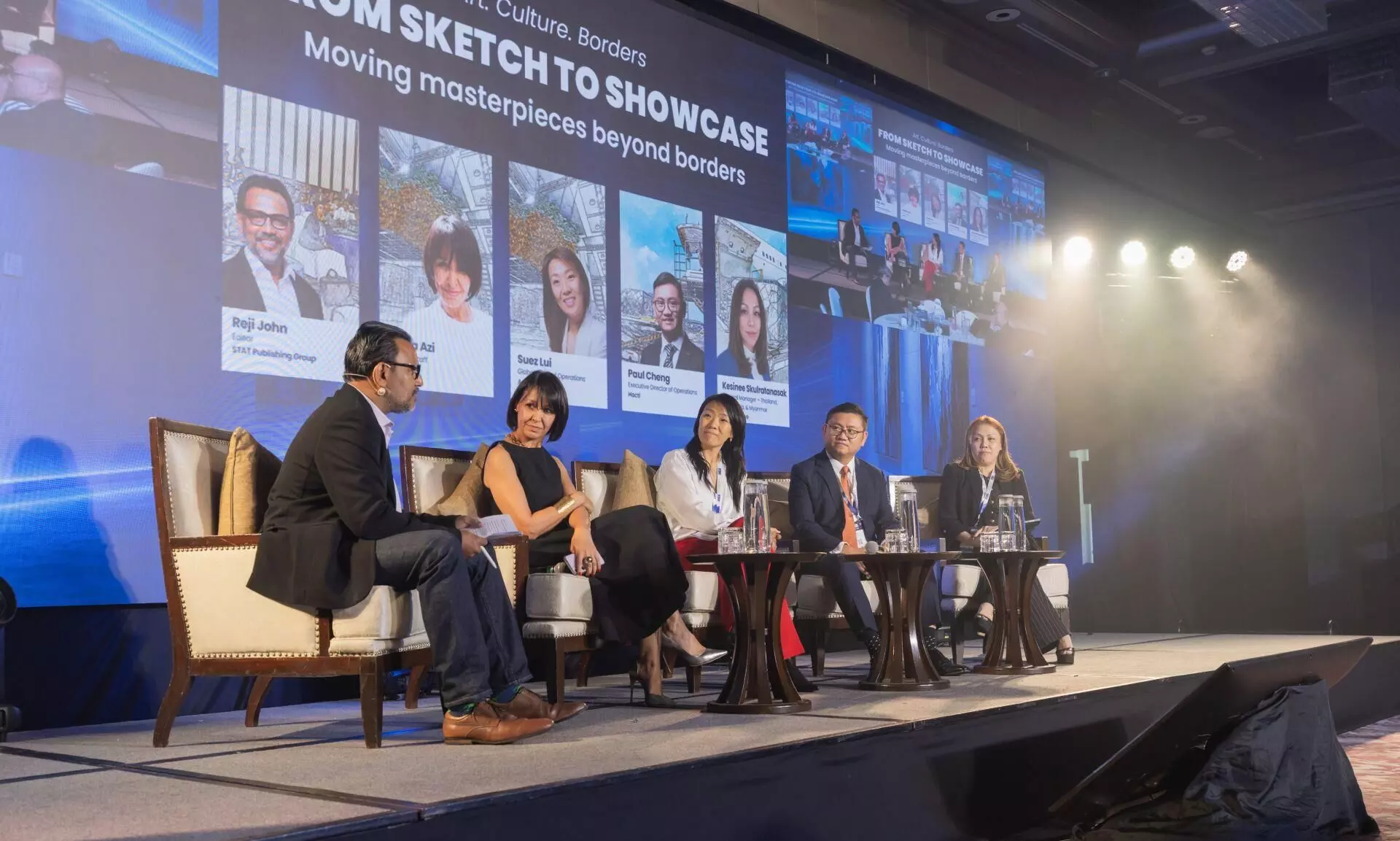
Reji John, Editor, STAT Publishing Group (Moderator), Zohra Azi of Eythos, Suez Lui of Art Basel, Paul Cheng of Hactl and Kesinee Skulratanasak of Etihad Cargo.
Behind every concert, festival, exhibition, sporting event, and fan experience lies a complex logistics operation that most audiences never see. At the Global Event Logistics Summit (GELS) 2026 in Bangkok, organisers, logistics providers, airports, airlines and event specialists from across the world came together to discuss how the industry is adapting to rising customer expectations, geopolitical uncertainty and increasingly complex event ecosystems. From transporting priceless artworks and elite competition horses to supporting FIFA Fan Festivals, music tours and international circuses, speakers shared how planning, technology, collaboration and contingency management are reshaping event logistics into one of the most specialised segments of the global supply chain.
The summit opened with a strong message that as event logistics expands in scale and complexity, success will depend on reliable air cargo networks, infrastructure investment and closer industry collaboration. Paul Cheng, Executive Director of Operations at Hong Kong Air Cargo Terminals Limited (Hactl), underscored the critical role of air cargo in keeping global events on schedule, noting, “In our world of event logistics, deadlines cannot be changed. If a concert starts at 8 pm, the gear has to be there by then. So for us, reliability is everything.”
“This reliability is exactly why Hong Kong is becoming the ultimate destination for mega-events. Thanks to the Hong Kong government's strategies, Hong Kong hosted over 90 major events last year. Our job at Hactl is to make sure the equipment powering those events moves with absolute precision,” he added.
Setting the regional context, Khata Vinin, Vice President - Air Cargo at Airports of Thailand Public Company, outlined Thailand’s ambition to become a leading event logistics hub by leveraging its airport infrastructure, connectivity and free-trade ecosystem. “We are at the centre of Asia with faster regional distribution, strong airport infrastructure and the free trade zone,” he said, highlighting the country's efforts to attract more global events and logistics activity.
Khata Vinin, Vice President - Air Cargo, Airports of Thailand Public Company
Art logistics: Precision, partnerships and technology
Speakers from the art logistics sector highlighted how the movement of high-value artworks depends on meticulous planning, trusted partnerships and growing use of technology. Suez Lui, Global Head of Operations at Art Basel, stressed that delivering world-class art events requires teams to “really plan to the detail as much as possible and connect all of those dots down to every minute of every hour of every day,” while emphasising that logistics providers are “the critical partner” behind every show.
Building on that theme, Zohra Azi, Chief of Staff at Eythos, a Hong Kong-based art logistics and storage company, argued that art logistics is becoming a more integrated and sustainable business, with services consolidated under one roof to reduce “unnecessary handling and transport, operational fragmentations, administrative burden, and carbon footprint.” She also highlighted the often-unseen role of specialist art handlers, noting that “without the art handlers we wouldn’t have our shows.”
Technology is increasingly strengthening this ecosystem. Kesinee Skulratanasak, General Manager for Thailand, Cambodia and Myanmar at Etihad Cargo, showcased digital monitoring tools that provide real-time visibility of sensitive shipments, explaining that their SmartTrack can report “real-time geo locations” as well as “temperature, humidity, tilt and shock-sensitive conditions through the dashboard.” She added that specialised artworks require dedicated solutions because they are “very priceless, powerful and valuable cargo.”
Farah Minwalla of Expo City Dubai (Moderator), Bradford Lee of HKTDC, Anindam Choudhury of TAM Group and Ivan M. Petrovic of EXIT Festival Group (virtual)
Experience economy raises the bar for logistics
As events evolve into multi-layered experiences, logistics is no longer simply about moving cargo but about orchestrating people, products, technology and partners to deliver seamless outcomes. Bradford Lee, Associate Director, Merchandise Trade & Innovation at the Hong Kong Trade Development Council (HKTDC), said logistics now directly shapes the visitor experience, noting that if cargo or exhibition infrastructure fails to arrive on time, “all the product launches cannot be done on time, and it badly affects the experience.” He argued that logistics today is about “moving people, moving business opportunities, moving results.”
This growing focus on experience is also changing how logistics providers operate. Anindam Choudhury, Vice President – Commercial at TAM Group, said event logistics requires a shift “from a volume mindset to precision engineering,” because “with experience management, time is not relative, time is absolute.” The objective, he said, is to ensure audiences enjoy the moment without ever seeing the complexity behind it.
Looking ahead, Ivan M. Petrović, Executive Board Member of EXIT Festival Group, said the experience economy will become even more interconnected, with events increasingly blending music, sports, gaming, technology and other creative industries. Describing festivals as “a complex puzzle of different experiences,” he said the ability to bring together diverse partners and suppliers “like in an orchestra” will be both the industry's greatest challenge and its biggest opportunity.
Reji John (Moderator), Paul Cheng of Hactl, Henry Bullen of Peden Bloodstock (virtual) and Nick Brooks-Ward of HPower Group (virtual)
Equine logistics: Planning around welfare
Equine logistics comes with the unique challenges of transporting elite competition horses, where success depends on years of preparation, meticulous coordination and an unwavering focus on animal welfare. Nick Brooks-Ward, Operations Director of HPower Group, stressed that logistics planning must begin with the event date and work backwards, noting: “You've got to start at zero day, which is when the first horses arrive, and then you've got to pull it backwards.” With hundreds of horses worth millions of pounds travelling to major competitions, he added that “there is a huge amount of money at stake, but also, primarily, horse welfare.”
That welfare-first philosophy was echoed by Henry Bullen, Managing Director of Peden Bloodstock, who argued that horses should be treated as athletes rather than cargo. “An equine athlete is exactly what they are. They are athletes, and they need to be treated with huge respect,” he said, explaining that every stage of the transport process is designed to ensure horses travel “quietly, calmly, and arrive in the best possible shape.” Equine logistics blends specialist expertise, long-term planning and care standards that place the well-being of the animal at the centre of every decision.
Rajarshi Chatterjee, Assistant Editor, STAT Publishing Group (Moderator), Bert Ng of Hacis and Carles Jorba of MotoGP Sports Entertainment Group (virtual)
Delivering the fan experience in an uncertain world
Successful sporting events depend not only on moving equipment and personnel but also on creating a seamless experience for fans while navigating an increasingly unpredictable global environment. Carles Jorba, Head of Operations at MotoGP Sports Entertainment, said event planning begins months in advance and extends far beyond the racetrack, with organisers focusing on every stage of the visitor journey. “Our intention is that since a fan gets out of their home or the hotel and arrives at the circuit, the experience must be positive,” he said, noting that everything from traffic flow and parking to grandstands and food services contributes to the overall experience.
At the same time, organisers and logistics providers must contend with disruptions ranging from geopolitical conflicts to pandemic-related challenges. Bert Ng, Director, Hong Kong Air Cargo Industry Services Limited (Hacis), pointed out that “any conflict in the world affects us,” citing the impact of events such as the Ukraine war, Covid-19 and tensions in the Middle East on global logistics networks. As a result, he stressed the importance of resilience, close coordination with partners and proactive planning, noting: “Our idea is to plan as much as we can always, and to avoid these delays.”
Rajarshi Chatterjee (Moderator), Sem Elitas of Electric Castle, Radu Rus of Untold, Jonas Bengtsson of Creative Freight Europe, Jovan Neo of Band Directors’ Association (Singapore), and Janet Ng of HAFFA
When the show must go on
Event logistics operates in a world where deadlines are absolute, disruptions are inevitable, and contingency planning is a daily reality. Unlike traditional freight, success depends not only on planning but on the ability to react instantly when things go wrong. Jonas Bengtsson, Founder, Creative Freight Europe, argued that missed flights, delayed shipments and unexpected disruptions are part of the business, noting: “We adapt and react to whatever happens.”
Experts stressed that behind every concert, festival, and live performance lies a vast logistics ecosystem coordinating people, equipment and specialist cargo across borders. As Jovan Neo of the Band Directors’ Association (Singapore) put it, “It’s really this whole ecosystem that is making things happen behind the scenes before the music actually comes alive,” adding that “we need the logistics to bring the world to us before we can bring the music to people.”
The complexity of these operations leaves little room for error. Janet Ng, Vice Chairlady of the Hong Kong Association of Freight Forwarding and Logistics (HAFFA), observed that while concerts demand perfection, “problems are constantly happening,” making strong partnerships across airlines, airports, terminals and freight forwarders essential. For festival organisers, even a single delayed truck can disrupt tightly choreographed schedules. As Electric Castle’s Production Manager, Sem Elitas noted, “If one truck with whatever material is late, we have a big issue,” because event build-ups are planned hour by hour and depend on hundreds of people and multiple suppliers working in sync.
Against this backdrop, resilience and backup planning have become fundamental capabilities. Radu Rus, Chief Technical & Production Officer at Untold, summed up the mindset shared by many event professionals: “Every single time there is a plan B, every single time, because you never know.” Together, the speakers highlighted that event logistics is ultimately a business of adaptability, where collaboration, connectivity and rapid problem-solving ensure that, regardless of the disruption, the show goes on.
Rajarshi Chatterjee (Moderator) and Lauren Terrien of FIFA (virtual)
Beyond the stadium: Building temporary cities for fans
Joining virtually from Miami, Lauren Terrien, Head of FIFA Fan Festival at FIFA, offered insights into the planning and logistics behind the FIFA Fan Festivals that will accompany the FIFA World Cup 2026 across Canada, Mexico and the United States.
Terrien explained that Fan Festivals have evolved from simple public viewing areas into large-scale entertainment destinations combining live match screenings, food and beverage services, sponsor activations, security, broadcast operations and crowd management. Unlike stadiums, which are controlled and ticketed environments centred on a single match, Fan Festivals operate as all-day event venues designed to engage fans beyond the game itself.
Reji John (Moderator), Jasmine Straga of World Circus Federation, Veneta Stefanova of Stefani Art Agency, Jonas Bengtsson of Creative Freight Europe and Yannick Chapados of Cirque du Soleil Entertainment Group (virtual)
Circus logistics: Preserving cultural heritage through mobility
Circus logistics is far more than the movement of equipment and performers. It is the infrastructure that sustains a centuries-old cultural tradition, enabling touring productions to carry artistic heritage across borders despite growing regulatory and operational challenges. Jasmine Straga, Director of the World Circus Federation, argued that mobility is inseparable from the circus itself, describing it as “a living vessel that protects and transports ancient UNESCO-recognised arts across borders.” She warned that modern regulatory frameworks often treat touring circuses as commercial freight rather than cultural assets, adding: “From ancient chariots to Boeing 747s, logistics is the lifeblood of the circus.”
Building on this theme, Veneta Stefanova, Director of Stefani Art Agency, highlighted the sheer complexity of modern circus touring, which combines large-scale infrastructure movements with the transport of highly specialised artistic equipment. She noted that circus logistics operates on “a high-stakes balancing act between industrial discipline and artistic passion,” where thousands of assets, performers and support systems must move in perfect sequence across multiple transport modes. Calling for greater digitalisation and policy support, Stefanova argued that “the livelihood of thousands of touring circus artists relies entirely on the fluid movement of people, equipment and assets across borders,” adding that “no matter what happens behind the scenes, the show must go on.”
Rajarshi Chatterjee (Moderator) and Richard Donovan of Polar Running Adventures (virtual)
Running the impossible
Joining virtually from Ireland, Richard Donovan, Race Director of Polar Running Adventures, shared remarkable insights into staging endurance events in some of the world's most extreme environments.
Drawing on more than 40 expeditions to the North Pole and Antarctica, Donovan explained how a marathon at the North Pole begins with Russian teams locating a stable ice sheet before an Ilyushin Il-76 airdrops equipment and personnel to establish a temporary ice camp. A runway is then carved into the floating ice, allowing Antonov An-74 aircraft to transport runners and supplies to the Pole. Donovan also discussed the logistics behind the pioneering 7 Marathons on 7 Continents in 7 Days concept, highlighting the charter flights, international coordination, and meticulous planning required to move participants across all seven continents within 168 hours.
Reji John (Moderator), Farah Minwalla of Expo City Dubai and Bradford Lee of HKTDC
From floor plans to freight plans
Farah Minwalla, City Management at Expo City Dubai, shifted the focus from infrastructure and freight to what she described as the often-overlooked human side of logistics. Drawing on experiences from Cirque du Soleil, Google, Expo 2020 Dubai, and Expo City Dubai, Farah highlighted how successful events are built not only on floor plans and freight plans, but on relationships, adaptability, communication, and calm decision-making under pressure. One of the key messages from her was simple yet powerful: “Floor plans tell you where things go, freight plans tell you how they move, but the people plan is what makes everything work.”
Building on this theme, the discussion explored how exhibitions and trade fairs are transformed from empty venues into global marketplaces that facilitate trade, investment, innovation, and international collaboration. Farah shared practical examples from Expo City Dubai, illustrating the strategy, planning, stakeholder coordination, and operational execution required to deliver world-class events. Complementing this perspective, Bradford Lee of HKTDC highlighted Hong Kong's position as a global exhibitions hub, drawing on examples ranging from ALMAC to other major international trade fairs and conferences.
The article was originally published in the June 2026 issue of The STAT Trade Times.
Rajarshi is an editorial professional with nearly a decade of experience in writing content for print and online publications. He has hosted numerous entrepreneurship events and moderated sessions at various events, including Flower Logistics Africa. He has previously worked with reputable organizations such as YourStory, YouGov, Inc42, and Sportskeeda and has catered to a diverse range of clients, including Google, PhonePe, the Karnataka State Government, and the Rajasthan State Government. In addition to writing, he enjoys watching films, cooking, and exploring offbeat locations in India.


