US transhipment crackdown raises compliance burden for exporters
The US crackdown on tariff-evasive transhipment is creating a new compliance reality: exporters must prove, not simply declare, a product’s origin with evidence that can withstand scrutiny.
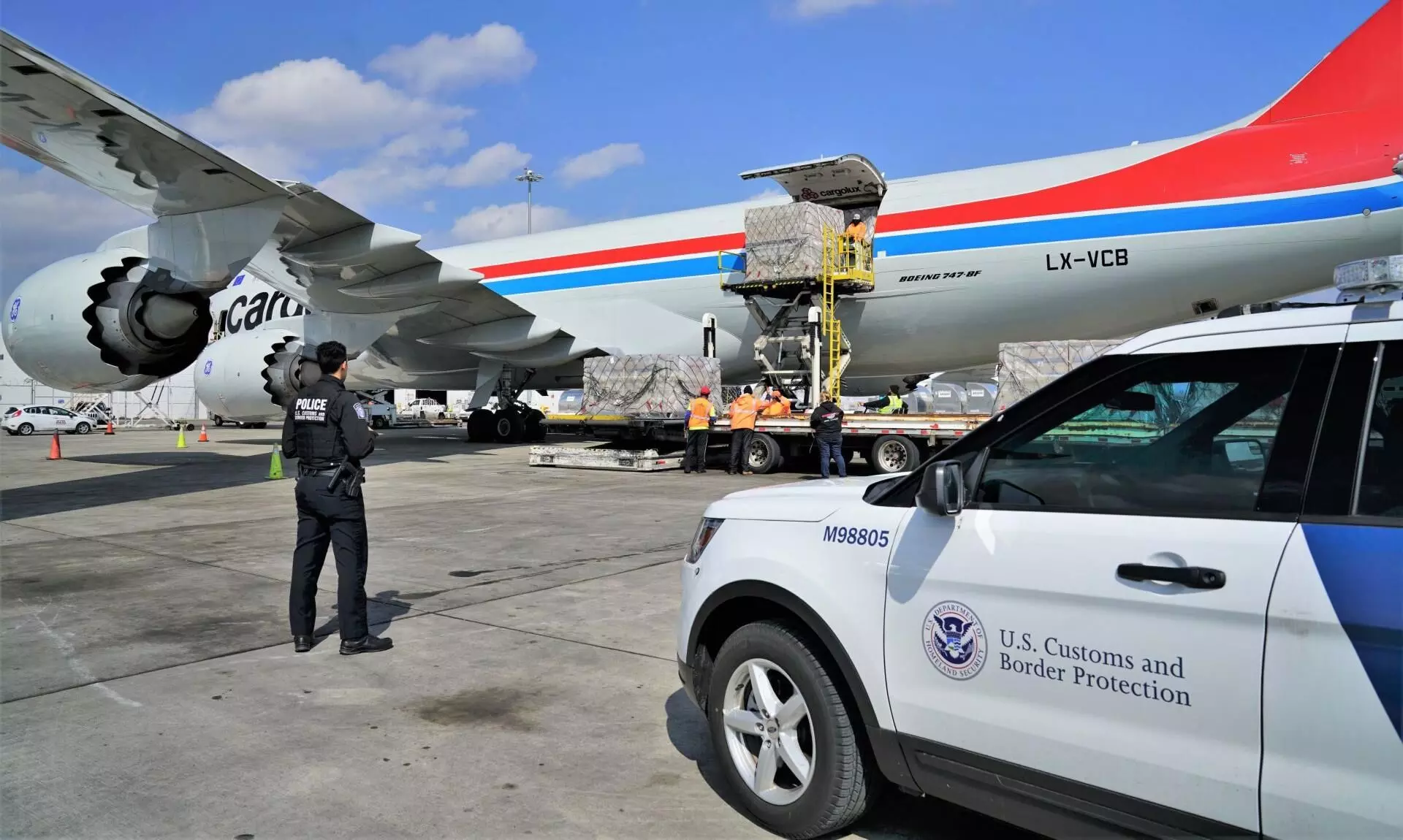
Credit: U.S. Customs and Border Protection
As the Trump administration expands scrutiny from individual shipments to entire supply chains, exporters face greater documentation demands, closer scrutiny of manufacturing processes and potentially more inspections and delays. For exporters to the US, the message is clear: knowing where a product comes from may no longer be enough. They will need to prove it quickly and with evidence that can withstand scrutiny.
On August 13, 2026, the United States released “The Great Transshipment Scam,” a 25-page report that places alleged tariff evasion through third countries at the centre of US President Donald Trump’s expanding trade-enforcement agenda.
The report, issued by the White House Office of Trade and Manufacturing Policy (OTMP), examines what it describes as the growing practice of routing goods, particularly those originating in China, through intermediary countries in order to disguise their origin and avoid higher US tariffs and other trade restrictions. “Illegal transhipment may involve relabeling, repackaging, re-invoicing, minor processing, false country-of-origin claims, or other actions intended to secure tariff treatment that would not apply if the goods’ true economic origin were declared,” the report reads as it defines the problem.
It identifies more than 40 countries associated with elevated illegal transhipment risk, grouping them into three tiers. The eight Tier 1 jurisdictions are Canada, the European Union, India, Israel, Japan, Mexico, South Korea and Taiwan.
History of CBP enforcement against illegal transhipment
The policy trail’s direct link to transhipment came in April 2025, when Trump’s reciprocal tariff order extended China’s tariff treatment to Hong Kong and Macau, reflecting concerns that third countries could be used to evade tariffs.
United States Customs and Border Protection (CBP)'s Enforce and Protect Act (EAPA) investigations soon provided concrete examples. In May 2025, CBP found that Chinese-origin mattresses had been transhipped through third countries and falsely declared as originating in those countries. A June 2025 investigation involved Chinese steel products allegedly transhipped through Thailand.
The focus on origin and circumvention widened in April 2026, when Trump’s metals proclamation authorised CBP to address “illegal transhipment, undervaluation, and other tariff evasion methods” involving aluminium, steel, copper and certain derivatives.
On June 3, Trump’s “Strengthening Customs Enforcement” order pushed scrutiny further into the supply chain, directing the Department of Homeland Security (DHS) and CBP to tighten importer vetting, bonding and supply-chain disclosure requirements. It also sought more detailed information on an imported good’s production and documentary history, laying much of the enforcement groundwork that would later be reflected in The Great Transshipment Scam.
“If the finished product is treated as retaining the country of origin of a major component, then the implications for valuation, classification and country-of-origin determination could be significant.”
Cindy Allen, Trade Force Multiplier
Changed interpretation of “substantial transformation”
In the view of Cindy Allen, CEO and MD of Trade Force Multiplier, a US-based customs and international trade advisory firm, the new report on transhipment represents a major change in how the administration is interpreting country of origin and substantial transformation. “The biggest issue is that the report appears to broaden the meaning of illegal transhipment.”
Traditionally, transhipment simply refers to moving goods from one conveyance to another. Illegal transhipment generally involves fraud. For example, goods produced in China might be sent to a third country, their country-of-origin markings removed or altered, and then falsely declared as originating in that third country. That is very different from a legitimate manufacturing process involving substantial transformation.
Cindy takes an example of an electric motor made in China and sends it to Vietnam, where it is incorporated into a chair. The finished product is then imported into the US as a motorised chair. Under the traditional interpretation of substantial transformation, the motor has been incorporated into a new product, and the finished article is imported as a chair.
Allen said, “The administration appears to be questioning whether simply incorporating the motor into the chair is sufficient. It is suggesting that the motor itself may need to undergo substantial transformation and may retain its own essential character.”
That is a major departure from decades of US case law and customs rulings. Allen adds, “If the finished product is treated as retaining the country of origin of a major component, then the implications for valuation, classification and country-of-origin determination could be significant.”
If the origin of a finished product can be questioned based on the origin and transformation of its components, exporters need much more than a country-of-origin declaration.
“Country of origin stops being a declaration and becomes a claim you must be able to prove on demand.”
Jackson Wood, Descartes
The origin claim will need an evidence trail
“Country of origin stops being a declaration and becomes a claim you must be able to prove on demand,” says Jackson Wood, Vice President, Trade Regulations at Descartes. The pressure may come even before formal regulatory changes, with US importers increasingly likely to build origin-verification requirements into supplier contracts and ask exporters to substantiate where and how goods were manufactured.
For exporters, that means going beyond a certificate or declaration and preparing a complete evidentiary package before shipment. “It is not a document; it is a package, assembled before the goods move,” Wood says.
At its core, it should be a detailed bill of materials that identifies every component, its origin, value, and Harmonised System (HS) classification. “Nothing else stands without it,” he says. Exporters should also document the manufacturing process through step-by-step production narratives, equipment and cycle times, while linking the claimed process to the specific shipment through lot numbers, production dates, machine logs and quality-control records.
Supplier declarations may also face greater scrutiny. Wood recommends “signed, dated supplier affidavits, tested for consistency against factory records,” rather than informal assurances. Government-issued certificates of origin could carry greater weight, particularly when issued by a ministry rather than a private body, with Wood pointing to Vietnam's transfer of certificate-issuing responsibility from the Vietnam Chamber of Commerce and Industry (VCCI) to the Ministry of Industry and Trade (MOIT) as an example.
The documentation must be internally consistent. “Origin stated identically on invoice, packing list and transport documents” is essential, Wood says, because inconsistencies across trade documents could themselves invite further scrutiny.
The burden, in other words, shifts from having the right document to having a defensible origin file. Marcus Eeman, Customs Director at Flexport, recently spoke at a company webinar and noted that the chaos of the last few years has mostly centred on tariffs. “The chaos in the months and years coming ahead is going to be more around who gets to import, when they get to import, and how they know what those countries of origin are.”
“Weak record-keeping today can turn into an expensive bill twelve months from now, for a matter the business thought was long closed.”
Nitish Rai, FreightFox
What does it mean for Indian exporters?For Indian exporters, the impact could extend beyond the direct customs obligations of the new US rules. In an exclusive article, Nitish Rai, Founder and Chief Executive Officer of FreightFox, an India-based supply-chain technology company, argues that tighter importer requirements, combined with India's designation as a Tier 1 transhipment-risk country, could raise the evidentiary burden even for legitimate manufacturers.
For exporters selling on Free on Board (FOB) or Cost, Insurance and Freight (CIF) terms, the US buyer may remain the Importer of Record (IOR), but will increasingly depend on the Indian exporter for certificates of origin, manufacturing and bill-of-materials records, shipping bills and other documents. “They will lean on the exporter to supply documents quickly and in a clear, audit-ready format,” Rai writes, warning that slow or incomplete records could delay shipments and push buyers towards suppliers that can respond faster.
The impact is more direct for exporters selling on Delivered Duty Paid (DDP) terms or directly to US consumers and acting as the IOR themselves. Rai points to formal entry requirements, bonding and Customs Trade Partnership Against Terrorism (C-TPAT) requirements.
“Weak record-keeping today can turn into an expensive bill twelve months from now, for a matter the business thought was long closed,” Rai writes, arguing that exporters need to move beyond fragmented records across emails, messaging platforms and spreadsheets towards systems that can quickly establish origin, substantiate transformation and retrieve supporting documents.
The rules are becoming harder to interpret, and exporters need stronger evidence to defend their origin claims.
AI could turn CBP’s supply-chain scrutiny into a wider net
The ability to prove origin is becoming more important as CBP gains greater ability to test those claims against broader supply-chain data.
The Great Transshipment Scam proposes “Detective Border”, an AI-enabled system that would analyse shipment data, routing histories, product classifications, ownership links and production capacity to distinguish legitimate nearshoring from illegal pass-through trade.
But Cindy Allen of Trade Force Multiplier, who previously worked on the Automated Commercial Environment (ACE), says CBP’s ability to analyse trade data is not new.
What changed, she says, was the expansion of supply-chain enforcement, particularly through forced-labour investigations. “CBP received additional funding to identify the origins of products further back in the supply chain, particularly in connection with the Uyghur Forced Labor Prevention Act and products linked to China's Xinjiang Uyghur Autonomous Region.” The private sector also developed tools to map suppliers and ownership relationships across multiple tiers.
“With AI added to these capabilities, CBP can analyse supply chains much more deeply. It can look at a fourth-tier supplier, assess what that company is capable of manufacturing, identify where it sources from and examine other supply chains connected to that supplier.”
That creates a multiplier effect. A concern with one supplier could trigger scrutiny of other companies sourcing from that supplier, potentially broadening an investigation beyond the original shipment or importer. “AI makes it possible to analyse large volumes of customs and transportation data much faster than a person manually reviewing documents,” Allen says.
“The chaos in the months and years coming ahead is going to be more around who gets to import, when they get to import, and how they know what those countries of origin are.”
Marcus Eeman, Flexport
Enforcement pressure could push compliance upstream
Even legitimate manufacturers could face scrutiny if their trade patterns raise red flags, such as sudden export growth, short port dwell times, HS code patterns resembling those of former Chinese flows, or ownership links to Chinese manufacturers. Wood expects this to translate into “more inspections, shipment delays, duty demands and potential penalties.”
A key shift could be automated targeting. The report's proposed AI-based screening could combine trade flows, ownership, production capacity and supply-chain data to identify potential circumvention, allowing CBP to focus on flagged corridors, commodities and companies. “Enforcement capacity is finite,” Wood says. Planned biannual CBP and Commerce lists of countries and facilities associated with circumvention could add another layer of risk, with Wood warning that appearing on such a list, or trading with a listed company, could increase the likelihood of shipment holds.
The exposure could extend beyond additional duties to penalties under the False Claims Act and broader fraud investigations. Yet the scope of enforcement remains uncertain. “Transhipment remains undefined in the operative rule,” Wood says. “So scope will be settled case by case.”
For exporters, that uncertainty makes advance preparation critical. “Build the origin file before you need it,” Wood advises, with documentation for individual stock-keeping units (SKUs) organised for retrieval “in days rather than weeks.” Companies should also monitor changes in bills of materials, suppliers and manufacturing processes, while examining ownership alongside factory geography. “Map ownership, not just geography. A factory in the right country with the wrong ownership is still exposed under the report's definition.”
Wood also recommends continuous screening against future CBP and Commerce lists, considering binding rulings for borderline origin cases and quantifying the financial impact of potential duties. “Model the downside explicitly,” he says. Where companies identify genuine compliance issues, he recommends seeking advice on voluntary disclosure quickly to limit broader fraud exposure.
The article was originally published in the September 2026 issue of The STAT Trade Times.