


Can air cargo decarbonise without breaking its margins?
At transport logistic and air cargo Shanghai 2026, panelists agreed that sustainability in air cargo is no longer a question of intent.
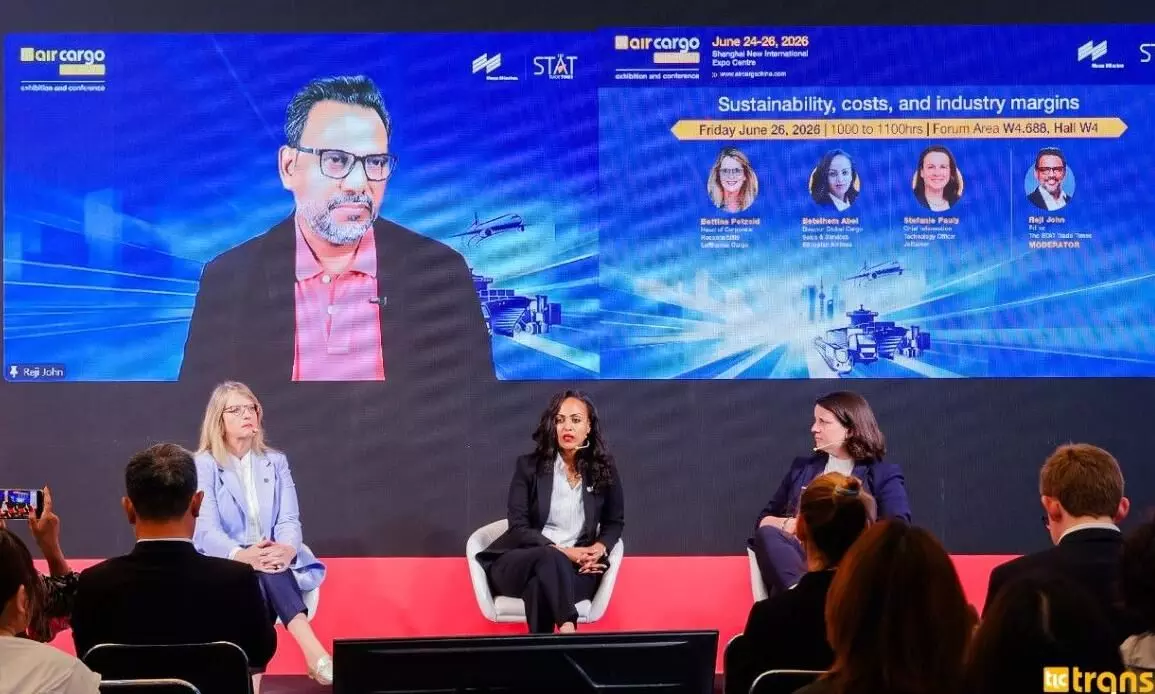
(L to R): Reji John (on screen), Bettina Petzold, Betelhem Abel and Stefanie Pauly
When asked to rank profit, people and planet in order of importance, the panel on sustainability, costs and margins on Day 3 of transport logistic and air cargo China 2026 in Shanghai arrived at a near-identical answer, even though, as the panel went on, it became clear the three companies on stage are not starting from the same place. The session was moderated by Reji John, Editor of The STAT Trade Times, and brought together Bettina Petzold, Head of Corporate Responsibility at Lufthansa Cargo; Stefanie Pauly, Chief Information and Technology Officer at Jettainer; and Betelhem Abel, Director of Global Cargo Sales and Services at Ethiopian Airlines.
Abel and Pauly both ranked planet first. "If our planet is not safe and the weather and everything is not good for people, then there will be no people," Abel said, arguing that profit follows once people are looked after. Pauly placed the same three words in the same order, describing sustainability and the regulation arriving with it as something the industry should treat "as a chance" rather than a cost to resist. Petzold put people ahead of the planet instead, pointing to what she called the board she answers to most regularly, her own kitchen table, where her family asks what she and her team have done to really reduce CO₂. Profit, in her account, was never the point of Lufthansa Cargo's sustainability strategy, only a byproduct of remaining the partner customers choose to keep working with.
The agreement was in reflection of the fifty minutes that preceded it. Underneath the shared ranking sat a harder, unresolved question: an airline with capital, scale and a domestic Sustainable Aviation Fuel (SAF) market, and an airline without any of those three things, had both just said planet comes first, but neither addressed what happens when 'planet first' collides with a balance sheet that cannot absorb the premium.
"We don't want to be the only one in the market doing it (framework contract approach to selling SAF). So, the more airlines are jumping into the concepts, the better the prices will get at the end of the day."
Bettina Petzold, Lufthansa Cargo
A market where demand outruns supply, and nobody fully owns the gap
Petzold described the state of SAF with a climate metaphor. "There is a lot of sun, but there's also still shadow and rain talking about decarbonisation," she said. The sun: Lufthansa Cargo is on track against its 2030 and 2050 targets, and SAF demand this year has outpaced her expectations. The shadow and rain: demand is now running ahead of supply, regulatory conditions vary too widely to call fair, and it is unclear whether capital markets are funding SAF production fast enough to close that gap.
She framed the shortfall as structural rather than temporary. "Demand is rising and production is not rising at the same time and speed that we need here," she said, adding that no single link in the chain, airlines included, can close it alone. It is a framing that puts the burden on the collective supply chain rather than on any one carrier's balance sheet, a position that is easier to hold from Frankfurt, where Lufthansa Cargo is already investing in line with its 2030 target, than from a market where SAF has to be imported at a premium before any of that investment can begin.
When pressed on whether that collective willingness to pay actually exists, Petzold did not concede the point outright, but she also did not point to evidence of voluntary uptake closing the gap on its own, returning instead to the difficulty of pricing a tonne of carbon that customers cannot see or quantify for themselves. "Can you even imagine a tonne of CO₂?" she asked. "Is it big? Is it small? We cannot imagine it, but we want people to pay for it."
Selling an invisible cost
Petzold's example was a smartphone bought for around €1,000, where sustainable transport adds an estimated 17 cents to the cost of getting it there, a sum she argues should pass through the chain to the end consumer rather than sit entirely with the airline. Lufthansa Cargo has built three ways to capture that willingness to pay: Sustainable Choice, an online add-on letting customers offset part of a shipment's footprint at booking; bulk deals negotiated directly with corporate sustainability teams; and multi-year framework agreements that fix process and certification standards upfront, cutting a typical four to six week negotiation down to a quick order once signed.
Petzold called the model deliberately open rather than proprietary, betting that wider adoption across the industry will eventually bring prices down, though she conceded that effect has yet to show up in the market.
"I can say automation is good, especially when you have very well-trained people and also backup data alongside until fully running by itself."
Betelhem Abel, Ethiopian Airlines
A different starting line in Africa
Abel's account of the same transition started from a different baseline entirely. SAF availability in Africa is minimal, she said, and Ethiopian Airlines has to import it, making it scarce and costly at once. Her response runs on three timelines: blending SAF on the airline's mandatory European routes in the short term, where the requirement currently stands at 2%, modernising the fleet and adopting new technology in the medium term, and working toward the same 2050 net zero target carriers elsewhere are pursuing in the long term. "If we're not starting now, we might lose our customers," she said, framing the cost of waiting as higher than the cost of acting early, even from a weaker financial position.
She also pointed to an early-stage effort to develop SAF production inside Ethiopia, in partnership with state oil and petroleum companies, while acknowledging the effort is not yet efficient. Her case for moving anyway rested less on matching European carriers than on Ethiopian Airlines' position as Africa's largest cargo network, with an estimated 35% share of the continent's air cargo market. That scale, in her framing, is leverage rather than just exposure, enough to justify investment now in the expectation that sustainability credentials will eventually convert into customer trust and volume. She added that this shift is no longer abstract to her own customers either. European buyers moving cold chain shipments out of Africa have started asking what the airline's sustainability strategy actually is, rather than waiting for the next mandate to force the conversation.
Treating ULDs as a carbon lever, not just a cost line
Pauly's part of the panel sat outside the SAF debate entirely, in the part of the supply chain that never burns fuel directly but still shapes how much an aircraft burns. Jettainer's pitch, as she described it, is that efficiency and sustainability are not separate goals. Around 80% of its AKE container fleet is now lightweight, and work with Lufthansa Cargo on lighter loading accessories, including square timber in place of heavier materials and lighter cargo nets, has cut an estimated 20 kilos per net.
Positioning, she said, matters as much as weight. Cutting the number of empty ULDs repositioned around the network and reducing the buffer stock airlines hold at individual stations both lower the amount of surplus equipment in circulation and the emissions tied to maintaining it. She was direct that the commercial case sits alongside the environmental one rather than behind it. Freed-up weight or space on a ULD can be sold as freight, and capacity no longer used to reposition empty containers can be sold to other customers, which she described as a mix of direct and indirect savings in conversations with airline customers.
"We are aiming for helping the airlines reducing costs, reducing weight with the ULDs, our lightweight ULDs, which are heavily used."
Stefanie Pauly, Jettainer
On data, Pauly said the harder problem is not collection but consistency, since ULDs move between airports, ground handlers and airline systems that do not share a single standard. Jettainer is rolling out IoT tracking across its full fleet to cut reliance on manual entry and is watching IATA's development of the One Record data standard as a route toward more consistent data exchange and, eventually, more AI-driven forecasting of ULD demand and positioning.
Where automation helps, and where it still needs a person watching
The panel turned to a cautionary example: a heavily automated cargo terminal in Europe that failed and left staff unable to locate pallets for several days. Petzold pointed to Lufthansa Cargo's new automated handling centre at its Frankfurt hub, a €600 million investment whose first phase opened the day before the panel, as evidence that automation and sustainability can be built together. But she was clear that people still interpret the data the system produces. She cited lightweight containers saving an estimated 18,000 tonnes of CO₂ last year as a figure that only became actionable once someone analysed it.
Abel was more cautious. Ethiopian Cargo and Logistics Services’ state-of-the-art e-commerce logistics facility, opened in February 2024, at Addis Ababa Bole International Airport, built at a cost of around $55 million, has cut processing time by an estimated 60% against manual handling, but when the system fails, she said, it takes longer to find the fault and requires more people and equipment to fix it than a manual setup would. Automation, in her view, only works when paired with trained staff and a data backup.
Pauly said Jettainer is moving from reactive to proactive fleet steering, using data to forecast ULD demand rather than respond to it after the fact. But she maintained that someone still has to supervise what the system predicts, particularly on balancing decisions across the network. On that point, all three speakers agreed: the data and the automation are only as good as the people checking them.
Sustainability in air cargo is no longer a question of intent, every speaker on the panel was already committed. The harder test, still unresolved, is whether SAF supply, cost and access can scale fast enough for that intent to mean the same thing in every corner of the world.

Crafting compelling stories and in-depth reports on air cargo, logistics, aviation, and supply chain sectors. Leveraging expertise in journalism, psychology, and English to create engaging content for industry professionals. Find me @ nikitha@statpublishinggroup.com


