UN and ECHO partner to green humanitarian supply chains
UNHCR, the WREC Coalition, and Climate Action Accelerator have launched a DG ECHO-funded project to reduce the environmental impact of aid supply chains.
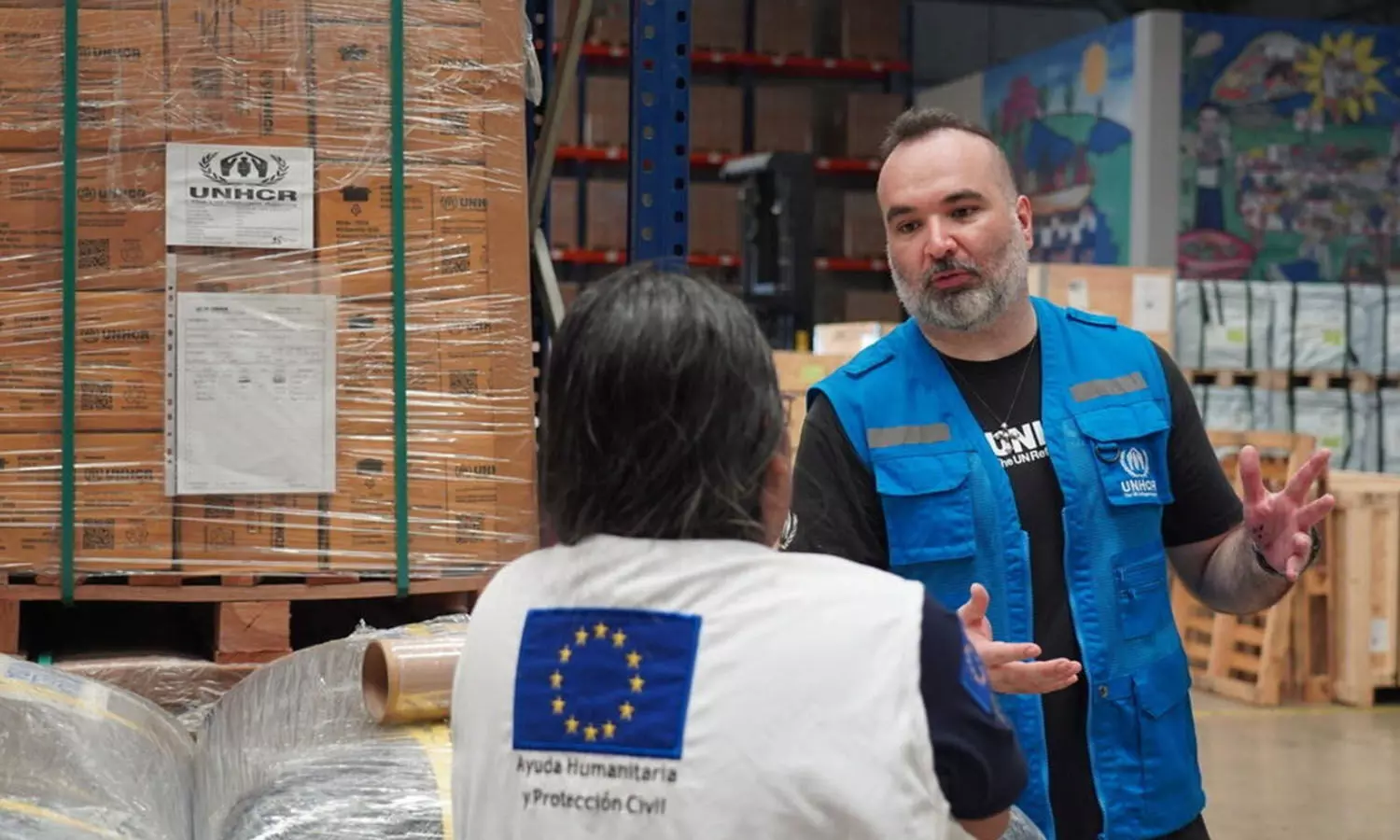
Image source: UNHCR/José Romero Vásquez
In an era where global freight and logistics networks are increasingly scrutinised for their environmental footprints, the humanitarian sector is taking decisive steps to ensure that the delivery of life-saving aid does not come at an unsustainable cost to the planet. UNHCR, the UN Refugee Agency, alongside the Logistics and Telecommunications Cluster (LTC)-led Waste Management and Measuring, Reverse Logistics, Environmentally Sustainable Procurement and Transport, and Circular Economy Coalition (WREC Coalition), and the Climate Action Accelerator, has officially launched a landmark collaborative project. Funded by the European Commission’s Directorate-General for European Civil Protection and Humanitarian Aid Operations (ECHO), this ambitious initiative is explicitly designed to support the broader humanitarian community in significantly reducing the environmental impact of its vital supply chains.
The primary objective of this new endeavour is to equip and help aid organisations to cut waste dramatically and utilise resources much more efficiently across their complex, global operations. Humanitarian logistics frequently operate under immense pressure and tight deadlines, historically leaving little room to prioritise ecological considerations. However, by embedding sustainable practices into the core of emergency response and ongoing relief programmes, the partners aim to fundamentally transform how aid is procured, transported, and managed post-delivery.
Crucially, this new project builds upon the strong foundations laid by the Humanitarian Leadership Group on Supply Chain (HLGSC). Launched earlier in 2024, the HLGSC is a forward-thinking, DG ECHO-driven initiative. Its creation was intended to foster coordinated, cohesive action among key humanitarian actors and to radically strengthen both the efficiency and the overall effectiveness of humanitarian supply chain networks globally. Within this framework, UNHCR, the LTC-led WREC Coalition, and the Climate Action Accelerator were recently selected as co-leads of the HLGSC Environmental Sustainability Thematic Working Group (ES TWG). This appointment is a direct reflection of their long-standing, fruitful collaboration and their continuous contributions to advancing environmental sustainability across diverse humanitarian supply chains over recent years.
Through this robust joint initiative, the three implementing partners, alongside ECHO, will pool their complementary expertise and vast logistical networks. The goal is to strengthen sector-wide collaboration, promote a much greater alignment of standards, and accelerate collective, tangible action towards environmentally sustainable humanitarian supply chains.
Emphasising the collaborative nature of this work, Benjamin Safari, Head of UNHCR Supply Management Service, noted: “As a member of the LTC-led WREC Coalition, UNHCR values the opportunity to work alongside Coalition members and the Climate Action Accelerator within the broader HLGSC framework. Through the Environmental Sustainability Thematic Working Group, this partnership can support coordination, bring together the knowledge and experience already present across the humanitarian community, and facilitate the development of practical approaches that respond to shared environmental sustainability priorities across humanitarian supply chains.”
Thanks to the crucial financial and strategic support from ECHO, UNHCR, the WREC Coalition, and the Accelerator will continue to work in a close, synergistic partnership with participating humanitarian organisations. Their focus will be on implementing concrete actions to deliver on the project's core objectives. The initiative is set to integrate environmental sustainability considerations throughout the entire life cycle of the humanitarian supply chain. For logistics professionals, this means a rigorous new focus on critical operational areas, including precise carbon emissions measurement, comprehensive life cycle assessment of relief items, green procurement strategies, advanced reverse logistics, and effective waste management in crisis zones where infrastructure is often severely compromised or completely non-existent.
The necessity for such a systemic overhaul is pressing, as the volume of global crises continues to surge, placing unprecedented demands on aid networks. Addressing this growing strain and the industry-wide consensus on the matter, Leonor Nieto, Head of the Humanitarian Emergency Response Capabilities Unit, DG ECHO, European Commission, stated: “As humanitarian needs grow, stronger collaboration and resource-sharing are key to more efficient supply chains. Over 60 humanitarian organisations have endorsed a concrete action plan recognising this need. Together with our partners, we aim to improve environmental sustainability, procurement, digitalisation, preparedness and localisation, so that aid can reach people affected by crises when and where they need it most.”
Ultimately, ECHO’s foundational support provides a highly important contribution to advancing more efficient, resilient, and environmentally sustainable supply chains across the entire humanitarian sector. Through the dedicated joint work of UNHCR, the LTC-led WREC Coalition, and the Climate Action Accelerator, and in continuous collaboration with the wider HLGSC community, this project will support humanitarian organisations in moving beyond mere pledges, successfully translating high-level climate commitments into practical, ground-level logistical approaches.