Industry braces as EU's €3 e-commerce duty takes effect
EU's €3 duty on low-value e-commerce imports came into force today, prompting logistics, customs and technology experts to assess its impact on cargo flows, supply chains and cross-border trade.
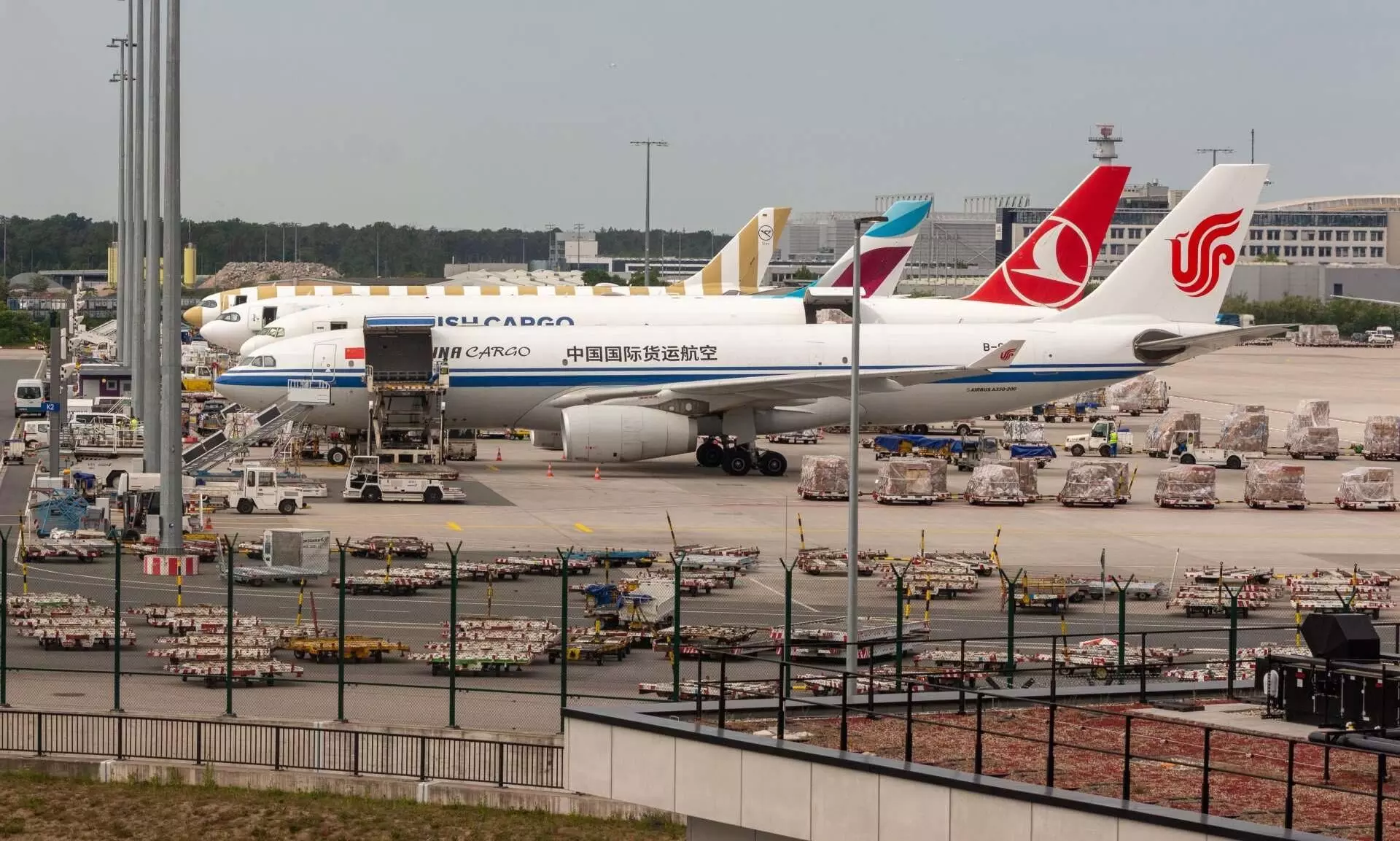
Air China Cargo A330-200 freighter parked at Frankfurt Airport on May 9, 2026
The European Union (EU) today began charging a temporary €3 customs duty on low-value e-commerce imports worth up to €150, ending a duty exemption that had been in place since 2008 for small consignments entering the bloc from outside the EU. The measure, which applies to goods sold primarily through online marketplaces, is intended to address the rapid growth in low-value imports, strengthen customs controls, improve consumer safety and create a more level playing field for European retailers. Introduced as an interim step ahead of the EU's wider customs reform due in 2028, the new duty is applied per product category in a shipment as it enters the EU customs system.
Frederic Horst, Managing Director, Trade and Transport Group, points out that volumes have been declining for 6 months, which either indicates a drop in demand or that a shift in supply chains was already underway around the time the measure was announced in late 2025.
Source: Trade and Transport Group
Meanwhile, the Netherlands-based air cargo consultant Rotate observed a 19% drop in direct freighter capacity between China and Europe in 48 hours from June 30 to July 1, 2026, in its Live Capacity data. However, they await e-commerce demand data from July onwards to draw any conclusions.
Tim van Leeuwen, Vice President and Head of Consulting at Rotate, pointed out that earlier this year, France and Italy introduced their own €2 handling fee on low-value e-commerce imports before the rest of the EU adopted a common approach. In response, many e-commerce platforms diverted shipments to other EU entry points, with cargo flows reportedly shifting from airports such as Milan Malpensa (MXP) to Budapest (BUD) to avoid the additional charges.
“Our capacity data shows that freighter capacity between China and France declined 25% in May, and between China and Italy fell 42%. Meanwhile, capacity to the rest of Europe grew (in a sign of airlines shifting destinations).”
“Dedicated (direct) China/HK-Europe freighter capacity in the last 48 hours is 19% lower than in the previous week”
Tim van Leeuwen, Rotate
"Based on our ongoing dialogue with customs authorities, they appear to be well prepared for the change. We expect the new duty to be implemented consistently and uniformly across the EU."
Despite these changes, Goovaerts does not expect overall air cargo volumes to decline, saying supply chains will continue to evolve and that logistics providers will adapt accordingly. "We do not expect this to reduce overall cargo volumes. Trade flows naturally evolve, and our global network and broad geographic footprint enable us to adapt quickly and continue supporting our customers as supply chains change."
“We have seen an increase in certain trade flows over the past week, indicating that some businesses have brought forward shipments and placed additional orders ahead of the duty coming into effect.”
Dirk Goovaerts, Swissport
Murat Odabas, Managing Director at GlobeCross, reports that the market has already begun reacting even before implementation. Large e-commerce platforms began adjusting their websites and pricing structures several days before the new duty came into effect.
According to GlobeCross's data, the average online shopping basket has risen from around €40 to €61, an increase of more than 50%. Thus, Odabas expects consumers to become more cautious as prices rise, leading to a temporary slowdown in demand before the market stabilises. "There will definitely be an impact. The real question is how large that impact will be." While he anticipates some disruption over the next year, Odabas believes the market will recover within 12 to 18 months as companies adapt to the new environment.
What operational challenges are expected?
While the market impact is still unfolding, the more immediate challenge lies in how companies adapt their customs and back-office operations. According to Odabas, the €3 duty is going ahead despite the fact that customs authorities and industry players acknowledge not everything is fully ready. “The systems are still being prepared, the software is not fully ready, and there are still questions about how the €3 processing fee will be calculated and handled.”
Companies will need to strengthen their customs processes and IT systems to handle additional customs information and ensure the new charges are correctly collected and remitted. "So the challenge is not in warehouse operations or cargo handling. It is in the back-office systems and administrative processes."
Despite the challenges, Odabas says there is a shared commitment across Europe to make the reform work. "Their message was, 'We don't yet know exactly how everything will run, but we will support each other and make it happen.”
According to Egor Paanukoski, Co-Founder and Management Board Member of Feeport (x7trade), the biggest operational challenge is not just filing more customs declarations. It is ensuring that the entire supply chain, from checkout to customs clearance, is aligned with the new €3 duty and the revised VAT calculation. "The supply chain has a fixed €3 duty for each item to deal with, and it also needs to consider the fact that VAT calculation is now based on the intrinsic value of the product plus the €3 duty."
Built by Feeport, x7trade is an Estonian logistics tech and neutral SaaS platform that enables regional and global supply chains to remain compliant with EU e-commerce shipment regulations such as Import Control System 2 (ICS2), and automates the customs clearance process for bulk B2C e-commerce imported into the EU from 3rd countries.
Paanukoski says the process must begin at the online checkout, where the new duty should be clearly displayed and collected from the customer. That information should then flow consistently through shipment data and customs declarations. "If €3 is not collected at the checkout stage, then we move into non- Import One-Stop Shop (IOSS) schemes where delivery duties are not paid (Delivery Duty Unpaid or DDU), and this will affect the deliveries and also probably have a negative effect on consumer behaviour."
Paanukoski also points to the financial implications of the new regime. With the €3 duty now applying to millions of low-value imports, customs authorities are expected to demand significantly higher financial guarantees from EU-based declarants. "Both exporters and their EU partners who act as declarants, be it customs brokers, logistics companies or others, will need to figure out who allocates the financial resources upfront."
"Our own data shows that the average shopping basket has increased from about €40 to €61, an increase of more than 50%. Naturally, when consumers suddenly see higher prices, some of them will hesitate before placing orders. There will definitely be an impact. The real question is how large that impact will be."
Murat Odabas, GlobeCross
Can €3 duty be avoided with loopholes?
As companies prepare for the new regime, another key question is whether some will try to avoid the additional costs altogether. According to Paanukoski, probably the biggest misconception is the idea of exploiting various loopholes or workarounds to avoid paying the € 3-per-item duty charge. “From attempts to move away from the IOSS scheme and present B2C distant sales as B2B trade or, more correctly, B2B2C to asking for various exemptions for, say, air-flown e-commerce.”
However, Paanukoski points out that the EU Commission and Directorate-General for Taxation and Customs Union (DG TAXUD) have made it clear that authorities at both the national and EU levels will closely monitor any deviations or attempts to circumvent the regulation. “For us, as an EU-based technology provider, it is also important to understand what practical enforcement measures — and political willingness — the EU and local customs authorities will have to prevent or address such circumventive practices.”
He also asks the question: Are all EU Member States´ customs authorities aligned with DG TAXUD on this issue? “Because,” Paanukoski says, “as history demonstrates with the EU ICS2 regulation prescribing the submission of Entry Summary Declaration (ENS) on a house parcel level, it is still not implemented across all the EU Member States.”
Another area to watch, he says, is the potential misuse of HS codes as companies look for ways to reduce the number of €3 charges. However, he believes upcoming requirements for more detailed product identifiers, such as Stock Keeping Units (SKUs), could make such practices much harder.
Odabas also dismisses suggestions that companies will find ways to avoid paying the new €3 duty. "There is no workaround." He says the fee is automatically applied once shipment data is electronically submitted to customs, regardless of which EU member state serves as the first point of entry. "If you send the customs data, you pay the fee. It is that straightforward."
“From attempts to move away from the IOSS scheme and present B2C distant sales as B2B trade or, more correctly, B2B2C to asking for various exemptions for, say, air-flown e-commerce. However, the authorities will closely monitor any deviations or attempts to circumvent the regulation.”
Egor Paanukoski, Feeport (x7trade)
If avoiding the fee is not an option, the next question is whether companies will redesign their supply chains instead. For instance, Derek Lossing, Founder of Cirrus Global Advisors, compared it to the de minimis removal in the United States in a recent LinkedIn post. “After the US de minimis changes, Chinese platforms and logistics providers moved quickly to protect demand through pricing, routing, fulfilment, and B2C-to-B2B2C models. Europe now becomes the next major test case.”
“The variables I’ll be watching: How much of the cost gets absorbed by sellers vs. passed to consumers, whether platforms shift more inventory into EU-based fulfilment, whether enforcement is consistent across member states, how air cargo demand responds on Far East to Europe lanes, and whether parcel-level economics push more volume toward consolidated B2B2C models.”
On whether companies will move inventory into European fulfilment centres, Odabas believes the answer will depend on economics rather than regulation alone. Building fulfilment centres across Europe would require substantial investment, while many retailers may simply continue shipping directly from China and pass the additional customs costs on to consumers. "What I do expect is a hybrid model."
He expects fast-moving products to be stocked closer to European consumers and replenished by sea freight, while slower-moving items will continue to be shipped directly from China. "Consumers could receive one delivery from Europe and another directly from China."
Also for Paanukoski, more Asian exporters are likely to consider storing inventory in European fulfilment centres as a way to avoid the new €3 duty on individual cross-border e-commerce shipments. However, he cautions that fulfilment is far from a universal solution. "It is impossible to physically store all the e-commerce goods as there is no such capacity in the EU." Paanukoski adds that expanding warehouse infrastructure will require significant investment and time. “This is still quite a risky endeavour to ship and store all your products in a volatile consumer market where trends and fashion change in the blink of an eye."
On the same line, Goovaerts also does not expect e-commerce companies to abandon their existing business models overnight. However, he believes some production could gradually move closer to Europe, while improvements in demand forecasting may encourage platforms to hold more inventory within the region for selected products. "As some production potentially shifts closer to Europe, for example to Turkey, and as e-commerce platforms continue to improve their forecasting through advanced algorithms and predictive analytics, it is possible that they will gradually increase inventory levels within Europe for certain products."
“After the US de minimis changes, Chinese platforms and logistics providers moved quickly to protect demand through pricing, routing, fulfilment, and B2C-to-B2B2C models. Europe now becomes the next major test case.”
Derek Lossing, Cirrus Global Advisors
Will customs data become more important?
Regardless of how companies structure their supply chains, one thing is becoming increasingly important: the quality of the data that accompanies every shipment. Odabas says major e-commerce platforms are already providing customs authorities with highly detailed product information. "We provide customs authorities with detailed SKU-level information, allowing them to see exactly what products were sold." He believes concerns over widespread undervaluation of Chinese e-commerce shipments are largely outdated because customs authorities can easily compare declared values with online product listings. "The data is accurate, transparent and reliable, and customs authorities are satisfied with its quality."
Meanwhile, Paanukoski thinks the new regime will inevitably accelerate investment in customs automation and digital platforms as the volume of cross-border e-commerce continues to grow. "It is already impossible to manually or semi-manually handle e-commerce volumes injected into the EU from third countries," Paanukoski notes that the scale of imports alone makes automation essential. Nearly 6 billion parcels entered the EU from non-EU countries in 2025. "With the adoption of the €3 per item duty charge, we add another crucial data element that the supply chain needs to take into account and process accordingly."
What happens next?
These changes extend well beyond the €3 duty and point to a broader transformation in how cross-border e-commerce will operate in the years ahead. Paanukoski notes that data quality and regulatory compliance will become as important as speed and cost. "Those supply chain members who don't manipulate data, who ensure data quality and consistency throughout the delivery process, will reign supreme in my view.”
"If your business is for a quick win, it is one story, but if you are playing a long game, take compliance seriously. In the long run, you will only benefit, as this will be your competitive advantage.” For logistics companies still preparing for the new rules, Paanukoski's advice is straightforward. "Adapt and play by the book because by doing so you will solidify your reputation, and your local partners' reputation, with EU Customs. In the long run, that will be one of your company's major assets."
Looking ahead, Odabas believes higher costs may temporarily slow online shopping but will not reverse the long-term growth of e-commerce. "You cannot stop e-commerce. It has become part of everyday life in Europe." He points out that Chinese online marketplaces have permanently changed the retail landscape by connecting consumers directly with manufacturers, reducing the role of traditional intermediaries. "There may be a temporary slowdown because of higher costs, but I believe demand will recover."