


The doctor's son who's rewiring pharma's supply chain
Agilent's Technologies' Joydeep Ganguly brought a surgeon's precision to LogiPharma Vienna and a radical vision for the supply chain's digital future.
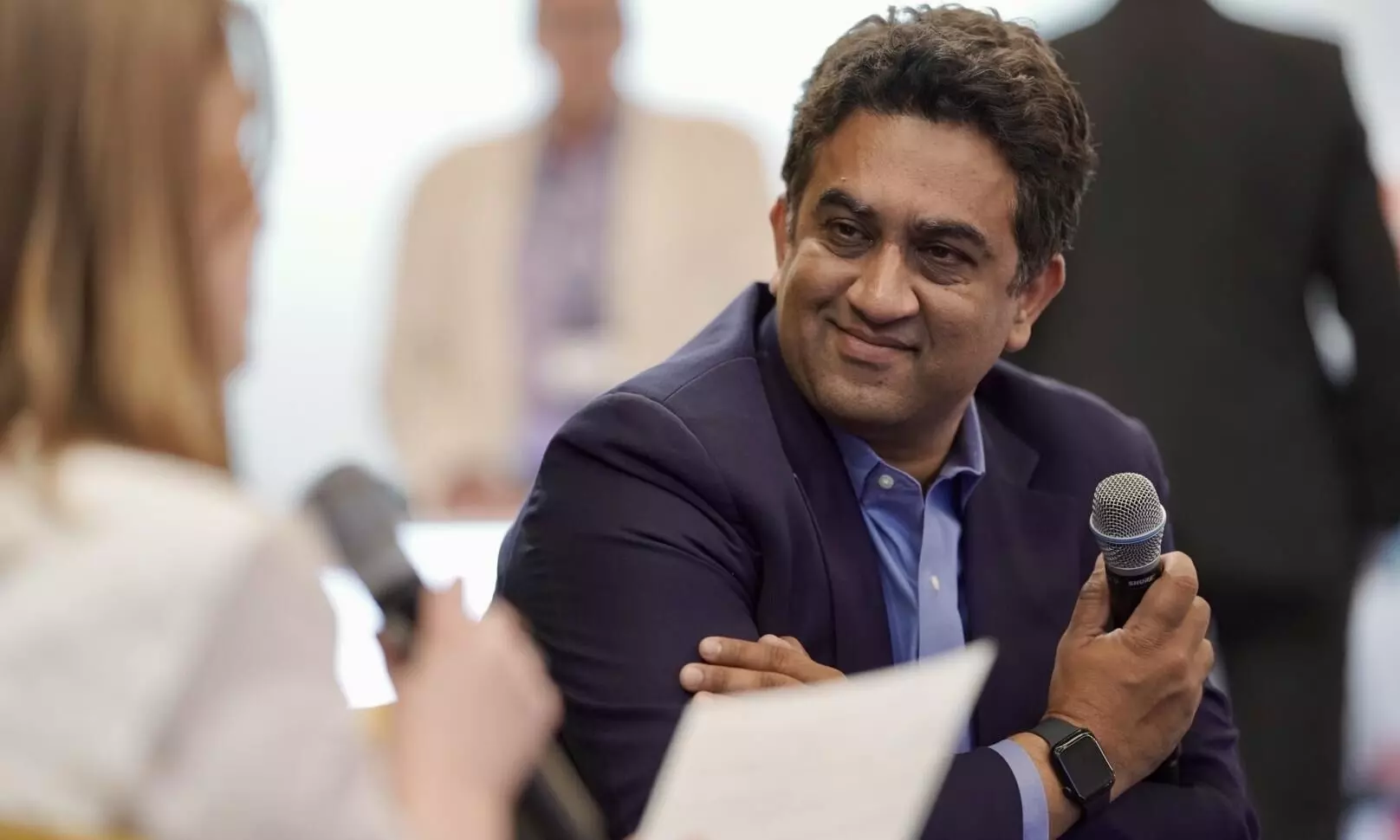
Joydeep Ganguly of Agilent Technologies at LogiPharma 2026 in Vienna; Photo: Richard Hadley/LogiPharma 2026
When Joydeep Ganguly took the stage in Vienna last week to deliver the opening keynote at LogiPharma, he brought with him something rare in the world of supply chain leadership: a perspective shaped not by spreadsheets and logistics textbooks but by a childhood surrounded by doctors, dinner table conversations about medicine, and a lifelong fascination with how science can be made to work better for people.
Ganguly is today the Chief Operations and Quality Officer at Agilent Technologies, a global leader in diagnostics, instrumentation, and contract manufacturing that, as he puts it, "enables biopharma companies and other industries to do their best work by providing trusted answers". But his path to that role was anything but conventional.
"It's a heritage of being the son of doctors," he told the LogiPharma Live podcast ahead of his opening keynote session on the first day of the 26th edition of LogiPharma. "My entire family is full of doctors. So, medicine was always very close to my family." Yet rather than following the clinical path, Ganguly chose to study electrical engineering and mathematics, a decision that placed him at a fascinating intersection of disciplines.
Ganguly holds a Master of Health Administration from Cornell University, an MBA from North Carolina State University, a Master of Science in electrical engineering from the University of Notre Dame, and a Bachelor of Science in electrical engineering from the College of Engineering, Pune.
"I think empiricists were trying to figure out ways to add a tonne of value into the overall value chain," he explained. "It was a very wonderful sort of choice of taking interdisciplinary flavours, where math could add value in a space that was typically dominated by biologists and chemists."
That instinct paid off. Ganguly spent a decade at Biogen before moving to Gilead Sciences, where he served for another decade as Senior Vice President of Corporate Operations and Chief Sustainability Officer. His decision to then join Agilent – crossing from the innovator pharma world to the enabling technologies side of the industry – was, by his own admission, a significant leap. "Joining the other side of the calculus was a big, big risk for me," he said. "But it's where the magic happens from a growth perspective.”
He admits it may sound cliché to say the industry is always changing, but after 25 years in the field, he insists this is the most radical digital disruption he has witnessed, especially in the supply chain.
His opening keynote, titled Fourth Industrial Revolution: How to Use Digital Technology and 4IR Innovations to Shape 21st Century Operations Models, set a clear and provocative agenda for the conference. His central argument: the supply chain of the future will not be built on technology alone; it will be built on a fundamental shift in how organisations think.
"True innovation doesn't just sit on top of an organisation; it has to breathe within the ecosystem," he declared, framing what he sees as the defining challenge of the era.
The keynote identified three pillars shaping the 21st-century supply chain. First, a move from reactive recovery to predictive resilience: a paradigm shift Ganguly illustrated with a telling observation: "We've gone from being an industry that for years had a maniacal obsession with just-in-time to now trying to develop more predictive resilience." AI-powered control towers, he argued, will act as the nervous system of future operations, enabling companies to anticipate disruption rather than merely respond to it.
Photo: Agilent.com
"We've gone from being an industry that for years had a maniacal obsession with just-in-time to now trying to develop more predictive resilience."Joydeep Ganguly, Agilent Technologies
Second, he stressed that people and culture remain the decisive factor in any digital transformation. "Digital transformation is almost universally a people and culture challenge masquerading as a technology effort," he said. Organisations that succeed are those that empower their workforce to operate at what he calls a "higher level of licence" — equipping humans to provide the contextual intelligence that no algorithm can replicate.
Third, and perhaps most philosophically, he called for the death of deterministic thinking. "In the Third Industrial Revolution, we lived by 'if-then' logic," he said. "In the Fourth, we live by interconnectedness, shifting from pure efficiency, doing things fast, to agility: doing the right things in a changing environment." He described this as moving from a linear supply chain worldview to one that is genuinely systemic, where resilience, agility, and purpose are not aspirations but operational metrics.
In his keynote, Ganguly offered something increasingly rare at industry conferences: ground-level evidence. Agilent, he noted, is one of a small number of companies globally to hold four World Economic Forum Lighthouse Factory designations.
The World Economic Forum’s (WEF) ‘Lighthouse Factory’ designation recognises the world’s most advanced manufacturing sites that successfully deploy cutting-edge digital technologies (AI, IoT, robotics, analytics) at scale, driving breakthroughs in productivity, sustainability, and supply chain resilience. It is widely regarded as the benchmark for Industry 4.0 excellence. This is part of the Global Lighthouse Network (GLN), launched by the WEF in collaboration with McKinsey & Company.
But Ganguly was more interested in the mindset behind those designations than the accolades themselves. He outlined a three-part "litmus test" for separating genuine innovation from the hype cycle: the "so what" test: does the technology deliver measurable value on the factory floor? The integration versus isolation test: Is the innovation embedded in daily operations or merely a side project? And the sustainability test: can it be maintained and scaled over time?
"The supply chain has never become more relevant to a company's value chain. Conversations are now entering the boardroom, as opposed to being more of an efficiency paradigm that ops leaders think about."Joydeep Ganguly, Agilent Technologies
"I wouldn't say there's a particular technology that wows me," he told the podcast host in a characteristically frank moment. "It's the technology when it lives in the entire overall innovation ecosystem." He cited a maxim that clearly guides his philosophy: "Transformations are 10% technology, 20% process redefinition, and 70% about people and culture."
Ganguly also spoke candidly about the pressures facing operations leaders today. Beyond the well-documented disruptions since Covid-19, he pointed to a deeper, more persistent challenge: structural volatility. "System resilience, which used to be a one-off project, has now become core to a company's fabric," he said.
He identified three interlocking micro-challenges: the need to think in interconnected systems rather than silos; the "massive digital debt" accumulated by decades of underinvestment in supply chain infrastructure; and the blind spots created by multi-tier supply complexity.
Yet the overarching message from Ganguly in Vienna was one of genuine optimism. "The supply chain has never become more relevant to a company's value chain," he said. "Conversations are now entering the boardroom, as opposed to being more of an efficiency paradigm that ops leaders think about. " For a discipline long seen as a back-office function, that shift, perhaps more than any single technology, may be the most consequential development of all.
Editor at STAT Publishing Group since 2013, I lead a small team of reporters in chasing stories about cargo flows from A to Z—by air, sea, road, and rail. If it moves, we track it. Got a compelling lead? Reach me at reji@statpublishinggroup.com (cargo only, please)


