
Beyond the cold chain: How smarter packaging is reshaping pharma logistics
Passive, active and connected packaging solutions are improving temperature protection, shipment visibility and sustainability in pharma logistics. But even the smartest packaging cannot replace cold-chain infrastructure.
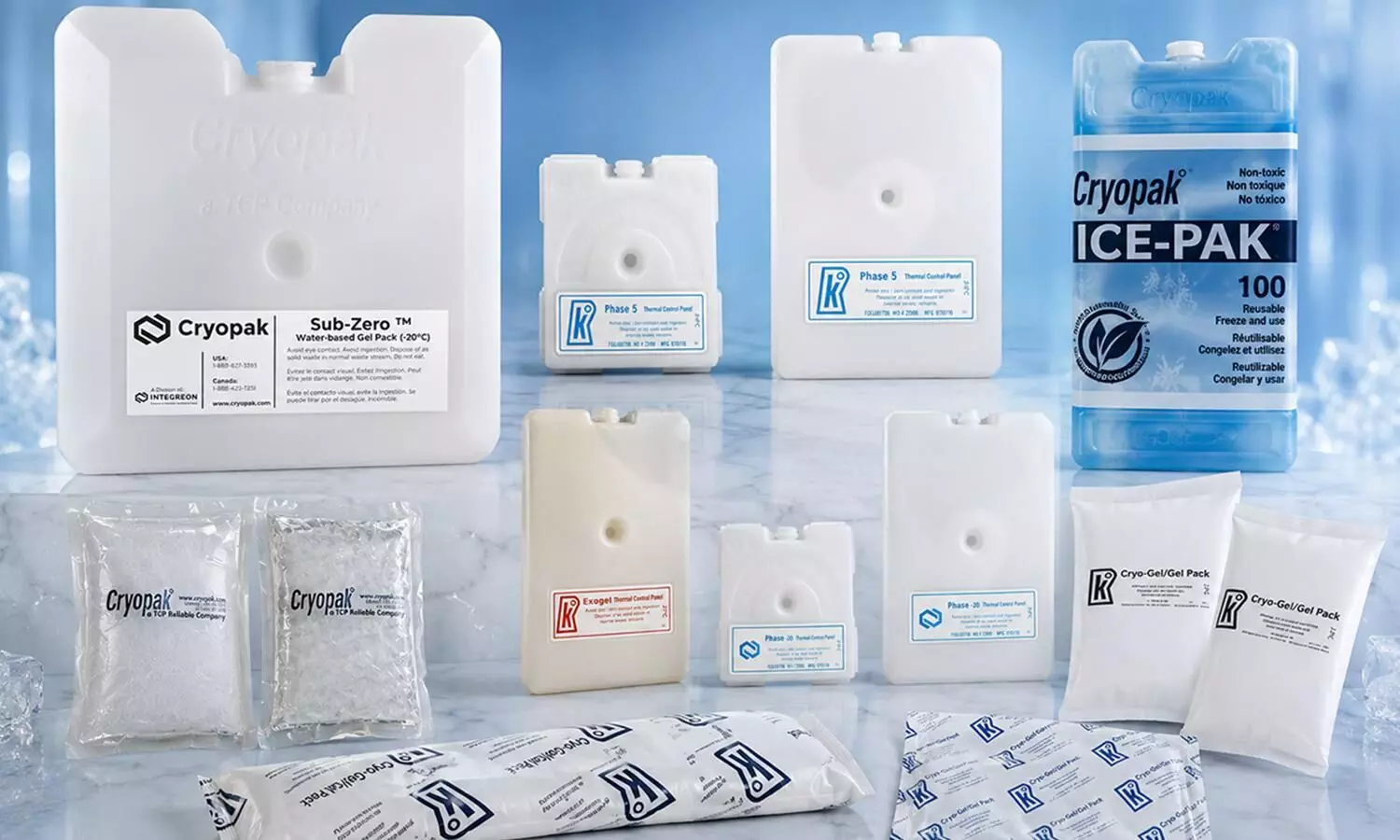
Cryopak gel packs and thermal control panels. (Image: Cryopak)
A refrigerated truck or a cold room protects a medicine only while it is inside. The trouble starts in the gaps: a delayed flight, a pallet waiting on a hot ramp, a customs check that runs long. In those moments, packaging is the only protection the product has.
That is why packaging has moved from the loading dock to the strategy meeting. Biologics, vaccines and cell and gene therapies need tighter temperature ranges and leave little room for error. According to the IQVIA Institute, the biopharma industry loses about $35 billion a year to failures in temperature-controlled logistics. According to IATA, more than half of temperature excursions in air transport happen while products are with airlines and airports.
The packaging business is growing in response. According to MarketsandMarkets, the temperature-controlled pharmaceutical packaging market will grow from $8.3 billion in 2025 to $18.11 billion by 2030. The firm says Asia Pacific led the market in 2025.
So can packaging become the next big competitive advantage in pharma logistics? The people who ship, fly and handle these products say yes, with conditions. Packaging gives shippers more choices. It does not let them skip the cold chain.
How passive and active packaging work
Passive packaging uses insulation and coolants to hold a temperature for a set time. The coolants can be gel packs, dry ice or phase change materials, known as PCMs, which absorb or release heat as they change state. Phase change materials, or PCMs, absorb heat as they melt at a set temperature, which keeps the inside of a box steady for as long as the material lasts. They can be tuned to ranges such as 2°C to 8°C and replace heavier, hazardous coolants such as dry ice. There is no power source and no moving parts. A passive pack is tested to protect a product for a specific number of hours under set conditions.
Active packaging works like a small mobile refrigerator. Electrical or mechanical systems heat and cool the load throughout the journey. In air cargo, most active solutions are unit load devices, or ULDs, the containers that load directly into an aircraft hold. Kuntal Baveja, Regional President Asia Pacific at Envirotainer, says active containers depend less on outside conditions because they heat and cool during transit. With real-time monitoring, he says, teams can step in earlier when something goes wrong. That matters most on long routes with several handovers and mixed climates.
Neither approach wins every time. Passive packaging has improved a great deal, and active containers have grown more capable. The choice has become a decision about risk.
How shippers decide
Hanoz Tarapore, Country Supply Chain Head for ASEAN, Korea and ANZ at QuidelOrtho, starts with the product. He looks at its temperature tolerance in degrees Celsius and in hours. He weighs the volume, the risk on that particular lane, whether the packaging has been validated, the value of the cargo and the cost of the pack. Together these decide whether he needs advanced active cooling or whether standard passive packaging will do.
The purpose of the tracking is to identify the root cause of the excursion. A simple data logger helps, at the very minimum
Hanoz Tarapore, QuidelOrtho
Kuehne+Nagel looks at the whole journey. Dorothee Becher-Schmacke, VP Global Air Logistics Healthcare, says the company assesses temperature range, product stability, shipment value, transit time, lane risk, handling complexity and the infrastructure along the route. Cost is judged across the operation, including conditioning, storage, handling, monitoring, equipment availability and recovery options. A cheaper pack can cost more overall if it adds handling complexity or raises the risk of an excursion.
That is a useful test for any packaging claim. The question is not what the box costs. It is what the journey costs when things go wrong.
A gradual move towards passive
The airline and the forwarder both see a shift towards advanced passive packaging. Envirotainer describes something less clear-cut.
Fausto Queiroz, Senior Product Manager Temperature Sensitive Solutions at Lufthansa Cargo, says Lufthansa Cargo sees a gradual move from active containers to advanced passive packaging, driven by better passive technology and reliable protection over longer periods. Queiroz adds that Lufthansa Cargo does not see a significant shift caused by worries about flight delays or cancellations.
Becher-Schmacke sees the same trend, with customers moving to passive packaging earlier in the product lifecycle. She links part of it to dedicated lanes such as Kuehne+Nagel's Cool Corridors, which combine GDP-compliant handling, temperature-controlled infrastructure and tightly controlled transfers to cut Time Out of Range, the time a shipment spends outside its permitted temperature. On such lanes, she says, customers can consider lighter passive packs where they once used active containers. Active containers still have a place on higher-risk lanes and for very critical shipments.
Baveja does not describe a move from one to the other. He says it is not an either-or choice. Pharma companies are taking a risk-based approach, and different technologies will coexist because different therapies have different needs. Each of these companies has products to sell, so each has a stake in how the trend is described.
Even the passive route needs infrastructure. Becher-Schmacke notes that passive packaging still has to be preconditioned, and that work needs temperature-controlled facilities and trained staff.
What smart packaging changes
A logger tells you what happened. A connected tracker can tell you where, when and why.
"The purpose of the tracking is to identify the root-cause of the excursion," says Tarapore. A simple data logger helps at the very least. But e-SIM GPS trackers now capture location, shock, tilt and humidity along with temperature. That gives investigators far more to work with. He says the data becomes undisputable evidence when partners make claims against each other, and it speeds up settlements and corrective action.
The value is not only in investigating a loss. Live data changes what a team can do during the journey. Fabrice Panza, Global Life Sciences & Healthcare Leader at Etihad Cargo, says visibility has become a basic requirement as therapies grow more temperature-sensitive, time-critical and valuable. Customers want confidence that product integrity is protected throughout the journey, not just a shipment's location. He says that shift has been a key driver of growth in Etihad Cargo's PharmaLife product.
Etihad Cargo's SmartTrack solution gives near real-time visibility of location, temperature and other conditions. Panza says it sends automated alerts for temperature excursions, unexpected delays, shock and unauthorised light exposure, and the alerts feed a 24/7 Control Tower in Abu Dhabi. The value, he says, lies in catching problems early and acting before product integrity is affected, not in reporting after the shipment. He expects predictive analytics and AI to help anticipate disruptions in future.
Lufthansa Cargo works along similar lines. Queiroz says real-time visibility and alerts let stakeholders fix problems before they become excursions. Lufthansa Cargo monitors shipments around the clock through its Pharma Control Tower and uses digital services such as smartULD to turn container management from reactive to proactive.
Baveja expects the next phase of innovation to go further. Better monitoring, predictive analytics and container intelligence, he says, will help people make better decisions in transit. The aim is to reduce risk through visibility and intervention, not only by adding thermal protection.
Roche's teams in India monitor critical shipments in real time as well. Ravi Ranjan, Senior Manager Logistics Operations at Roche Diagnostics India, says this is part of a redesigned cold chain process that has significantly reduced temperature excursions.
Reusables and the sustainability sum
A container that makes many trips creates less waste than one that is thrown away. The catch is what happens between trips.
Baveja says the benefits of reuse depend on how well the network is managed. Envirotainer works to use its assets fully and balance its global network so containers are where customers need them with as few unnecessary movements as possible. It is also using more sea freight to reposition containers, so fewer empty ones fly. Sustainability, he adds, includes preventing excursions, product loss and replacement shipments.
I do not see packaging replacing cold chain infrastructure altogether. Packaging should be viewed as an enabler, not a complete substitute
Kuntal Baveja, Envirotainer
Becher-Schmacke makes a similar point. Weight, reverse logistics, repositioning, refurbishment, cleaning and utilisation all affect the result, so Kuehne+Nagel assesses sustainability lane by lane. Reusables deliver the most when utilisation is high and returns are well managed. She warns that cutting packaging costs at the expense of the product can undo any sustainability gain.
The research points the same way. According to a lifecycle study by the University of Minnesota and Minnesota Thermal Science, a closed-loop reusable system needed 772 shippers where a single-use system needed 30,000. It produced 225 metric tonnes of emissions against 1,100. The reusable shipper's manufacturer commissioned that study. According to the Austrian Institute of Technology, reusable packaging can save CO2 against cardboard, but the savings depend on usage conditions, particularly shrinkage and returns.
Roche shows the shipper's side of the trade-off. "We have shifted away from dry ice for sub-zero shipments in favor of advanced PCMs," says Ranjan. Dry ice is heavy, hazardous to handle and carries a high carbon footprint. Roche Diagnostics India also validates packaging for specific transit times and local seasons, including thermal blankets during peak Indian summers. That lets it use less gel coolant and smaller boxes, and it cuts shipment weight while keeping thermal stability across climate zones.
We have shifted away from dry ice for sub-zero shipments in favor of advanced phase change materials, which offer controlled latent heat capacity
Ravi Ranjan, Roche Diagnostics India
Rajesh Shetty, Supply Chain Lead of Roche says the company first checks that packaging can protect the product from temperature shocks, and then looks at sustainability. It uses reusable packs where possible. He is frank that total cost is still a long way from being efficient, and Roche aims to recover it by reusing packs many times. Reusable packaging can pay off, but not automatically. The economics depend on how many trips a pack makes and how many come back.
Where ULD innovation fits
For air cargo, the ULD is where packaging meets the aircraft. Queiroz says recent active ULDs offer more precise temperature control, longer operating autonomy, better batteries and stronger monitoring, with some providing real-time telemetry. Lufthansa Cargo pairs them with dedicated handling and trained staff for high-value biologics and advanced therapies. Etihad Cargo describes a similar layered model of active and hybrid containers, thermal corridors and dedicated infrastructure in Abu Dhabi.
The engineering challenge is balance. Baveja says the hardest part is delivering more protection without giving up efficiency. Customers want longer protection times and more resilience to delay. But a solution that protects the product and makes transport much less efficient, he says, only moves the problem elsewhere. Weight, payload and cost all limit how far thermal protection can grow. The next ULD advantage may come from intelligence, not extra insulation.
Why packaging cannot replace infrastructure
On this point, the airline, the forwarder, the container maker and the shipper agree.
Queiroz explains why from the airline's side. Air transport faces loading, transfers, customs, weather and irregular events. Every passive solution has a qualified performance duration and works within set environmental assumptions. When a long disruption, extreme heat or cold, or an unexpected wait pushes past those limits, packaging alone may not be enough. Airlines therefore focus on cutting time on the tarmac. Lufthansa Cargo describes a layered protection model in which packaging, infrastructure, monitoring and operations complement each other. "The industry is not moving beyond the cold chain. Instead, it is moving toward a smarter cold chain," says Queiroz.
Becher-Schmacke agrees. Advances such as longer-lasting passive packs, better insulation and PCMs will keep widening the range of lanes that can carry sensitive products. But "packaging alone cannot replace the broader cold-chain ecosystem," she says. Compliant handling, temperature-controlled facilities, trained people and contingency plans are still needed, most of all at airports, transfer points and customs.
Baveja is the most careful. Advanced containers can give a more self-sufficient environment during transfers, delays and storage where refrigeration is limited, so to some extent they can reduce dependence on infrastructure. But, he says, "I do not see packaging replacing cold chain infrastructure altogether." He calls packaging an enabler that adds flexibility when things go wrong. In Asia Pacific, where infrastructure varies from one country and lane to the next, better containers can help companies reach more markets while protecting product integrity.
The gap is visible in India. "The infrastructure for cold chain is growing at a very rapid pace, but it is still not sufficient," says Shetty. Roche compensates with the process. It carries out thorough due diligence before onboarding distributors, couriers and other providers, trains them to handle cold chain products, and monitors shipments in real time.
Panza points to how the airline's role is changing. "Airlines are evolving from transportation providers to strategic healthcare logistics partners," he says. Customers now expect quality assurance, compliance and risk management, not just capacity.
When the mode changes the question
There is one case where packaging matters less. Tarapore says QuidelOrtho has been moving some international shipments from air to ocean. In his experience, ocean shipments do not use passive cooling packaging. They use active-cooling reefer containers. The priority shifts from packaging to making sure the reefer stays plugged into power on the vessel, at the dock and on the truck, so cooling is never interrupted. In a slower mode, the risk moves. The question is no longer how long a box holds its temperature. It is whether power reaches the container at every handover.
Is packaging the next competitive advantage?
Packaging is becoming an advantage, but not in the way the headline suggests.
It does not free shippers from the cold chain. What it gives them is choice. A shipper that knows its lane, validates packaging for the real transit time and season, and gets live data from the shipment has options. It can choose a lighter pack on a well-run corridor and an active container where the risk is highest. It can find a cause faster and settle a claim sooner. It can cut wasted product and unnecessary movement.
Those benefits depend on the system around the box. Kuehne+Nagel says packaging works best alongside controlled lanes. Lufthansa says it works best alongside airport infrastructure and monitoring. Etihad Cargo says it works best alongside live data and a responsive control tower. Envirotainer says different products and routes will keep needing different tools. Roche says reuse and validation pay off only when they are managed well.
There are open questions. Passive packaging is gaining ground, but nobody in this story could say by how much. The cost case for advanced and reusable packaging is still argued in general terms. And cell and gene therapies, which need the tightest control, may keep some of the most demanding shipments on active solutions for a long time.
The industry is not going beyond the cold chain. It is making it smarter. For a business where one failed shipment can mean a lost batch, that may be advantage enough.