
Intradco leads first beluga rescue flight to US homes
Intradco Global orchestrated the safe relocation of six belugas from Marineland Canada to US aquariums, marking phase one of a 30-whale rescue.
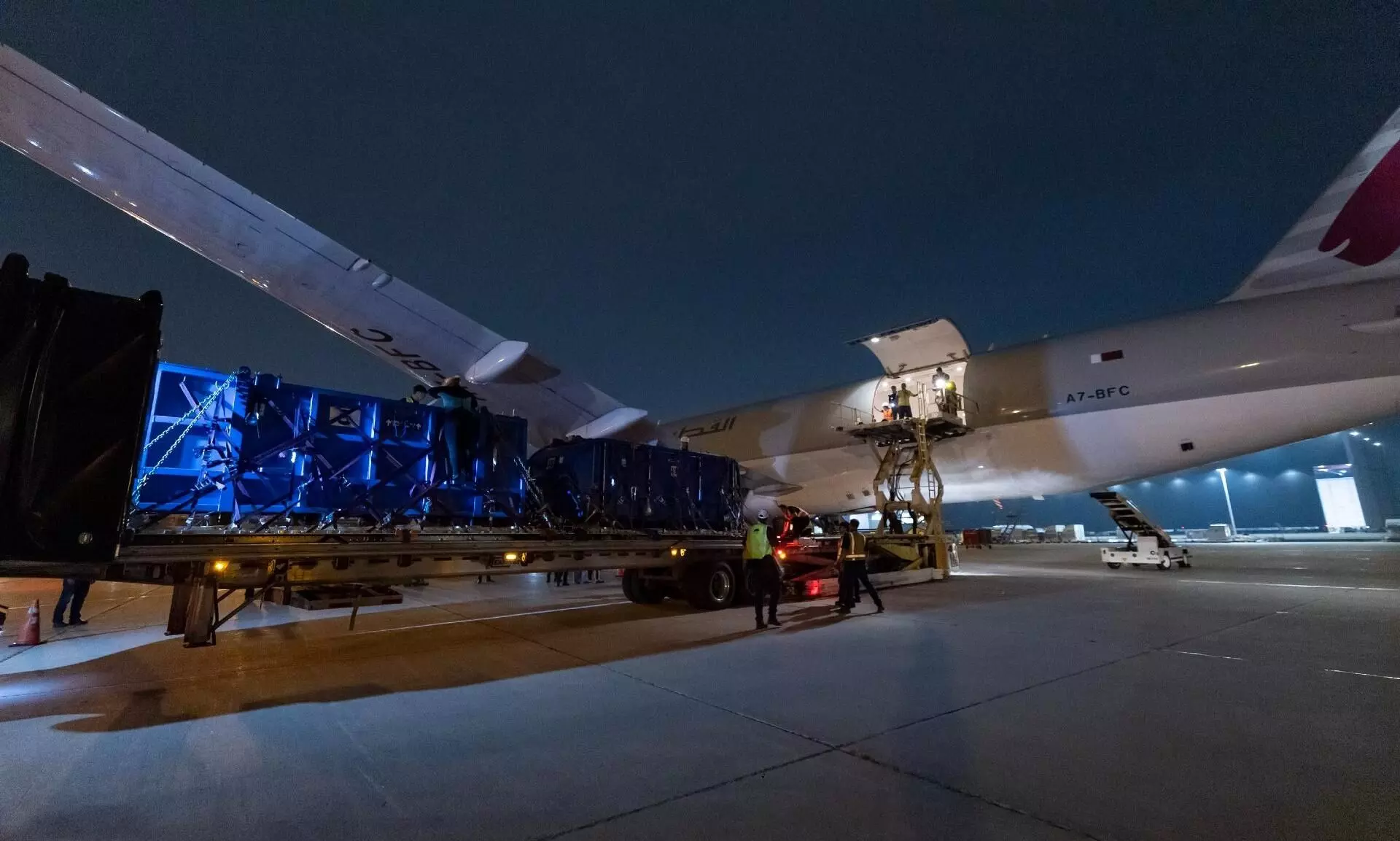
Rescued belugas being loaded onto a QR Cargo freighter at Toronto Pearson International Airport (Photo: Brenna Hernandez/Shedd Aquarium)
Six of Marineland Canada’s remaining 30 beluga whales have completed their journey to new homes in the United States, marking the first phase of a long-planned and tightly coordinated international relocation effort. The move follows the closure of the Niagara Falls marine park in September 2024 and represents a critical step in securing long-term, specialised care for the animals.
The six whales are part of a large pod that had been living at Marineland, a now-closed facility that can no longer support their ongoing welfare needs. Their transfer is the beginning of a multi-stage rescue initiative designed to ensure stability, expert veterinary oversight, and improved living conditions for all belugas still at the site.
A key partner in this complex operation is Intradco Global, the live-animal transportation specialist under the Chapman Freeborn Group. Intradco is providing the logistical expertise, equipment, and coordination required for a relocation of this scale, working alongside veterinarians, regulators, and receiving facilities to ensure the whales’ safety throughout the journey.
The whales, four bound for Shedd Aquarium in Chicago and two for SeaWorld San Antonio, completed their move on July 21, 2026, traveling from Marineland in Ontario. The whales were moved by road to Toronto Pearson International Airport, from where they were flown to their final US destinations aboard Qatar Airways Cargo freighter aircraft.
Marineland had operated from 1961 until its closure in 2024, after which the facility's care costs were sustained entirely by donations. When funding began drying up, caretakers warned Canadian authorities in October 2025 that euthanasia could become unavoidable without government support, underscoring the urgency behind the relocation programme now underway.
The mission was led by Dennis Christen, Global Product Manager for Wildlife, Zoological, and Marine Logistics at Intradco Global. Christen joined the company in September 2025, bringing 36 years of hands-on marine mammal experience from senior roles at Vancouver Aquarium, Alaska SeaLife Center, and Georgia Aquarium, a background that shaped the operation from its earliest planning stages.
Each beluga whale is carefully secured and loaded into a specialised coldwater transport container (Photo: Brenna Hernandez/Shedd Aquarium)
A welfare mission, not a transport job
For Christen, the initiative was never primarily about logistics. "It began as a welfare challenge," he said. With Marineland's future uncertain, accredited zoological institutions and marine mammal professionals began exploring whether a phased relocation could offer a sustainable path forward for the whales.
Veterinary records were reviewed extensively, behavioural patterns observed, and social bonds between individual whales carefully mapped before any transport plan took shape. "From the outset, the strategy prioritised animal welfare above operational convenience," Christen said. "Rather than attempting to relocate all thirty whales simultaneously, we developed a phased approach that would allow every movement to benefit from continual learning and operational refinement."
Orchestrating hundreds of moving parts
Executing that welfare-first strategy required assembling an extensive logistics framework months ahead of the move. These include specialised transport systems, lifting infrastructure, airport resources, and contingency planning, all tested and rehearsed before departure.
The six whales, ranging in age from 6 to roughly 40 years old, were cleared for travel by veterinarians before being loaded into specialised cold-water containers for the journey. Caretakers and veterinary specialists accompanied the animals throughout transit, monitoring them continuously until arrival at Shedd Aquarium in Chicago and SeaWorld San Antonio, both facilities already home to established beluga pods.
"The success of this operation depended not on any single aircraft, vehicle, institution or organisation, but on our ability to orchestrate hundreds of interconnected activities into one cohesive welfare-focused mission," Christen said. Veterinarians, aquaria, regulators, engineers, airline personnel, airport operators, and transport providers each contributed specialised expertise, coordinated to align at precisely the right moment.
"In live animal transportation, operational excellence and animal welfare are inseparable," he added. "Every smooth transition reduces risk, minimises stress and allows veterinary and animal care teams to focus entirely on the animals themselves."
Caretakers and veterinary specialists accompanied the belugas throughout their journey (Photo: Heidi Zeiger/Shedd Aquarium)
Decades on the receiving end
Christen's approach draws directly on his career on the institutional side of animal movements, including earlier work supporting internationally recognised beluga relocation efforts from Ukraine amid significant geopolitical and operational complexity.
"Having spent much of my career on the receiving side of animal movements, I understand the practical realities faced by veterinarians, animal care professionals and receiving institutions," Christen said. "That experience shaped every aspect of our transportation strategy. It wasn't built solely around operational requirements; it was built around the long-term welfare of the whales."
A coalition of specialists
Intradco Global coordinated the broader logistics framework, including equipment positioning, transportation planning, airport coordination, and operational rehearsals. Paddock Transportation International supported the preparation, positioning, and movement of specialised equipment; AmeriConnect coordinated critical infrastructure movement; and DeSantis Crane Service delivered the lifting capability required to transfer the whales safely into their transport carriers. Qatar Airways Cargo supplied the freighter aircraft that carried the whales between countries.
"When organisations with different expertise align behind a shared purpose, transport becomes something far greater than moving animals from one location to another," Christen said. "It becomes a collective commitment to their long-term welfare."
Arrival is only the beginning
Teams at Shedd Aquarium and SeaWorld San Antonio spent months preparing habitats, acclimation strategies, and introduction protocols tailored to each whale ahead of arrival. Foraging, socialising and exploratory behaviours are being tracked closely in the weeks following the move as key indicators of successful acclimation.
"For experienced marine mammal professionals, successful relocation is never measured in hours," Christen said. "It is measured by the long-term health, welfare and successful integration of every animal."
Dennis Christen, Global Product Manager for Wildlife, Zoological, and Marine Logistics at Intradco Global (Photo: Intradco Global)
Planning for what's next
With phase one complete, the remaining 24 belugas will move in stages over the coming months. Six additional belugas are scheduled to join Shedd Aquarium and 11 more SeaWorld San Antonio, while three will move to SeaWorld San Diego, two to Georgia Aquarium, and two to Oceanogràfic Valencia in Spain, pending final veterinary clearance and international permits. Sub-pods will be grouped according to bonded relationships to keep connected whales together throughout transport.
Christen continues to design specialised air transport solutions for zoological institutions and conservation organisations worldwide, combining zoological expertise with logistics precision across tailored transport products, welfare-centered planning, regulatory compliance, and innovation in carrier design, pallet configuration and aircraft utilisation.
"The Beluga Rescue Initiative demonstrates what can be achieved when animal welfare, scientific expertise, conservation leadership and operational excellence work together towards a common goal," he said. "When logistics are intentional and welfare-driven, transportation becomes far more than movement. It becomes an extension of care."