
Air cargo's capacity squeeze runs to 2030
Delivery delays at Boeing and Airbus are starving freighter conversions and tightening belly capacity, reshaping shipper contracts through 2030.
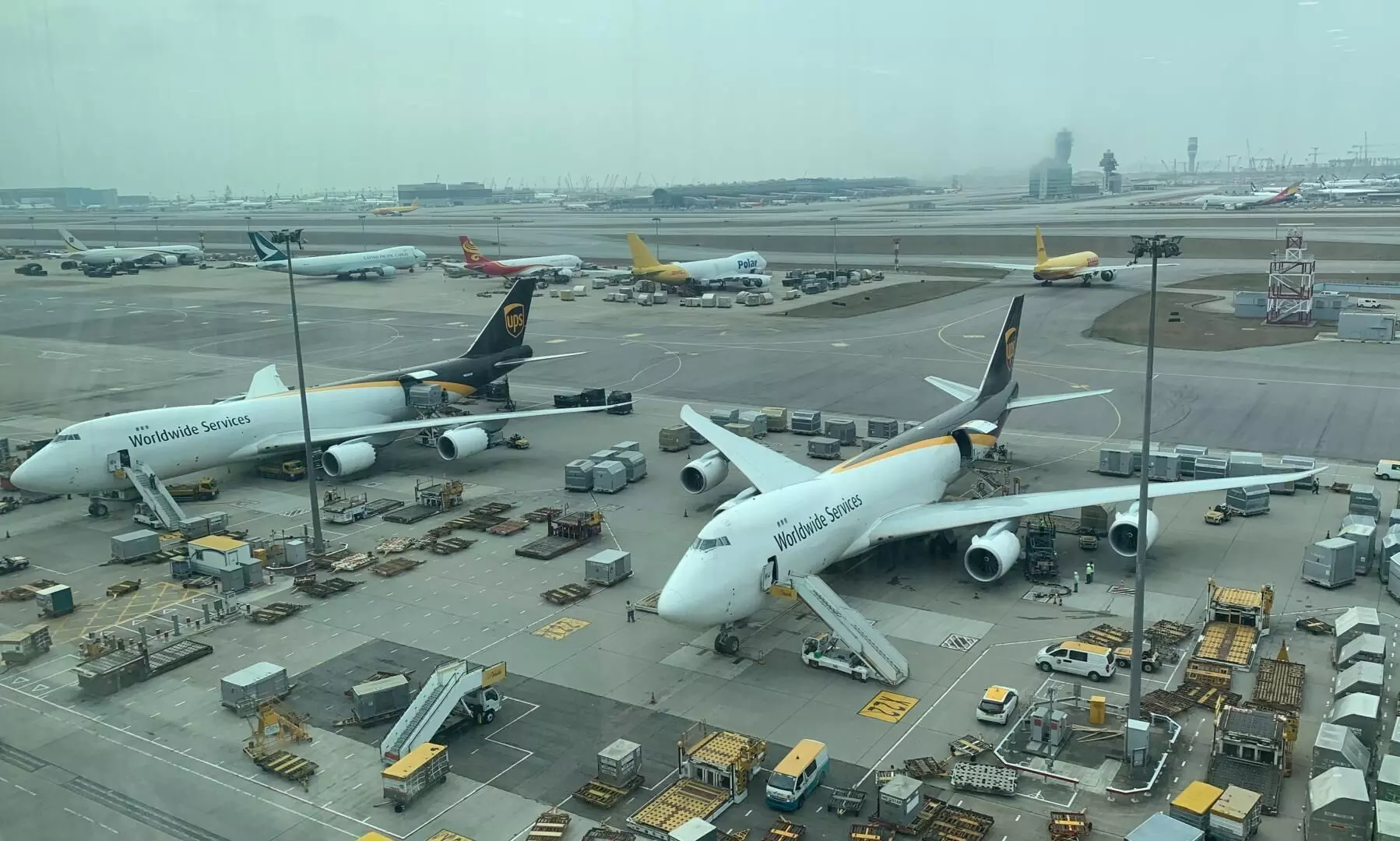
Freighters lined up at Hong Kong International Airport, March 2024
Manufacturer delays at Boeing and Airbus are rippling straight into air cargo capacity and the pain will not ease before 2030, according to Flexport and Atlas Air Worldwide executives speaking on a webinar titled "The capacity squeeze nobody budgets for: air cargo 2026–2030."
David Grinevald, director of air freight at Flexport, and Richard Broekman, chief commercial officer and head of sustainability at Atlas Air Worldwide, laid out how a stalled aircraft production pipeline is compressing widebody belly space, drying up the passenger-to-freighter (P2F) conversion queue, and pushing up rates, with shippers set to absorb the fallout through the end of the decade.
A 17,000-aircraft backlog
Grinevald opened with the scale of the industrial shortfall: the industry is sitting on over 17,000 unfilled aircraft orders, a backlog that will take more than 12 years to clear. Global aircraft production finished 2025 some 24% below 2019 levels; a production shortfall of roughly 6,000 aircraft industry-wide, with fleet growth through 2036 now lagging pre-pandemic projections by six years.
Airbus is targeting 11 A350s a month by 2027 but is currently building five; Boeing was targeting five widebodies a month, including freighters, but is producing two, with the 777X still unapproved by the Federal Aviation Administration (FAA). Boeing and Airbus together account for roughly 80% of aircraft entering circulation, Grinevald noted, meaning their combined delays have no near-term workaround.
Broekman said the constraint is being felt directly on the airline side. "The biggest challenge for us is indeed access to additional capacity," he said, noting Atlas operates close to 15% of the global widebody freighter fleet. This year marks the first in many years that Atlas has not added aircraft to its fleet — "just really a function of no availability out there," he said.
Certification limbo and a broken supplier
On the Boeing side, Grinevald pointed to the 737 MAX groundings that followed two fatal crashes, after which the FAA tightened its grip on Boeing certification programmes. The result: a seven-year slip on the 777X, now in its fifth year of certification with no clear end date, alongside the 737 MAX 7 and MAX 10 — together representing 14–24% of Boeing's order book, Grinevald said.
Airbus's delay traces to a different root cause: Spirit AeroSystems, a key fuselage supplier to both manufacturers that became financially dependent on Boeing and fell into distress after Boeing's own troubles. Airbus warned customers as of May 2026 of further A350 delays tied to Spirit's production problems. Both the A350 and 777 are now delayed past 2027.
Smaller manufacturers won't fill the gap, Broekman said. Moving global trade "really relies on the large widebody aircraft," he said, and even medium-widebody freighters carrying 50–60 tonnes "are just not as competitive" on a per-kilo basis. A new entrant, he added, "would struggle tremendously to enter into this space" without an existing global supply chain.
Atlas hedges with a $7 billion Airbus order
Atlas has made two moves in the past 18 months that Grinevald called directly illustrative of the squeeze: acquiring a 49% stake in Air Atlanta Icelandic, which brings 14 widebody aircraft into the fold, and placing a $7 billion order for 20 Airbus A350Fs in March — Atlas's first Airbus commitment after operating as an exclusive Boeing customer.
"We know there's going to be a tremendous shortage of widebody freighter capacity," Broekman said, citing steady general freight demand, sustained growth in cross-border e-commerce out of China, and a newer driver — the buildup of hyperscaler and data-centre infrastructure powering the AI industry. Atlas evaluated both Boeing and Airbus options before choosing Airbus based on fit with current customers and earlier availability, though Broekman said future Boeing orders "are not out of the question." The Air Atlanta stake, meanwhile, extends Atlas's network into Africa and Europe-Asia lanes where its partner is strongest.
The conversion pipeline is drying up
The P2F conversion cycle — airlines retire older widebodies, conversion shops retrofit them, freighters enter the market, is the industry's main source of new dedicated freighter capacity. But because airlines can't retire aircraft they haven't yet replaced, that replacement cycle is now roughly six years late, Grinevald said. The conversion backlog dropped to about 320 units in 2025, and some aircraft are returning to passenger service rather than converting, a trend Grinevald called new.
The forecast conversion volumes are stark: 80–95 P2F conversions a year between 2026 and 2029, dropping to 67 in 2030, 54 in 2031, 27 in 2032, and just four aircraft in 2034. Conversions will account for only 3.4% of the global cargo fleet over the next decade, Grinevald said. This means the freighter fleet in 2036 will still be dominated by aircraft built well before that.
An $11 billion bill — and rising
The supply chain crisis is costing airlines more than $11 billion in 2025, according to IATA estimates cited on the webinar: $4.2 billion in excess fuel cost from flying older, less efficient aircraft; $3.1 billion in additional maintenance; $2.6 billion in engine leasing premiums as new deliveries run late; and further costs from spare-parts stockpiling. Fuel represents at least 40% of freighter operating costs, Broekman said: "so if 40% of your cost suddenly doubles overnight, that has to be reflected in market rates as well."
MRO (maintenance, repair and overhaul) spend will nearly double between 2019 and 2036, with 75% of MRO survey respondents reporting longer engine turnaround times over the past year. MRO EBITDA multiples have climbed to 15x, Grinevald said. "The market is pricing in sustained scarcity."
Belly capacity adds another layer of pressure: roughly 50% of global airfreight currently moves on passenger-aircraft bellies, down slightly from a pre-Covid split closer to 55/45 in favour of belly. "Shortage on belly just compounds the shortage of overall capacity," Broekman said, since freighters are already generally full.
AOGs, transparency and a shipper playbook
Both executives pointed to aircraft-on-ground (AOG) events. According to them, this is now more frequent, given an aging fleet and higher utilisation as a growing source of schedule disruption. Grinevald described Flexport's digitised SOP system for tracking customer constraints during disruptions, while Broekman pointed to Atlas's tracking tools that let forwarders monitor aircraft status directly. "AOGs are a fact of life," Broekman said. "They're very frustrating because they always happen at the wrong time."
The session closed with a practical framework for shippers navigating the 2026–2030 window. Start by segmenting cargo by criticality: time-critical freight with no mode substitute needs a named carrier and an allocation contract, plus a contingency routing plan for AOG events. Freight that can absorb 48–72 hours of delay can run on spot or spot-adjacent capacity, backed by buffer stock at destination. Freight that can downgrade should be flagged for fast-ocean options.
Weighing allocation against spot is the real trade-off. Spot cargo is cheaper when the market is loose, but it's first to be bumped when disruption hits. Allocation contracts carry a premium but they guarantee space, lower bump risk, and priority loading. "Premium is an insurance," Grinevald said. "It doesn't mean it will work every single time, but it will most definitely give you more certainty."
Shippers should also ask harder questions in Request for Proposal (RFPs) and Quarterly Business Reviews (QBRs). What percentage of lane capacity is belly versus dedicated freighter? What's the contingency plan if freighters go AOG? What's the average overbooking rate in peak weeks? How far in advance can allocation be guaranteed and which specific aircraft are in the freighter fleet? Grinevald, who previously worked on the shipper side, said that last question is rarely asked in tenders today.