


The freight intelligence that keeps Art Basel intact
Behind every masterpiece at Art Basel Hong Kong lies a logistics battle against weather, geopolitics, and time.
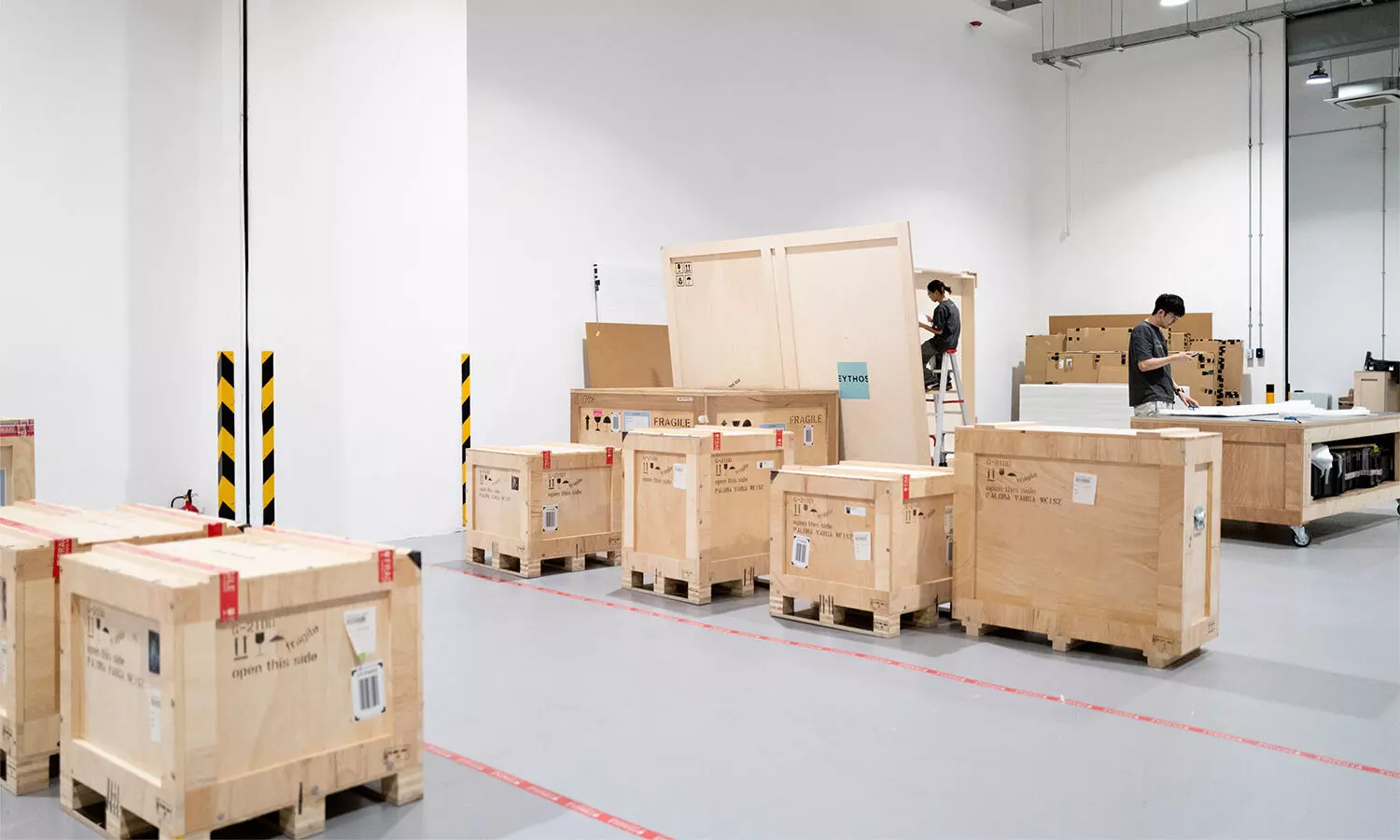
Every March, the Hong Kong Convention and Exhibition Centre absorbs roughly $1 billion worth of fine art within a busy, 72-hour window. As galleries from 40 countries ship priceless masterpieces via private air freight, bonded cargo, and temperature-controlled road transport, the waterfront venue becomes the centre of an operational challenge that would stress-test most supply chains. While wealthy collectors see only the pristine white walls, perfect lighting, and the quiet theatre of international wealth, they remain entirely blind to the intense logistical orchestration happening behind the scenes.
According to Art Basel's own closing report for its 2026 Hong Kong edition, galleries recorded 12 seven-figure transactions across the fair, 9 of them during the opening preview alone, surpassing the total recorded for the entire 2025 edition. Concurrent auction activity that same week reinforced the scale of what is at stake: according to ARTnews, leading auction houses generated a combined $164.9 million across their Hong Kong evening sales.
Zohra Azi, Chief of Staff at Eythos, a specialist in fine art logistics, helps us explore the realities of transporting irreplaceable artworks into one of Asia’s most operationally complex environments.
Navigating flight paths and geopolitical friction
The fine art freight industry operates without the luxury of safety stock, buffer inventory, or acceptable rates of loss. When international airspace closes unexpectedly, as has happened with increasing frequency across Middle Eastern and Eastern European corridors in recent years, the threat to a shipment is immediate and existential. While standard freight operators can tolerate the added time and cost of rerouting, fine art operators must possess a pre-built contingency architecture before an aircraft even leaves the ground.
As Azi explains, "When you are moving irreplaceable art, you cannot simply pray for the best if an airspace suddenly closes. At Eythos, we never rely on a single route and always prepare for the worst. Before an artwork even leaves the ground, we map out pre-cleared backup flight paths and secure storage hubs along the way. If a crisis hits mid-flight, we don't scramble; we immediately switch to a pre-approved alternative route.
Our partners on the ground are notified instantly, ensuring the cargo moves smoothly from the tarmac to a secure, climate-controlled facility without a single gap in security. Recently, a shipment flying to Hong Kong from Italy via Qatar had to be terminated in Doha. It was safely transferred to a climate-controlled truck, driven 7 hours to catch a flight from Riyadh, and arrived safely in Hong Kong on time for the exhibition set-up, completely avoiding the risk of being trapped indefinitely, waiting for the geopolitical crisis to pass"
Combating invisible threats
While geopolitical hurdles require constant vigilance, fine art logistics must also battle an invisible, highly destructive environmental enemy known in the industry as the "sweat factor." This phenomenon accounts for a disproportionate share of in-transit damage claims, yet it receives very little attention outside specialist conservation circles.
The physics behind the threat are straightforward but devastating. A painting or paper sketch stored for weeks in a crisp European or North American winter gallery, where temperatures hover between 18 and 21 degrees Celsius and relative humidity sits at a stable 45 to 55%, will arrive in Hong Kong’s humid March climate, where outdoor humidity frequently surpasses 80%. The moment the cold surface of a transit crate meets that warm, saturated tropical air, condensation forms instantly. For paper or canvas, the effects manifest within hours in the form of collecting, mould activation, tide marks, and paint delamination.
Industry estimates suggest that humidity-related damage accounts for between 15 and 20% of all fine art transit claims by value in the Asia-Pacific corridor. Azi explains that bringing delicate works into Hong Kong's tropical climate is a recipe for instant ruin if not managed with extreme patience and heavy insulation.
Eythos enforces a rigid three-stage acclimatisation protocol. The company's work involves travelling solely within custom-built environments, heavily insulated museum crates designed to maintain an isolated internal microclimate. Upon arrival, these crates remain completely sealed for a minimum of 24 hours and up to 72 hours inside a dedicated facility held at exactly 20 degrees Celsius and 45 to 55% relative humidity. Unpacking occurs only after absolute thermal equalisation is confirmed, ensuring the internal crate environment matches the controlled venue environment. Maintaining this discipline requires resisting immense commercial pressure to accelerate timelines during the frantic setup of the fair.
Weathering the storm and closing the tarmac gap
The logistical puzzle is further complicated by Hong Kong's unpredictable weather patterns. A Typhoon Signal 8 or above effectively paralyses ground transportation, port operations, and external logistics across the territory. During Art Basel’s compressed 72-hour load-in window, a sudden storm bottleneck does not pause the delivery queue; it stacks it, leaving time-sensitive, high-value cargo trapped in loading bays or on exposed tarmacs.
To mitigate this structural vulnerability, Eythos utilises its secure warehouse facility in Tsing Yi as a dedicated storm sanctuary. When a severe weather warning is issued, all active deliveries stop immediately, and all works in transit revert to the Tsing Yi hub, which maintains strict climate control via emergency generator power throughout the storm. Once the meteorological all-clear is given, a phased, prioritised delivery schedule activates, using a dedicated fleet of climate-controlled vehicles to sequence the artwork safely to the venue.
“To add another layer of security, our Airport Storage Facility (scheduled to open in Q1 2027 in time for Art Basel 2027) will soon provide an extra layer of custodianship, bringing the works straight from the tarmac into our highly secured compound," Azi confirms
This structural upgrade will allow cargo to move seamlessly into a climate-controlled environment, completely removing tarmac exposure and redefining the security architecture of the Art Basel Hong Kong supply chain.
With the global fine art logistics sector projected to reach $4.6 billion by 2035 and growing at a CAGR of 6.5% annually, according to Market Research Future, the infrastructure supporting these cultural events has evolved into a highly sophisticated specialism.
A Global platform connecting collectors, galleries, and artists, with fairs in Basel, Hong Kong, Paris, and Miami Beach. Each edition is defined by its host city, its galleries, and its collectors. What connects all four is a logistics chain of extraordinary complexity, and the specialist operators who ensure that the art arrives safely, on time, and in perfect condition, making the spectacle possible in the first place.
"I bring stories to life from the heart of the air cargo, logistics, and aviation supply chain industries. As a News Correspondent at Stat Publishing Group, my focus is on delivering in-depth coverage, industry trends, and expert insights that drive conversations and shape perspectives. With a background in visual communication, photography, and content creation and storytelling, ensuring every report provides value to industry professionals.


