


China-Europe e-commerce cargo after EU de minimis reform
China-Europe e-commerce volumes fell sharply after the EU's €3 import duty implementation took effect on July 1, prompting capacity cuts, changes in fulfilment strategies and greater focus on customs compliance.
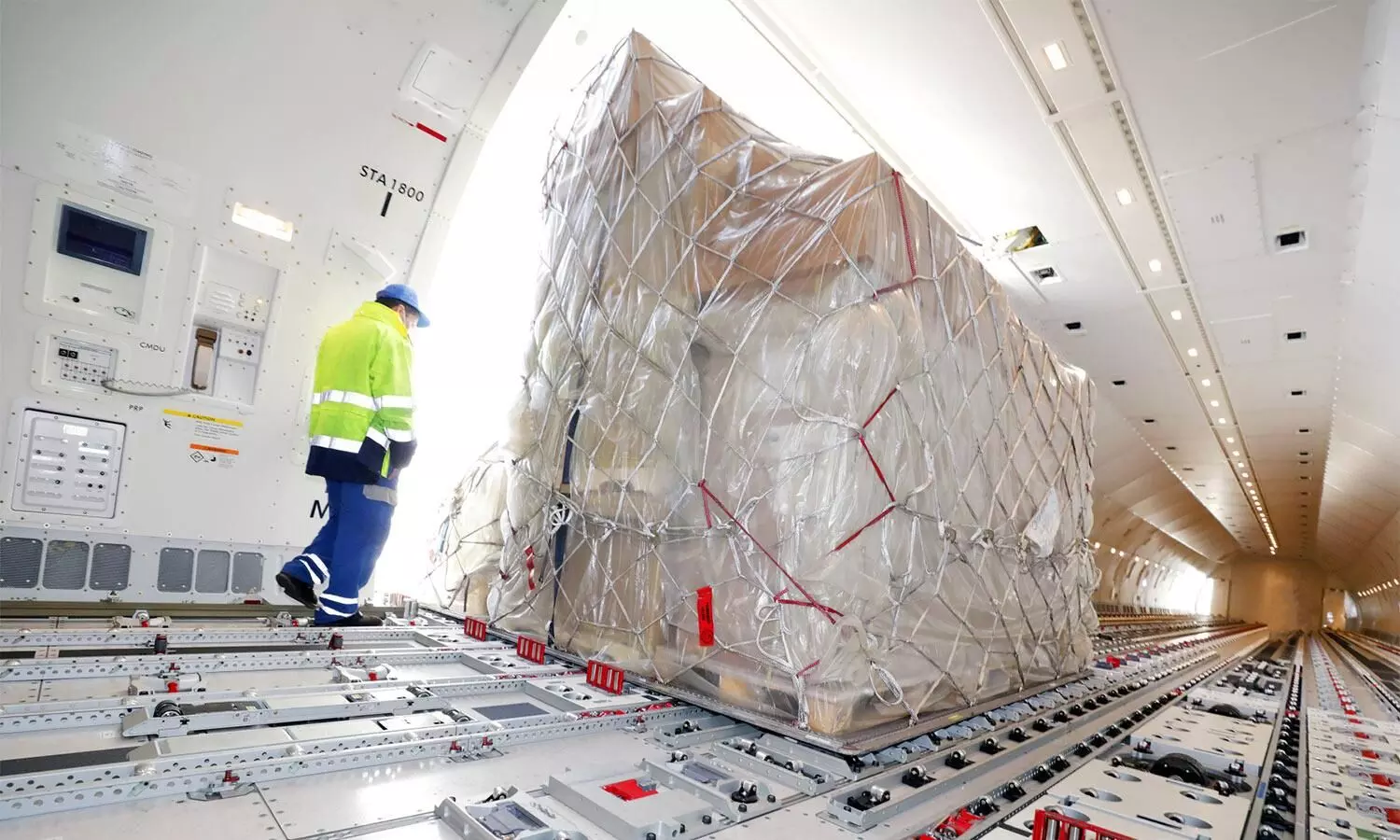
For years, the economics of China-Europe e-commerce air cargo were built around a simple proposition: millions of relatively low-value parcels could move quickly from Asian sellers to European consumers, often without attracting customs duty if their value was below €150.
That model changed on July 1, 2026, when the European Union introduced a temporary €3 customs duty on low-value parcels imported directly from outside the EU. The measure applies to goods valued at €150 or less and is charged by customs classification rather than simply treating every parcel as one item. Within weeks, the impact began appearing in the air cargo network.
At Liège Airport, one of Europe's major e-commerce gateways, July brought a sharp decline in low-value parcel activity. Yet the airport's overall cargo tonnage increased. At Frankfurt Airport, China-origin tonnage also fell, but total cargo continued to grow.
Those two developments capture the central story of the EU's first month under the new regime: the policy is clearly disrupting direct e-commerce flows, but the effect on the broader air cargo market is more complicated.
The question now is not simply how many parcels have disappeared. It is where the underlying consumer demand, and the cargo supporting it, is moving.
The first shock: Low-value parcels fall
The clearest evidence comes from Liège-Bierset. In the Liège-Bierset customs zone, the number of e-commerce parcels fell 24% in July compared with July 2025 and 41% compared with June 2026. The number of declarations in June 2026 also decreased by 52% compared with July 2025 and 67% compared with June 2026.
B2C volumes valued below €150 declined sharply following the implementation of the new EU regulations.
At the same time, parcels valued at over €150 increased by 10%, according to an official post from Liege Airport. That suggests that the market is already adjusting its shipment profile, with some operators moving towards higher-value flows as the economics of very low-value direct-to-consumer shipments change.
“Most lost capacity hasn't been redeployed elsewhere, so global freighter utilisation is down, sharpest on converted B747-400Fs (-13.8%), which typically fly ad hoc.”
Tim van Leeuwen, Rotate
The figures are also consistent with the broader market response recorded by Rotate. Its Live Capacity and Air Demand data showed that e-commerce imports into Europe fell 24% in July compared with June, while direct China/Hong Kong-to-Europe freighter capacity subsequently settled at around 28% below June levels.
The capacity reduction has been uneven. Rotate recorded declines of 58% at Budapest, 35% at Liège and 78% at Madrid between its June reference period and August. On the Asian side, capacity fell 72% at Ürümqi and 28% at Hong Kong.
Most of the capacity removed from China-Europe routes has not yet been redeployed elsewhere, according to Rotate's Head of Consulting, Tim van Leeuwen. He added, “Most lost capacity hasn't been redeployed elsewhere, so global freighter utilisation is down, sharpest on converted B747-400Fs (-13.8%), which typically fly ad hoc.”
The early evidence therefore points to a network responding to a demand shock rather than simply a temporary dip in parcel traffic.
But Liège's cargo story is bigger than e-commerce. Liège's broader cargo performance offers an important counterpoint. Overall tonnage rose 4% in July 2026 year-on-year, despite a 4% decline in aircraft movements, indicating higher utilisation of available capacity. Pharmaceuticals, data centre equipment and flowers supported activity, while continued cold-chain investment strengthened the airport's position in high-value, temperature-sensitive freight. The figures underline Liège's diversified cargo base and show why falling e-commerce parcels have not translated into lower overall tonnage. That distinction becomes even clearer at Frankfurt.
Frankfurt feels the China slowdown—but not across the board
At Frankfurt Airport, one of Europe's major gateways for China-Europe trade, the new regime is already affecting China-origin cargo. “We are currently experiencing a moderate decline in tonnage from China. Since early July, tonnage has declined at an accelerated rate, with volumes from China down 16.5% in July,” said Joachim von Winning, Director Cargo Partnerships at Fraport AG.
The decline has not translated into an overall cargo contraction. Tonnage to China increased 10.5% in July, while Frankfurt's overall cargo volumes grew 0.9%. Fraport continues to view e-commerce within a broader, diversified cargo portfolio. “E-commerce remains an important growth area for us, and we are actively participating in this market,” added Winning.
However, July's figures cannot be attributed entirely to the EU's €3 import processing fee. The decline in China's low-value exports to Europe had begun earlier. Frederic Horst, Managing Director of Trade and Transport Group, said Chinese e-commerce export data showed a 54% year-on-year decline in July, but noted that low-value and e-commerce exports to the EU had already been in negative territory since December 2025.
"We are currently experiencing a moderate decline in tonnage from China. Since early July, tonnage has declined at an accelerated rate, with volumes from China down 16.5% in July.”
Joachim von Winning, Fraport AG
The policy nevertheless adds cost and administrative pressure to a business model based on small individual transactions. Platforms including Shein, Temu and AliExpress have been important generators of direct China-Europe shipments, but their logistics strategies are increasingly shifting towards European inventory.
“They are in the process of changing to more localised inventory. We think it will lead to a shift from air to ocean,” Horst said.
That could prove more significant than the initial fall in airfreight volumes. Instead of thousands of individual orders moving from China to Europe by air, platforms can import larger consolidated shipments, potentially by ocean, and store products in regional warehouses before final delivery.
From direct parcels to European inventory
The shift is already visible in air cargo data. Lawrence Tse, Head of E-commerce at Menzies Aviation, said China and Hong Kong-to-Europe air cargo tonnage fell around 9% month-on-month in July, while Hong Kong, which has a particularly high e-commerce mix, declined around 19% from June.
“The immediate impact has been a moderation in some China-Europe e-commerce flows rather than a structural decline in demand,” Tse said.
“Chinese e-commerce export data shows a drop of 54% in July compared to 2025. However, it is worth noting that low-value and e-commerce exports to the EU have already been in negative territory since December 2025.”
Frederic Horst, Trade and Transport Group
“Since 1 July, the most notable shift has been in fulfilment and supply chain strategies rather than demand. While the products being purchased have remained largely unchanged, e-commerce platforms are increasingly evaluating different ways to serve European customers, including direct cross-border airfreight against bulk importation, regional fulfilment and local inventory models. As a result, we expect ongoing adjustments in routing and fulfilment patterns as businesses adapt to the new customs environment,” added Tse.
Customs data becomes part of the cargo operation
The transition is also changing what happens before shipments reach airports. More emphasis is being placed on product-level information, classification and duty processing.
“The new regulatory framework places greater emphasis on accurate product-level data, classification and duty processing, increasing the importance of pre-arrival data validation and customs readiness,” Tse said.
"The EU will make Product Identifiers mandatory from November 1, 2026, which should further strengthen traceability and product-compliance controls.”
Lawrence Tse, Menzies Aviation
For e-commerce operators, consolidated shipments can contain thousands of individual products and customs declarations, making accurate product descriptions, classifications and electronic records increasingly important.
“The EU will make Product Identifiers mandatory from November 1, 2026, which should further strengthen traceability and product-compliance controls,” he said.
Airports are consequently becoming more closely involved in the customs process. Fraport is already working with customs authorities on e-commerce procedures. “In collaboration with customs authorities, we have established standardised processes for e-commerce shipments to ensure reliable handling in compliance with applicable requirements,” Winning said.
The emerging picture is therefore less about e-commerce disappearing from air cargo and more about where, how and when the cargo enters Europe.
The €3 duty applies per HS code per parcel, while the upcoming €2 e-commerce processing fee from November will apply per parcel.
Moving customs upstream
For Tse, the objective is to move as much customs processing as possible upstream, before the aircraft arrives. That requires advance cargo data, API connectivity, automated scanning and sorting, real-time shipment visibility, accurate product-level information and closer integration between airlines, handlers, customs authorities and final-mile operators.
"By the time cargo arrives at the airport, customs authorities and handling partners should already have the information needed to assess risk and, where possible, pre-clear the shipment."
The shift has wider implications for the air cargo industry. In the earlier e-commerce model, speed and capacity were central competitive advantages. Under the new regime, data quality and customs readiness increasingly become part of that proposition.
Fraport's von Winning said the airport is also working with international partners to improve e-commerce processes. "We also maintain regular, in-depth exchanges with airports and market partners worldwide to continuously improve our processes and support the seamless flow of e-commerce. Our recent partnership with PVG is one example of this approach," he said. In November 2025, Frankfurt Airport and Shanghai Pudong International Airport (PVG) formalised a strategic cargo partnership to streamline processes, strengthen cooperation and pursue new market opportunities.
The objective is not necessarily to preserve the old e-commerce model unchanged, but to ensure that the airport remains capable of handling whatever model emerges.
What consumers buy has not changed much—yet
Despite the decline in direct shipments, there is little evidence that the product mix itself has fundamentally changed. Tse said China remained the dominant origin for EU low-value imports, accounting for approximately 93% of low-value import items by volume in 2025. Hong Kong remains an important e-commerce air cargo gateway, while Vietnam, Thailand and other Asian origins are growing from a much smaller base.
“We are also observing a shift toward general cargo imports accompanied by the buildup of local warehousing capacities.”
Murat Odabas, GlobeCross
Fashion and accessories, consumer electronics and accessories, beauty and personal care products, household goods and other lightweight consumer products continue to dominate. "The more notable shift has been in fulfilment and supply chain strategies rather than demand," Tse said.
This distinction will be critical in interpreting future cargo statistics. A reduction in China-origin e-commerce parcels does not necessarily mean European consumers have stopped buying those products. Some of the same demand may now be served from inventory already positioned inside Europe.
That would mean less direct China-Europe parcel traffic but potentially more inbound inventory, warehousing and domestic distribution.
The US provides a possible but imperfect precedent
There is already some evidence from other markets that changes to de minimis regimes can eventually alter the type of air cargo moving through a market rather than simply eliminate demand.
Rotate's analysis compared Europe with Brazil and the US, where comparable policy changes were followed by recovery in e-commerce imports within 12 months. Europe, however, has only one month of post-policy demand data so far, making any longer-term conclusion premature. Horst also pointed to the US as an example of how reduced direct e-commerce imports can eventually be accompanied by stronger conventional airfreight in selected categories.
"It’s not evident in the data yet, but if we look at what happened in the US following the end of the de minimis exemption in May 2025 then general airfreight in some key categories increased," he said. He further added that in the first seven months of 2026, the US imported 27,000 tonnes more clothing and apparel products than a year earlier.
The lesson is not that Europe will necessarily follow the same path. Rather, it shows why a decline in low-value parcel traffic should not automatically be interpreted as the disappearance of the underlying trade.
General cargo could become the beneficiary
There are already early signs that some cargo is moving in this direction. Murat Odabas, Managing Director of GlobeCross, a wholly owned subsidiary of Lufthansa Cargo formed through the merger of heyworld and CB Customs Broker, which combines cross-border e-commerce logistics with customs expertise, said the China-Europe e-commerce market is shifting away from direct B2C parcel flows towards more consolidated freight movements and local inventory. He added, “The volume of B2C e-commerce imports from China dropped sharply in the week following July 1, 2026. Consequently, freight capacities were reduced, while remaining volumes remain highly volatile and are primarily handled via hard blocks or ad-hoc capacity.”
Explaining the overall scenario, Odabas mentioned, “In parallel, we are also observing a shift toward general cargo imports accompanied by the buildup of local warehousing capacities. Initial attempts to simply rename the previous direct import model have proven unsuccessful. In our assessment, the questionable B2B2C scheme—where pre-labelled parcels are shipped based on private end-customer orders—is not occurring, not least because it lacks any legal foundation. Whether such disguised B2B2C imports are taking place through other European hubs remains unclear for now.” That could prove important for European airports and airlines.
A platform that previously moved individual customer orders from China to Europe by air may instead move larger inventory consignments into European distribution centres. Ocean freight could handle replenishment, while airfreight could be reserved for urgent or time-sensitive inventory.
The resulting logistics chain would look very different from the direct parcel model:
Asian production → consolidated international freight → European inventory → local fulfilment → consumer.
That does not eliminate air cargo. Instead, it changes where and why air cargo is used.
Capacity searches for its next market
The immediate challenge for airlines is where to redeploy capacity withdrawn from China-Europe e-commerce routes. Rotate found much of the capacity had yet to be redeployed, contributing to weaker global freighter utilisation. Some demand is shifting, however.
"We are seeing some shifts in trade flows, including increased demand for e-commerce shipments from Asia across the Pacific to the United States," a Lufthansa Cargo spokesperson said. Customers are also seeking flexible, short-notice solutions.
For Hunter Chen, Director, International Capacity Department – East China Region at Yanwen Express, late-August China-Europe and China-UK airfreight remained subdued, with soft rates, ample capacity and weak conversion of enquiries into bookings. Airlines responded with capacity discipline and selective cancellations. Chen expects only gradual improvement into September.
Tse also mentioned Middle East-Europe capacity fell 18% in early 2026, while airspace restrictions forced longer routings. Shippers are retaining alternatives through Hong Kong, Singapore and Central Asian road-air and rail-air solutions.
The direct e-commerce model has been disrupted, but demand has not disappeared. Some flows may shift to ocean, general cargo or European warehousing, while remaining airfreight will increasingly depend on customs compliance and accurate data.

Rajarshi is an editorial professional with nearly a decade of experience in writing content for print and online publications. He has hosted numerous entrepreneurship events and moderated sessions at various events, including Flower Logistics Africa. He has previously worked with reputable organizations such as YourStory, YouGov, Inc42, and Sportskeeda and has catered to a diverse range of clients, including Google, PhonePe, the Karnataka State Government, and the Rajasthan State Government. In addition to writing, he enjoys watching films, cooking, and exploring offbeat locations in India.


