


Boeing built the backbone, NASA aimed it at the Moon
NASA's first crewed Moon mission in 54 years is also the most complex supply chain operation humanity has ever attempted.
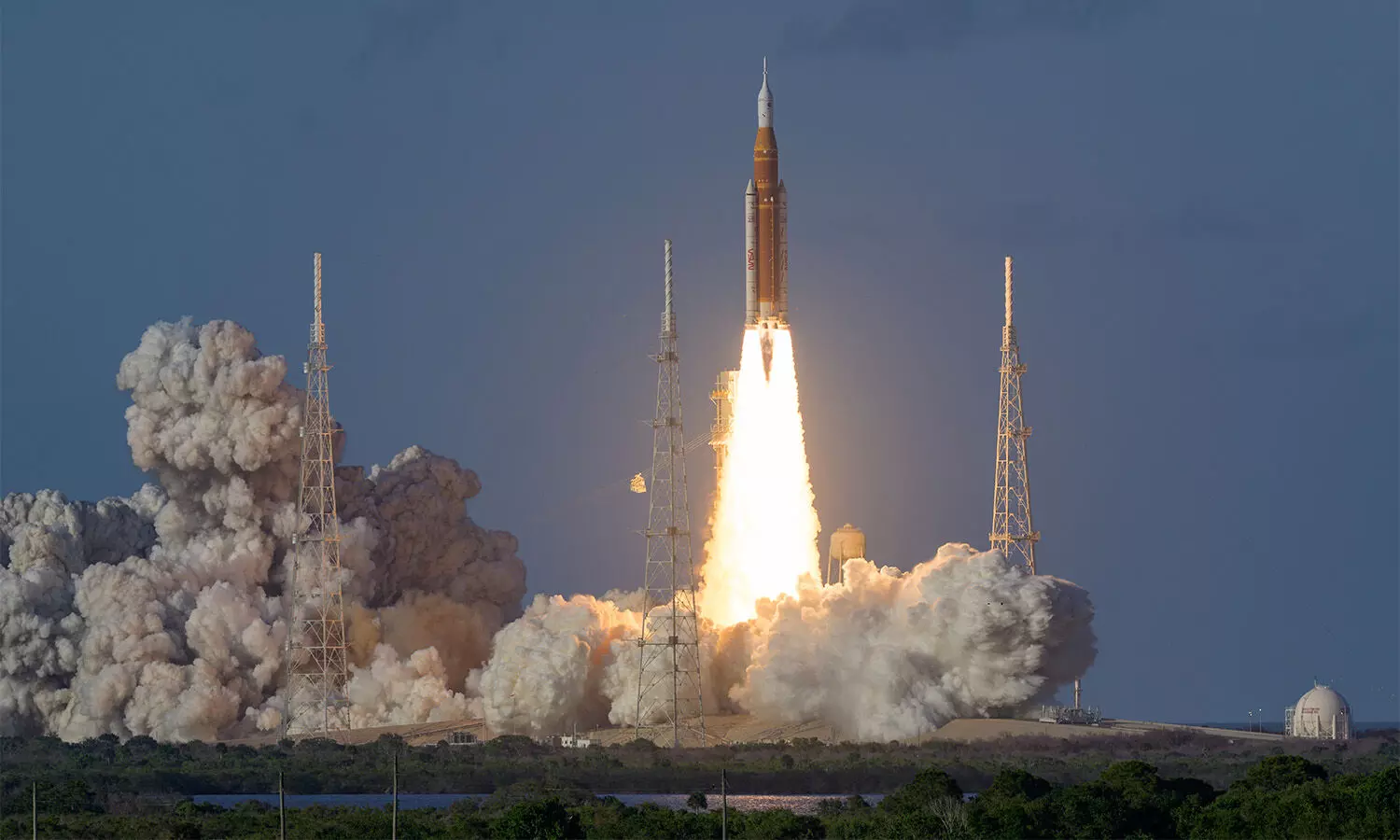
Artemis II Launch, Source: NASA/Bill Ingalls
When NASA's Space Launch System (SLS) lifted off on April 1, 2026, carrying four astronauts to return to the Moon for the first time in more than 50 years, the backbone of that rocket was a Boeing product. The company's role in Artemis II is not incidental. It is structural, in the most literal sense of the word.
Boeing designs, develops, tests, and produces the core stage, upper stages, and avionics for the SLS. That single sentence covers an enormous scope of engineering and logistics work spanning years, multiple states, and one of the most complex manufacturing pipelines in the American aerospace industry.
The aluminium 2219 alloy core stage supports the thrust from the engines beneath, the tug of the boosters, and the weight of the Orion spacecraft and other payloads. It is 212 feet (64.6 metres) tall, 188,000 pounds (85,300 Kilogrammes) empty and 2.3 million pounds (1 million Kilogrammes) fully fuelled. Designed by Boeing engineers in Alabama, built in Louisiana and tested in Mississippi.
NASA’s Artemis II Orion spacecraft to the Final Assembly and System Testing (FAST) cell, Source: NASA/Glenn Benson
Inside that structure are two enormous tanks that Boeing built and integrated. The liquid hydrogen tank makes up two-thirds of the core stage. It weighs 150,000 pounds (68,000 kilograms) and has a capacity of 537,000 gallons (2 million litres) of liquid hydrogen, cooled to minus 423 degrees Fahrenheit (minus 253 degrees Celsius). The liquid oxygen tank holds 196,000 gallons (742,000 litres) of liquid oxygen cooled to minus 297 degrees Fahrenheit (minus 183.8 degrees Celsius).
At the base of the core stage is the engine section. The engine section attaches the four RS-25 engines, which, with two solid rocket boosters, produce a combined thrust of 8.8 million pounds (4 million Kilogrammes) at liftoff.
Boeing's contribution goes beyond metal and propellant tanks. The avionics are aerospace electronics, including flight computers, power distribution, cameras, and gyros in the SLS core stage. They process data and issue commands to guide the rocket's trajectory while communicating with Orion and ground control teams.
Sitting atop the core stage, the forward skirt carries additional intelligence. The forward skirt is the brain of the SLS, ensuring the rocket reaches its destination. It houses flight computers, cameras, and avionics. Together with the liquid oxygen tank and intertank, it forms the top half of the core stage.
The manufacturing of the Artemis II core stage took place at NASA's Michoud Assembly Facility in New Orleans, Louisiana. Boeing successfully rolled out the second Space Launch System Core Stage 2 to NASA on July 16, 2024, a major milestone in the agency's Artemis campaign to return astronauts to the moon. On July 23, Core Stage 2 was delivered to NASA's Kennedy Space Center in Cape Canaveral. It was transported to the Vehicle Assembly Building on July 24, where it was integrated with the upper stage, boosters, and NASA's Orion spacecraft.
That delivery journey followed a precedent set during Artemis I. For the first flight, after Green Run testing at Stennis Space Center in Mississippi, the stage travelled 900 miles (1,400 kilometres) on the NASA Pegasus barge, then was offloaded and rolled into the Vehicle Assembly Building, where it was stacked on its mobile launcher between two solid rocket boosters.
On October 20, 2025, all components of the SLS were assembled in the Vehicle Assembly Building through a series of lifts. These components included the solid rocket boosters, the core stage, the Launch Vehicle Stage Adapter, the Interim Cryogenic Propulsion Stage, the Orion Stage Adapter, the Orion spacecraft, and its Launch Abort System.
Then came the rollout. Boeing and other industry partners helped NASA carry out additional tests of the Artemis II system inside the Vehicle Assembly Building and rehearse launch and mission procedures. During two rollouts, NASA moved the entire rocket through the VAB's 456-foot (139-metre) doorway on a 6.6 million-pound (3 million-kilogramme) crawler-transporter for a nearly 11-hour, 4-mile (6.4-kilometre) journey to Launch Pad 39B to complete its final prelaunch checks.
NASA’s Space Launch System (SLS) rocket and Orion spacecraft, secured to the mobile launcher, Source: NASA/Aubrey Gemignani
Before the crew boarded, two wet dress rehearsals were conducted. The SLS rocket conducted an initial wet dress rehearsal on February 3, followed by a successful wet dress rehearsal on February 19. During these operations, teams loaded, managed, and drained cryogenic propellants in the rocket's core and upper stages and practised a launch countdown.
Boeing's scope also includes the upper stage hardware that places Orion on its lunar trajectory. Built by United Launch Alliance and Boeing for the SLS Block 1, the Interim Cryogenic Propulsion Stage delivers 59,500 pounds (27 tonnes) to the moon and propels the Orion spacecraft on the Artemis II mission.
Boeing people and products have powered giant leaps in human space exploration for over six decades. Now, with NASA's Artemis campaign, the SLS rocket, powered by a Boeing-built core stage, will help return humanity to the moon and enable sustainable exploration of its surface like never before. NASA's SLS is the only proven deep-space optimised, super-heavy lift rocket designed to carry astronauts and cargo to the moon in a single launch.
The Artemis II mission, carrying Commander Reid Wiseman, Pilot Victor Glover, and Mission Specialists Christina Koch and Jeremy Hansen, is not just a milestone for NASA. It is the culmination of Boeing's longest and most complex deep-space manufacturing commitment in the post-Apollo era.

"I bring stories to life from the heart of the air cargo, logistics, and aviation supply chain industries. As a News Correspondent at Stat Publishing Group, my focus is on delivering in-depth coverage, industry trends, and expert insights that drive conversations and shape perspectives. With a background in visual communication, photography, and content creation and storytelling, ensuring every report provides value to industry professionals.


