


When cargo becomes a weapon: The dangerous goods challenge
Undeclared dangerous goods are exposing critical gaps in air cargo safety, raising questions about screening technology, regulatory compliance, and the industry's ability to detect hidden threats before they reach aircraft.
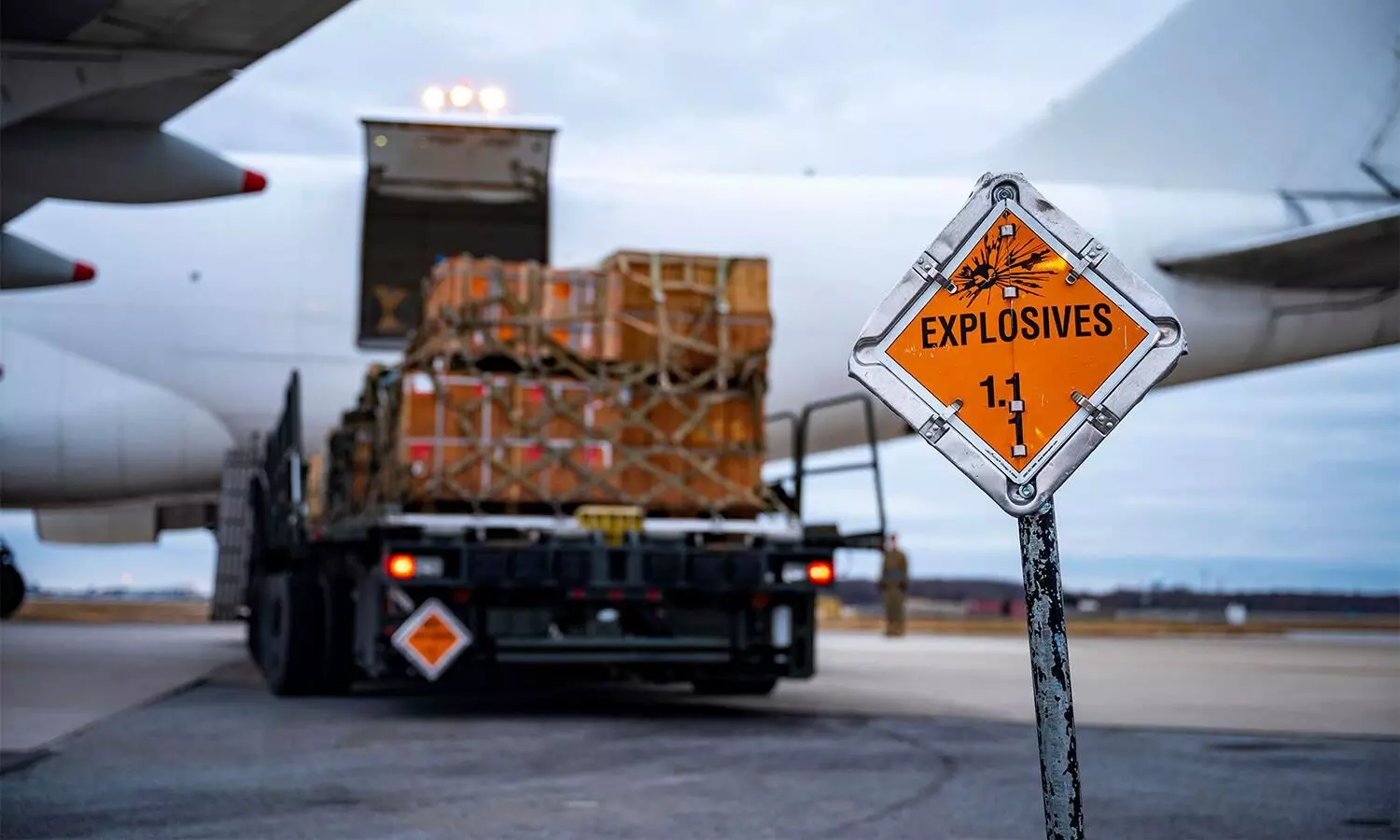
An explosives warning sign marks a security cordon around a commercial aircraft at Dover Air Force Base, Delaware, on January 13, 2023
In 2024, The Wall Street Journal reported that Russia was behind the shipment of two incendiary devices to DHL logistics centres in Germany and the United Kingdom, part of a broader sabotage campaign aimed at sparking fires aboard aircraft bound for North America. One package exploded at DHL’s Leipzig facility just before its scheduled departure, while another ignited at the Birmingham distribution centre. Together, these incidents underscore how dangerous goods can be weaponised, exposing vulnerabilities in air cargo safety amid rising geopolitical tensions.
After authorities in Europe and the UK launched a joint investigation in 2024 following incidents involving self-igniting parcels that detonated in Germany, Poland and at a DHL depot in the UK, investigators reported that 22 suspects had been identified in Lithuania and Poland, allegedly acting on behalf of Russia's military intelligence service.
The incident raises a broader question: to what extent geopolitical tensions influence cargo movements, not just route diversions but also the nature of goods being transported. The transportation of dangerous goods remains a sensitive issue that cannot be overlooked, particularly as the potential weaponisation of such materials emerges as a growing concern amid increasing geopolitical instability worldwide.
According to a white paper published by the International Air Transport Association (IATA), undeclared dangerous goods accounted for over 81% of all incidents reported to the association within the 6-month referenced period of 1 January – 30 June 2025, representing 2,798 cases. Other reported incidents included incorrect, missing, or illegible labels and markings (7%); damage without release of contents (5%); misdeclared goods (4%); inadequate or incorrect packaging (2%); and spillage or leakage resulting in a release (1%).
Dangerous goods (DGs) are divided into nine principal classes applicable across all modes of transport, including air cargo. These classifications cover more than 3,500 substances and articles, ranging from explosives and lithium batteries (including power banks) to flammable liquids and gases, corrosive substances, and radioactive materials. Although such goods are regularly transported by air, their carriage is subject to stringent international safety requirements and regulatory frameworks. These include International Civil Aviation Organisation (ICAO) Annex 18, the ICAO Technical Instructions (Doc 9284), International Air Transport Association (IATA) Operational Safety Audit (IOSA) Standards, and the IATA Dangerous Goods Regulations (DGR).
Despite the existence of regulations, where does the responsibility lie? According to ANA Cargo, “When arranging shipments, shippers or forwarders must identify any hazards in compliance with the IATA DGR and relevant laws and regulations. It is the responsibility of the shipper or forwarder to make appropriate declarations in accordance with the IATA DGR and applicable legal requirements before booking the cargo.”
The shipper bears primary responsibility for accurately identifying and declaring dangerous goods. Accordingly, the most effective stage for detecting and verifying such items is during the initial booking and acceptance process, involving both the shipper and the freight forwarder. However, there are multiple cases when shipments are labelled as ‘undeclared dangerous goods,’ such as an IATA-cited 2025 incident at a cargo terminal in East Asia, where a shipment declared on the air waybill as “mobile phone accessories” was found, upon inspection, to contain damaged lithium batteries that had not been declared.
Fitsum Abadi Gebrehawaria, Managing Director of Cargo, Kenya Airways, said, “When documentation does not clearly identify hazardous contents, detection relies heavily on trained personnel, known commodity risk indicators, shipper validation processes, and robust acceptance procedures. Security screening alone cannot always identify the nature or hazard class of concealed materials.”
“When documentation does not clearly identify hazardous contents, detection relies heavily on trained personnel, known commodity risk indicators, shipper validation processes, and robust acceptance procedures.”Fitsum Abadi Gebrehawaria, Kenya Airways
These risks have been further exacerbated by the rapid expansion of e-commerce, the growing incorporation of lithium batteries into consumer products, increasingly intricate global supply chains, and the emergence of improvised incendiary devices targeting air cargo operations.
Paul Horner, Managing Director of Dangerous Goods Safety Group (UK), said the primary concern in the air cargo supply chain is not the deliberate misuse of dangerous goods themselves, but intentional misdeclaration or wilful non-compliance with established dangerous goods regulations.
Addressing this issue he said it is exceptionally challenging, particularly given the involvement of organised criminal networks within certain e-commerce reseller operations. Shippers may deliberately employ multiple intermediaries to obscure the origins and movement of consignments, creating opaque supply chains that are difficult for regulators to monitor and control. Such activities are often conducted on an industrial scale, further complicating regulatory oversight and enforcement.
While addressing the biggest gaps in preventing thermal runaway during air transport, particularly when batteries are damaged, defective, or improperly declared, Horner added that “The quantity per package is limited, the quality of the package is mandated, personnel preparing the package are trained, and the airline knows what they are accepting, where it is loaded, and what to do in case of an emergency. When an airline receives undeclared dangerous goods, including lithium batteries, the quantity tends to exceed permitted limits, the quality of the packaging may be poor, and the contents are unknown. It is very challenging to deal with an in-flight emergency involving undeclared dangerous goods, as the airline does not know what they are dealing with.”
While stringent regulations govern the movement of dangerous goods, the risks associated with improper handling remain significant, potentially resulting in costly accidents, cargo operation delays, and reduced operational reliability. In this context, how can efficient technology help bridge the gap between regulatory compliance and safe, seamless cargo operations?
Both ICAO and IATA emphasise that effective dangerous goods detection requires a layered defence that includes accurate shipper declarations and documentation, trained and certified dangerous goods personnel, acceptance and compliance checks, risk-based cargo assessments, physical inspections when necessary, and security screening technology.
The conventional screening technologies, such as X-ray and explosive detection systems, are valuable risk-management tools but cannot reliably identify every undeclared dangerous good or determine its regulatory classification. “The most effective safeguard against undeclared dangerous goods is therefore not a single technology, but an integrated compliance framework supported by competent personnel and rigorous operational controls,” said Abadi.
“Why are we waiting for an accident? Regulators are already aware of the scale of the problem globally, yet very little is done to tackle it. It is almost like we are waiting for a catastrophe to happen.”Paul Horner, Dangerous Goods Safety Group (UK)
Similarly, Horner acknowledged the need to advance existing screening technologies to improve their ability to detect dangerous goods. He said, “Given the volume of items classified as dangerous goods available on some e-commerce platforms offering global shipping from China for free, I would argue that the current screening system is wholly ineffective in identifying hidden dangerous goods, including lithium batteries.”
Horner also addressed the industry's preparedness to investigate dangerous goods incidents suspected to involve deliberate interference rather than accidental causes, questioning whether adequate mechanisms are in place to investigate such cases and share intelligence across borders.
“I think this is the key question. If we had an accident involving dangerous goods that were found to be deliberately misdeclared or undeclared, strong action would be taken across multiple agencies and multiple borders. Why are we waiting for an accident? Regulators are already aware of the scale of the problem globally, yet very little is done to tackle it. It is almost like we are waiting for a catastrophe to happen,” he said.
The real test for air cargo is no longer just moving dangerous goods safely, but spotting what is deliberately hidden. As threats evolve, stronger accountability, smarter technology, and cross-border cooperation will be crucial to keeping cargo and aircraft out of harm's way.

Shefali is a correspondent with over six years of experience in the media industry. She has worked with leading news platforms, including BW Businessworld and India Today, before joining the Taiwan-based EAT News portal, where she covered diverse beats in geopolitics and international relations alongside human interest stories. Six of her stories were put forward for nomination at the SOPA Awards 2022 across categories such as human rights, women's issues, environmental reporting, and the Scoop Award. Outside of work, she enjoys dancing, travelling, and balancing fitness with food.


