
UPS reports $21.2 billion revenue in Q1 2026, reaffirms outlook
US domestic volumes declined, while international growth and higher yield per piece supported margins and cash flow
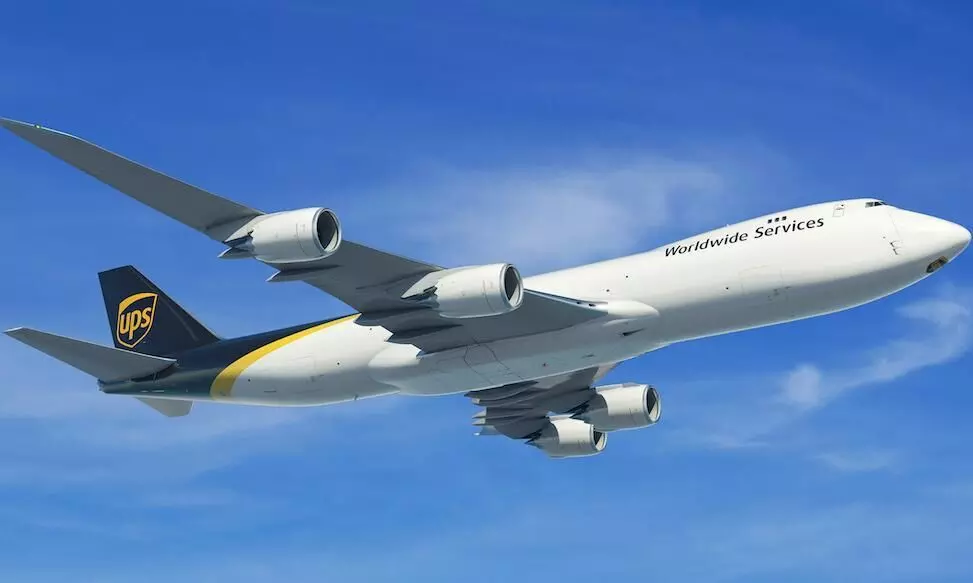
United Parcel Service reported a decline in its first-quarter 2026 financial performance, with consolidated revenue at $21.2 billion, down from $21.5 billion in the same period last year. Non-GAAP adjusted operating profit fell to $1.32 billion from $1.76 billion, while operating margin declined to 6.2% from 8.2%. Non-GAAP adjusted diluted earnings per share stood at $1.07, compared with $1.49 in the first quarter of 2025.
The company said the first quarter of 2026 marked a critical transition period. During the quarter, UPS reduced Amazon volume by around 500,000 average daily volume and closed 23 buildings. It launched its voluntary Driver Choice Programme and said it is on track to achieve its $3 billion cost reduction target. The company also capitalised on trade lane shifts resulting from 2025 trade policy changes, transitioned a portion of its Ground Saver volume to the United States Postal Service for last-mile delivery, and scaled back leased aircraft while replacing retired MD-11 capacity with new aircraft deliveries.
UPS stated that its underlying business performed better than expected during the quarter. Chief Executive Officer Carol B. Tomé said the company’s results were better than its financial plan and targets, although first-quarter performance deviated from seasonal norms due to certain cost pressures. She noted that these pressures are largely behind the company and it expects to return to consolidated revenue and operating profit growth and expand operating margin in the second quarter.
In the US domestic segment, revenue declined to $14.1 billion from $14.46 billion year-on-year. Non-GAAP adjusted operating profit fell to $565 million from $1.01 billion, while operating margin dropped to 4.0% from 7.0%. Total non-GAAP adjusted operating expenses were nearly flat year-on-year. UPS said higher productivity and progress on reducing Amazon-related volume partially offset short-term cost pressures of $350 million. These included temporary third-party lease expenses to cover retired MD-11 capacity, transition costs and excess operational staffing related to Ground Saver, as well as costs from inclement weather and increased casualty expenses. Non-GAAP adjusted cost per piece increased by 9.5%, and operating margin included a 250 basis point negative impact from these short-term pressures. The company said these cost pressures are largely behind it as it moves into the final months of executing its Amazon volume reduction and network reconfiguration initiatives.
Average daily volume in the US domestic segment declined by 8% year-on-year. However, small and medium-sized business (SMB) volume grew, accounting for 34.5% of total US volume, marking the highest SMB penetration in the company’s history. UPS said its strategic actions drove SMB average daily volume growth and improved product and customer mix over several consecutive quarters.
Revenue per piece increased by 6.5% year-on-year. The company said base rates and package characteristics contributed 340 basis points to this growth, while improvements in customer and product mix added 200 basis points. The remaining 110 basis points increase was due to changes in fuel prices. Overall US domestic revenue declined by 2.3% year-on-year, as strong revenue per piece growth largely offset lower shipment volumes.
In the international segment, UPS reported revenue of $4.54 billion, up from $4.37 billion in the previous year, reflecting growth of 3.8%. The company said revenue increased across all regions, driven by strong revenue quality and a focus on premium markets. However, non-GAAP adjusted operating profit declined to $551 million from $654 million, primarily due to trade policy changes. Operating margin stood at 12.1 %, down from 15%. The company noted slight improvements in volume trends outside the United States, despite declines in US inbound lanes.
The Supply Chain Solutions segment reported revenue of $2.54 billion, down from $2.71 billion year-on-year. Non-GAAP adjusted operating profit increased to $206 million from $98 million, while operating margin improved to 8.1% from 3.6%. UPS said logistics revenue declined due to Mail Innovations, partially offset by growth in healthcare logistics. Air and ocean forwarding revenue also declined in line with market conditions. However, UPS Digital, which includes Roadie and Happy Returns, recorded revenue growth of 19.9% year-on-year.
UPS highlighted that it is prioritising premium volume as part of a global strategy. This includes speeding up its European ground network to capture premium commercial volume, expanding its Incheon Airport hub in South Korea, and opening its largest and most advanced logistics centre in Taiwan. The company is also accelerating services across Asia Pacific and between Asia Pacific and Europe, while enabling global supply chains in sectors such as manufacturing, high technology and healthcare. UPS said its global healthcare portfolio has gained market share every year since 2021 and generated its first $3 billion revenue quarter in the first quarter of 2026, with all three segments delivering year-on-year revenue growth.
The company said it remains focused on improving productivity and ensuring the right mix of volume moves through its network, supported by capabilities such as RFID, cold chain solutions, Roadie, Happy Returns and Delivery After Purchase (DAP).
UPS reported progress on its cost-saving initiatives, stating that total operational hours declined in line with volume. By the end of the quarter, the company had reduced operational positions by nearly 25,000 year-on-year. It also initiated the Driver Choice Programme, which is expected to reduce full-time driver positions by around 7,500 over time. In addition to the 23 buildings closed in the first quarter, UPS plans to close a further 27 buildings during the year.
The company said it achieved approximately $600 million in cost savings from its transformation initiatives in the first three months of 2026 and expects to achieve around $3 billion in full-year savings. These initiatives include Network Reconfiguration and Efficiency Reimagined programmes, aimed at improving automation, consolidating operations and redesigning processes across its network. UPS expects these programmes to continue through 2027 and anticipates excluding between $1.3 billion and $1.5 billion in related costs during 2026, primarily linked to employee separation benefits and third-party consulting fees, including $1.2 billion associated with the Driver Choice Programme.
Looking ahead, UPS reaffirmed its full-year 2026 consolidated guidance, projecting revenue of approximately $89.7 billion and a non-GAAP adjusted operating margin of around 9.6%. The company expects revenue growth in the low single digits year-on-year across segments, with US domestic operating margin projected at 7.5 to 8.5%, international operating margin at 13 to 14%, and supply chain solutions operating margin at 9.5 to 10.5%.
UPS also outlined additional financial expectations for 2026, including pension contributions of $1.3 billion, capital expenditure of around $3 billion, free cash flow of approximately $5.5 billion including the Driver Choice Programme, and dividends of about $5.4 billion subject to board approval. Non-GAAP adjusted diluted earnings per share are expected to remain flat year-on-year.