
Smart cargo, bold moves: How China is reshaping air freight
From Shanghai to Ezhou, China's airports are using technology, data and automation to build smarter cargo networks, changing how freight moves and how airports compete worldwide.
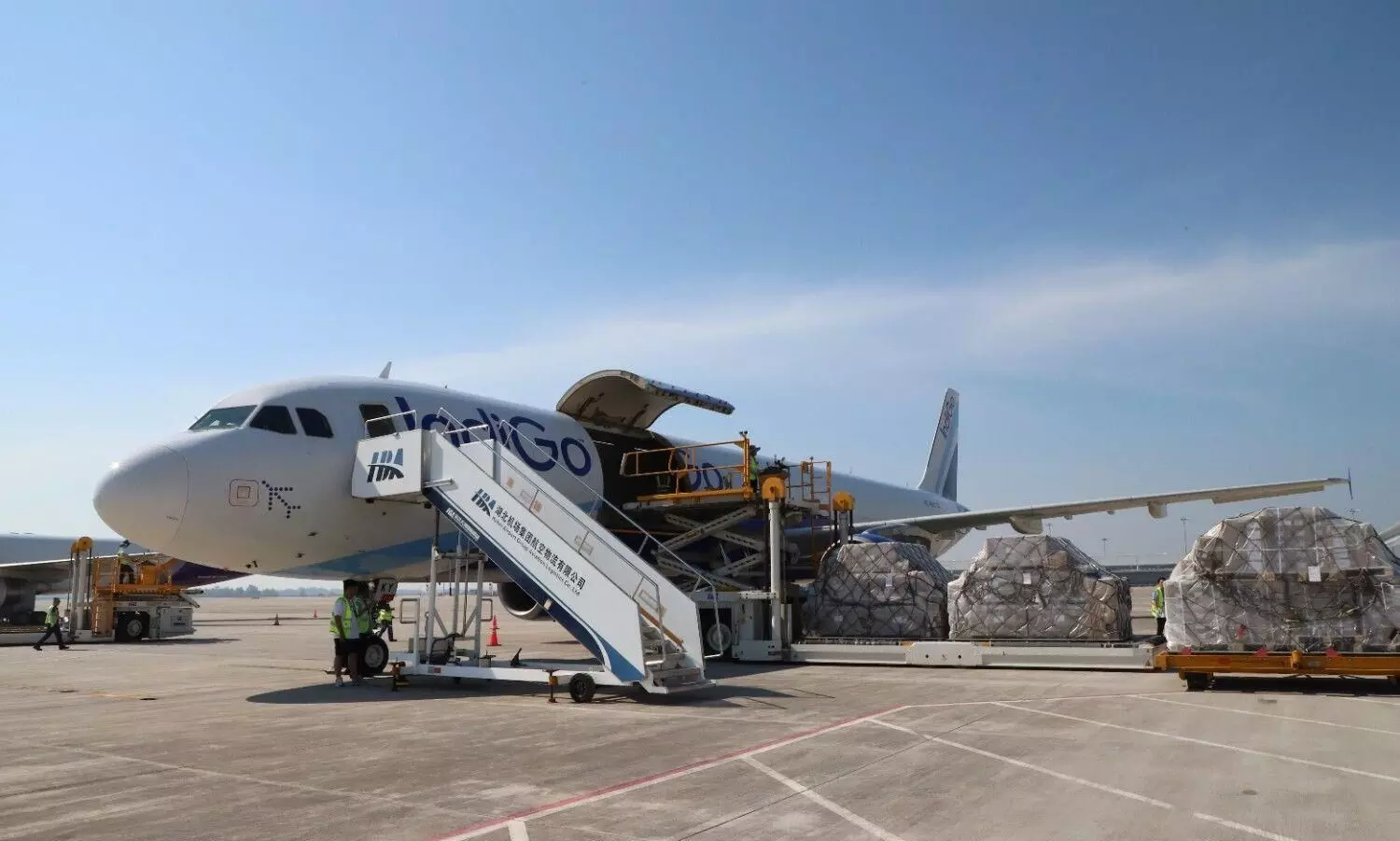
IndiGo CarGo A321P2F freighter being loaded at Ezhou Huahu International Airport
For years, China's air cargo story was largely about size. The country built some of the world's busiest airports, expanded manufacturing at an extraordinary pace and became the source of an enormous share of global exports. Cargo volumes grew, freighter fleets expanded and international airlines rushed to secure a presence in the market.
But size alone is no longer the story.
A quieter transformation is taking place behind the scenes. Across China, airports are investing in digital cargo ecosystems, automation, smart customs systems and integrated logistics platforms that are changing how freight moves through the country. The result is an air cargo network that is becoming faster, more transparent and increasingly data-driven.
This shift is significant because it comes at a time when global supply chains are undergoing profound change. E-commerce is reshaping freight flows. Manufacturers are diversifying production networks. Geopolitical tensions continue to influence trade routes. Meanwhile, customers are demanding greater visibility, predictability and speed.
Against this backdrop, China is attempting something much larger than simply moving more freight. It is trying to build a smarter cargo system — and that raises an important question. As airports across the country modernise operations and compete for cargo traffic, is China creating a new model for air cargo development, one that other markets may eventually follow?
Beyond runways and warehouses
Not long ago, airports competed largely on physical assets. More runway capacity, bigger terminals and larger warehouses were often enough to attract airlines and freight forwarders. Today, those factors still matter, but they are no longer enough.
A shipment moving from a factory in inland China to a customer in Europe or North America passes through multiple organisations — airlines, freight forwarders, customs authorities, ground handlers, trucking companies and cargo terminals. The challenge is not simply moving the cargo; it is ensuring that information moves just as efficiently.
That is where digitalisation enters the picture.
Brendan Sullivan, Global Head of Cargo at International Air Transport Association, believes Chinese airports have become leaders in applying technology to cargo operations. "Chinese airports are at the forefront of how digitalisation and technology can be employed to enhance workflows and boost handling capacity," he says.
He points to Shanghai Pudong's Smart Hub project, launched in late 2025, which combines AI forecasting, automated sorting systems and end-to-end visibility tools. Similar investments are being made at Guangzhou, Shenzhen and Ezhou, where automated guided vehicles, autonomous mobile robots and automated weighing systems are becoming part of daily operations. China's customs authorities have also introduced integrated clearance systems and smart customs services designed to reduce delays and improve predictability.
China is seeing booming cross-border e-commerce, accounting for about 50% of the global total and sustaining double-digit annual growth, serving as a major supplier of high-value and time-sensitive air cargo
Brendan Sullivan, IATA
The changes may appear technical, but they have a direct impact on supply chains. When a shipment spends fewer hours waiting for clearance, products reach customers faster. When cargo data is available in real time, companies make decisions more quickly. When handling becomes more automated, airports process larger volumes without bottlenecks. In an industry where every hour matters, those improvements create a competitive advantage.
The rise of the smart cargo airport
The phrase "smart cargo airport" is widely used, but what does it actually mean?
According to Yngve Ruud, Executive Vice President Air Logistics at Kuehne+Nagel, it is not simply about technology. "A truly smart cargo airport is not defined by its size or network reach, but by how seamlessly it integrates data, processes and partners to enable reliable, transparent cargo flows," he says.
Many airports around the world have invested heavily in infrastructure. Fewer have managed to connect airlines, customs authorities, handlers, freight forwarders and shippers into a single operational ecosystem. For forwarders such as Kuehne+Nagel, the real value comes from visibility — data shared between stakeholders allows problems to be identified earlier, delays can be addressed before becoming major disruptions, and customers receive better information to adjust their supply chains.
Dimerco is seeing the same trend. Kathy Liu, Vice President, Global Sales & Marketing at Dimerco Express Group, says shippers are increasingly choosing airports based on digital ecosystems rather than physical scale. "Shippers no longer just look at who has the most runway space. Instead, they choose hubs that offer a smooth, digital experience, from fast customs clearance to real-time tracking," she says.
Shippers no longer just look at who has the most runway space. Instead, they choose hubs that offer a smooth, digital experience—from fast customs clearance to real-time tracking
Kathy Liu, Dimerco
That shift is particularly visible among companies shipping electronics, semiconductors and AI hardware — valuable, time-sensitive products moving through highly complex supply chains. A delay of several hours can disrupt manufacturing schedules, product launches or customer deliveries. As Liu puts it, "The airport was no longer chosen by default. It was chosen by data."
Hong Kong and the Greater Bay Area challenge
No discussion of China's air cargo landscape is complete without considering Hong Kong. For decades, Hong Kong International Airport has been one of the world's most important cargo gateways. Yet it now operates in a region where neighbouring mainland airports are investing aggressively in technology, infrastructure and logistics.
Rather than viewing this as zero-sum competition, Cathay Cargo sees the region as an integrated ecosystem. "We see Hong Kong and the wider Greater Bay Area as one integrated cargo ecosystem," the airline says. Its strength lies not only in its own facilities but in its ability to connect with the manufacturing centres and logistics networks spread across southern China.
To support that approach, Cathay Cargo has developed multiple connectivity models linking Hong Kong International Airport with the wider Greater Bay Area, including air-to-air services, cross-border trucking networks and bonded sea-air solutions through its logistics facilities in Dongguan. The company has also introduced its Air-Land Fresh Lane service, allowing perishables such as seafood, fruit and chilled products to move directly into the Greater Bay Area under a single air waybill, combining temperature-controlled trucking with simplified documentation.
At the same time, Cathay Cargo recently increased its commitment to the Airbus A350F programme to eight aircraft, strengthening Hong Kong's cargo connectivity while supporting long-term regional growth.
Competition is no longer simply airport versus airport. Increasingly, it is ecosystem versus ecosystem.
Data becomes the new currency of air cargo
For decades, air cargo was a business where information travelled slower than freight. A shipment could pass through multiple stakeholders, each maintaining separate systems, while information became fragmented along the way. China's air cargo industry is now changing that.
Sullivan says the country has already built a strong foundation. "China's air cargo sector has laid a firm foundation that allows the industry to advance fully to an integrated and paperless cargo ecosystem." He notes that electronic air waybill adoption has surpassed 80%, while ONE Record pilot programmes are already operating at 12 Chinese airports. Airlines including Cathay Cargo and China Southern Air Logistics have begun implementing the data-sharing standard across parts of their networks.
The goal extends far beyond reducing paperwork. Anindam Choudhury, Vice President of TAM Group, says digital integration has moved beyond being an operational upgrade. "Digital integration has shifted from an IT objective to an absolute baseline for commercial survival." Airlines, he argues, increasingly require real-time visibility across capacity, pricing and shipment performance to stay competitive.
Cathay Cargo is among those embracing that shift. "A key example is our adoption of IATA ONE Record standards, which support secure, real-time data exchange across the supply chain," the airline says, adding that greater transparency allows customers to track time-sensitive shipments more effectively, while digital booking platforms and intelligent cargo planning systems are improving coordination and reducing planning times.
Jean Ceccaldi, Chief Executive Officer of ECS Group, says airlines now expect digital integration as a basic requirement when operating in China. "Airlines now come to us with a very clear message. In China, they expect a real digital roadmap, not just a line in a strategy document." They are demanding continuous data flows, unified tracking dashboards and performance reporting across multiple Chinese gateways. "Visibility is no longer a nice-to-have that sits on top of the product. It is at the core of the sales story."
Despite massive investments at many Chinese airports, airlines still feel the impact of customs processes on predictability and dwell times
Jean Ceccaldi, ECS Group
Cargo terminal operators see the same shift. PACTL says customers now expect more than speed: "In today's air cargo industry, efficiency alone is no longer enough. Customers increasingly expect transparency, predictability and real-time responsiveness." Information quality is becoming just as important as physical handling capability in China's emerging smart cargo ecosystem; visibility itself is becoming part of the product being sold.
Reliability is replacing size
As digital capabilities improve, they are changing how cargo moves through China. Historically, the country's largest airports attracted the majority of freight through extensive airline networks, strong infrastructure and frequent connections. Today, cargo customers are more selective. The question is no longer which airport is the largest, but which airport can deliver the most reliable outcome.
Kuehne+Nagel's Ruud says customers are "becoming increasingly selective in their choice of Chinese cargo airports," with reliability and digital maturity becoming major decision factors. "Digital maturity is also a key factor, as customers value real-time visibility and faster exception management, often outweighing marginal cost differences." A slightly cheaper route may no longer be attractive if it introduces uncertainty.
Looking ahead, we expect continued acceleration in digitalisation and automation, with greater emphasis on data standardisation and ecosystem-wide integration
Yngve Ruud, Kuehne+Nagel
The same trend is influencing airlines. Lufthansa Cargo, which has operated major China-Europe cargo corridors for many years, says airports are becoming attractive not simply because of their size but because of the quality of their logistics ecosystems. Anand Kulkarni, Head of Global Markets at Lufthansa Cargo, points to efficient customs processes, specialised handling facilities, strong intermodal connections and digital integration as decisive factors. "Round-the-clock services combined with strong digital integration help minimise ground times and support efficient handling of transit cargo," he says. The result is a market where operational performance increasingly determines competitiveness.
E-commerce is redrawing China's cargo map
While digitalisation is changing how cargo moves, e-commerce is changing where it moves.
According to IATA, China now accounts for approximately half of global cross-border e-commerce activity and continues to generate double-digit annual growth. Those volumes are reshaping airport operations throughout the country.
Traditional cargo flows were often planned weeks in advance with predictable shipment patterns. E-commerce behaves differently: orders arrive continuously, volumes fluctuate rapidly and customer expectations are measured in hours rather than days. PACTL says cross-border e-commerce has fundamentally altered the operational rhythm of cargo handling. "Compared with traditional freight, e-commerce shipments are characterised by shorter lead times, higher shipment frequency, and much greater volatility during peak periods."
For cargo terminals, this creates new demands. Success is no longer defined simply by how much freight can be processed, but by how quickly facilities can respond to constantly changing shipment flows. To meet those requirements, PACTL established a dedicated Cross-border E-commerce Cargo Handling Centre and continues investing in specialised infrastructure, screening technologies and digital tools, moving away from a planned-flow operation towards a real-time response model.
Cathay Cargo notes that Southeast Asia is becoming increasingly important within the e-commerce landscape as manufacturing activity expands across the region, responding by strengthening freighter connectivity and adding cargo capacity into markets such as Bangkok. For airlines, flexibility is becoming essential; capacity must move wherever demand emerges.
The rise of China's secondary cargo hubs
One of the most interesting consequences of e-commerce growth is the emergence of secondary cargo airports.
For many years, international air cargo activity was concentrated around a small group of major gateways: Shanghai, Guangzhou, Shenzhen, Beijing and Hong Kong. Those airports remain dominant. However, growth is increasingly occurring elsewhere.
According to analysis from Rotate, an air cargo strategy consulting firm, secondary Chinese airports have been growing faster than the country's traditional cargo giants. While primary hubs recorded approximately 17% growth in cargo capacity over the past year, secondary airports achieved around 26%. Maria Faro, Strategy Consultant at Rotate, says several secondary airports have recorded exceptionally strong growth in freighter activity and cargo capacity, with Zhengzhou, Ezhou, Chengdu, Urumqi and Hangzhou among the most notable. Each serves a distinct role: Zhengzhou has strengthened its position as a major e-commerce gateway; Ezhou continues to expand around SF Express; Hangzhou has emerged as one of China's most important cross-border e-commerce centres; and Chengdu's dual-airport system is developing into a major inland cargo platform.
The trend reflects broader changes within China's economy and logistics sector. Cargo no longer needs to pass through a handful of coastal gateways before entering international markets. As airport infrastructure improves and digital systems become more sophisticated, airlines can connect directly with manufacturing centres and consumer markets across the country.
Dimerco's Liu notes that inland hubs such as Zhengzhou, Chengdu and Wuhan are becoming increasingly important because of their links to major manufacturing clusters, reducing transportation complexity and shortening transit times. TAM Group's Choudhury adds that airports such as Hangzhou and Chengdu are benefiting from strong e-commerce growth, extensive logistics connectivity and supportive government policies. As more international airlines launch services into secondary cities, global cargo networks become more distributed and resilient.
Why freighters remain central to China's cargo future
The rise of e-commerce and secondary cargo hubs is also influencing aircraft fleets. For years, many observers expected passenger aircraft belly capacity to absorb much of future cargo growth. Instead, dedicated freighters continue to play an increasingly important role.
EFW, one of the world's leading passenger-to-freighter conversion specialists, sees strong demand throughout the Chinese market. "With the strong growth of the cargo segment in China, demand for passenger-to-freighter conversions is also increasing," the company says, expecting both medium-sized and smaller regional freighters to play important roles as networks diversify. E-commerce and express logistics, it notes, are likely to grow faster than traditional industrial freight, creating sustained demand for dedicated cargo aircraft.
Airlines are responding accordingly. Lufthansa Cargo continues to see strong demand on China-Europe corridors, particularly for high-value cargo including semiconductors, advanced technology products and e-commerce shipments.
Taken together, these developments tell a larger story. China's cargo industry is no longer defined solely by infrastructure expansion. It is increasingly defined by intelligence, connectivity and operational performance. Data is influencing decisions. Reliability is shaping competition. E-commerce is creating new cargo flows. Secondary airports are gaining importance. Dedicated freighters are supporting increasingly specialised networks.
The result is a cargo landscape that looks very different from the one that existed a decade ago. China's smart cargo revolution may have started with technology, but its impact is now being felt across every part of the air freight ecosystem: from airport strategy and airline networks to shipper behaviour and global trade flows.