
Peak season, disrupted skies and a Central Asian long shot
The Middle East conflict is testing Central Asia’s potential as an alternative Asia–Europe cargo corridor, but capacity, cost and reliability remain key hurdles.
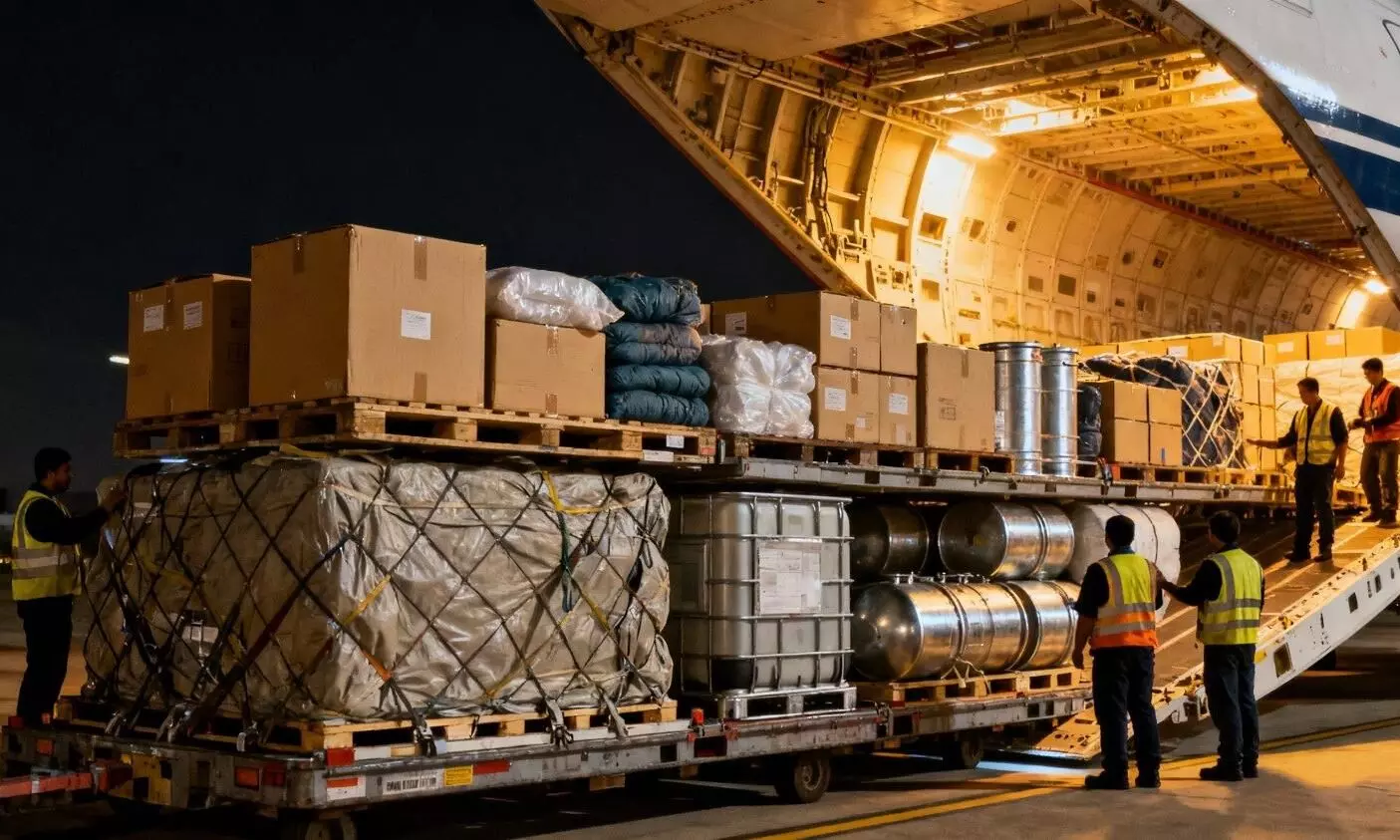
Picture a pallet of electronics in Zhengzhou, due in Europe before Christmas. In an ordinary year, the forwarder books it on the quickest route and moves on. This year, every route comes with a catch.
The air is expensive. Jet fuel costs more than double what it did a year ago, and the BAI00 global index is up 26.4%. The sea is slower, and still finding its way back to Suez. The Gulf hubs that once stitched Asia to Europe are running below full strength after months of war. And a handful of airports in Central Asia are telling anyone who will listen that they can be the way round.
Can they? That is the question hanging over this peak season, and it is harder to answer than the pitch suggests. The answer sits at the end of a chain: a peak that is strong but oddly shaped, a Middle East network that is repaired but not whole, and a corridor in Central Asia that has ambition and is still hunting for proof. Follow the pallet, and each link either tightens or snaps.
A peak with an odd shape
The first surprise is the peak itself. Neil Wilson, Editor at TAC Index, says the usual spike ahead of Thanksgiving in the US and Christmas in Europe has barely begun, and prices are already ahead of the last two seasons. “Overall rates, as per the BAI00 global index, are already above the previous two peak seasons,” says Wilson. A rush like that would normally mean demand is flooding everywhere. It is not.
The demand is real, but it is narrow. Yngve Ruud, EVP Air Logistics at Kuehne+Nagel, says this will not be the broad, consumer-led peak of earlier years. Cargo is coming from specific sectors: AI infrastructure, semiconductors, high-tech goods, pharmaceuticals and perishables. Those sectors have a map of their own. Data-centre hardware from Taiwan, Vietnam and Thailand is squeezing the transpacific, which is why Kuehne+Nagel runs 14 flights a week between Vietnam and the US. Dimerco’s November Asia Pacific Freight Report calls air from Taiwan to the US extremely tight and tells shippers to book one to two weeks ahead.
Europe tells the opposite story, and this is where the pallet’s trouble begins. Wilson says volumes on key Asia to Europe lanes, Hong Kong among them, have dropped by an estimated 30% since July. That is when the EU ended its old de minimis exemption for small parcels and brought in an interim flat-rate customs duty. E-commerce, which once filled Europe-bound decks, has thinned out.
Softer demand should mean cheaper space, and in places it does. Dimerco says China to Europe air rates fell 7% week on week because demand dropped faster than freighters were withdrawn. But airlines are fighting back. They have moved freighters to better-paying lanes and retired older, thirstier aircraft, which has kept the market tighter than weak demand alone would suggest. Pockets stay hot. Dimerco notes that mid-November bookings from East China to Europe are high, with consumer tech and fast fashion competing for the same decks. Then the 25 October winter schedule changed trimmed belly space just as Black Friday arrived.
Kathy Liu, VP, Global Sales and Marketing at Dimerco Express Group, says nobody should expect relief. “With no freighter capacity coming before year-end, rates will settle high rather than drop, and quiet lanes like Europe can turn fast once Christmas stocking and fuel kick in,” says Liu. Wilson adds a warning. Many shippers, e-commerce players among them, booked early. Some of the hyperscalers racing to build data centres reportedly have not, and they could push rates much higher by year-end.
So space is scarce and costly even where demand is soft. A pallet cannot simply ride the usual bridge out of Asia and hope for the best, because that bridge has been damaged.
The Gulf bridge is still being repaired
For years the Gulf has worked as an air cargo bridge. Hubs there connect Asia, Europe, Africa and the Americas, moving freight on freighters and in passenger bellies. When Gulf airspace shuts, the damage is not confined to cargo flying to or from the Middle East. It is felt on every lane that crosses the bridge.
Judah Levine, Head of Research at Freightos, dates the break to March, when the war began and the Strait of Hormuz closed. Rates jumped. They eased from April and May but never returned to the pre-war baseline. Freightos’s booking data dipped in the first quarter and recovered to growth by the third, with the big Gulf carriers hit hardest.
The scale was startling. Ruud says 18% of global aviation capacity was caught up in cancellations at the height of the disruption. “The conflict demonstrated how quickly capacity can disappear when airspace is restricted and major transit hubs are affected,” says Ruud. The repair is well advanced but not finished. Citing Rotate, he puts throughput at the main Middle Eastern hubs at 80 to 90% of pre-conflict levels, and regional carriers at 90 to 100% of their former capacity. Airports in Saudi Arabia have recently closed again, if only temporarily.
Nowhere is the strain clearer than in India, where a large share of export cargo used to route through Gulf hubs. TAC Index puts rates on lanes from India up 70 to 80% year on year. Lanes from Europe to the Middle East, including Amsterdam and London, are up around 100% or more. Stephanie Pöhn-Helbig, Head of Region Middle East, Africa, South Asia and CIS at Lufthansa Cargo, says longer routings are adding operational complexity and pulling cargo flows away from markets that relied on Middle Eastern connections. Demand from India, pharmaceuticals and time-critical general cargo included, stays strong. “In response, we have already deployed additional freighter capacity on selected routes, particularly from India, and further increased frequencies with the winter schedule,” says Pöhn-Helbig. Extra freighters from Egypt to Europe are planned for the perishables season.
The greatest vulnerability would be a renewed loss of airspace and hub capacity in the Middle East at the same time as peak-season capacity is already tightening elsewhere
Yngve Ruud, Kuehne+Nagel
Forwarders have drawn a hard lesson. Kuehne+Nagel now keeps a diversified carrier portfolio, secures space on key lanes and refuses to depend on a single transit hub, Ruud says. It has used air-road corridors to keep cargo moving when airports shut, and moved its sea-air hub from Dubai to Los Angeles. Its advice to customers turns on what a delay would cost them: commit space for predictable volumes, stay flexible for volatile ones, and pay for a direct connection when lateness costs more than the premium.
Which brings the pallet back to its problem. If the old bridge is not fully rebuilt, and no sensible forwarder wants to lean on a single bridge anyway, there must be another way across. A few names come up. One keeps coming up louder than the rest: Central Asia.
Central Asia’s surge has yet to show up
Central Asia has a natural story to tell. The region sits between China and Europe, and its airports have spent years trying to become more than refuelling stops. If cargo is fleeing Middle East airspace, this is where it should land.
Levine went looking for that surge in Freightos’s data. He did not find one. Freightos has only sporadic rate data for Central Asian hubs, and what it has moved in step with the wider market, driven mostly by fuel. Bookings from carriers in the region followed the pattern everyone else did: a fall from Gulf carriers and growth from the rest, with no spike. He stresses that Freightos sees only part of the market. What he does see is a trend that began before the war, as hubs invest in turning technical stopovers, where an aircraft lands to refuel while cargo stays aboard, into true east-west transhipment. “I think it’s probably going to be gradual just like it was before but it probably solidifies the argument,” says Levine. He speculates that the slump in Asia to Europe e-commerce may be shrinking the price for now. The rivals are not standing still either. Saudi Arabia is also investing to become an east-west hub, though the war has touched its airports directly.
The rail and multimodal world is just as cautious. Thomas Kowitzki, VP, Global Head of China Rail/Multimodal and ICC Europe at DHL Global Forwarding, says the Middle East disruption did push some customers towards rail and multimodal products such as DHL’s OceanExpress. It also raised requests for the Middle Corridor, where sanctions or Russian crossings blocked the route through Russia. An Electrolux block train of 50 containers made it from Turkey to China via Central Asia in 35 days. The corridor works, in other words. It does not yet work at scale. Kowitzki sees no significant shift from China to Europe, and says most of the movement went to OceanExpress and to rail via Russia. “There are still many obstacles to be solved before it leads to a significant increase of cargo volumes,” says Kowitzki. He points to uncertainty and a lack of capacity for predictable door-to-door times. Shippers hunting lower costs are looking at rail, or road and air via Almaty or Tashkent.
Time is also working against the detour. Dimerco says 63% of Far East to Europe ocean capacity is back via Suez, with a full return expected by the first quarter of 2027. As ships return, some of the urgency behind alternatives will ease. Kowitzki expects cost-driven business to drift back to established routes. Time-critical cargo, which needs predictable lead times, is the part that will keep looking for options.
That leaves a narrow opening. It belongs to urgent, high-value cargo, and it is exactly the market one airport in Uzbekistan says it is chasing.
Navoi bets on the opening
Navoi International Airport sits squarely in that opening. Alisher Klichev, Airport Director, says Middle East airspace restrictions and longer routings have significantly raised interest in alternative corridors on the Asia to Europe route. He is careful not to oversell it. “I wouldn’t say the impact is limited, but I wouldn’t overstate it either,” says Klichev. About 30 to 35% of new requests from airlines and forwarders have reached the practical planning stage, mostly for urgent, high-value cargo moving from China to Europe.
Navoi sits at a convenient midpoint on the China-Europe route, which helps optimize flight distance and fuel costs
Alisher Klichev, Navoi International Airport
There are early signs of life. Fly Meta has launched flights between Zhengzhou and Budapest via Navoi and is lifting frequency to seven or eight a week. Galistair flies twice a week with a technical stop. Charter operators Abakan, Camex and Volga-Dnepr are starting to use the airport. For the peak, Klichev says the target cargo is electronics, e-commerce shipments, clothing and holiday gifts from Shanghai, Guangzhou and Zhengzhou. The pallet in Zhengzhou is exactly the kind of cargo he means.
The airport has built a pitch to match. Fifth and seventh freedom rights let a carrier pick up cargo in China, load and unload at Navoi and carry on to Europe. Courier shipments enjoy a reduced customs fee until the end of 2028. A free economic zone offers road and rail links, and the airport is hiring loaders and unit load device operators, renewing equipment and building a fuel reserve. Resolution PQ-50, signed by Uzbekistan’s President on 9 February 2026, sets the long game: 7,000 flights, 150,000 passengers and 45,000 tonnes of cargo a year by 2030, with a maintenance centre by the end of 2028 and a Porto Franco regime with a free customs zone.
Then comes the catch, and Klichev names it himself. For years Navoi was seen as a place to refuel. It does not yet hold RA3 certification, which he says is required to ship cargo to Europe. The process is at its final stage, he says, and the certificate is expected within the next few months. Until it arrives, the airport can handle flights with technical stops. Fuel is the second problem. Uzbekistan imports petroleum products, so aviation fuel costs significantly more than in neighbouring countries. The reserve secures supply. It has not found an answer on price.
So what happens to the pallet? On the evidence so far, it will probably not travel through Navoi this winter. The certificate may arrive after the peak has passed. The Gulf is running at 80 to 90% of its old throughput, short of full strength but not absent. And part of the cargo Navoi is courting, the e-commerce flow, has already fallen by about 30% on key Asia to Europe lanes. For forwarders, Central Asia is a contingency to test, not a lane to plan around. Levine and Kowitzki both describe a gradual build, and both tie its success to reliability. The conflict has given Central Asia an audience. Reliability will have to give it a business.