How CargoPoint de-risks China-Europe supply chains with multimodality
As Middle Eastern tensions and Eurasian disruptions become a permanent baseline, European supply chain leaders are locking in Central Asia’s mature Truck+Air network to guarantee ex-Asia inbound trade continuity.
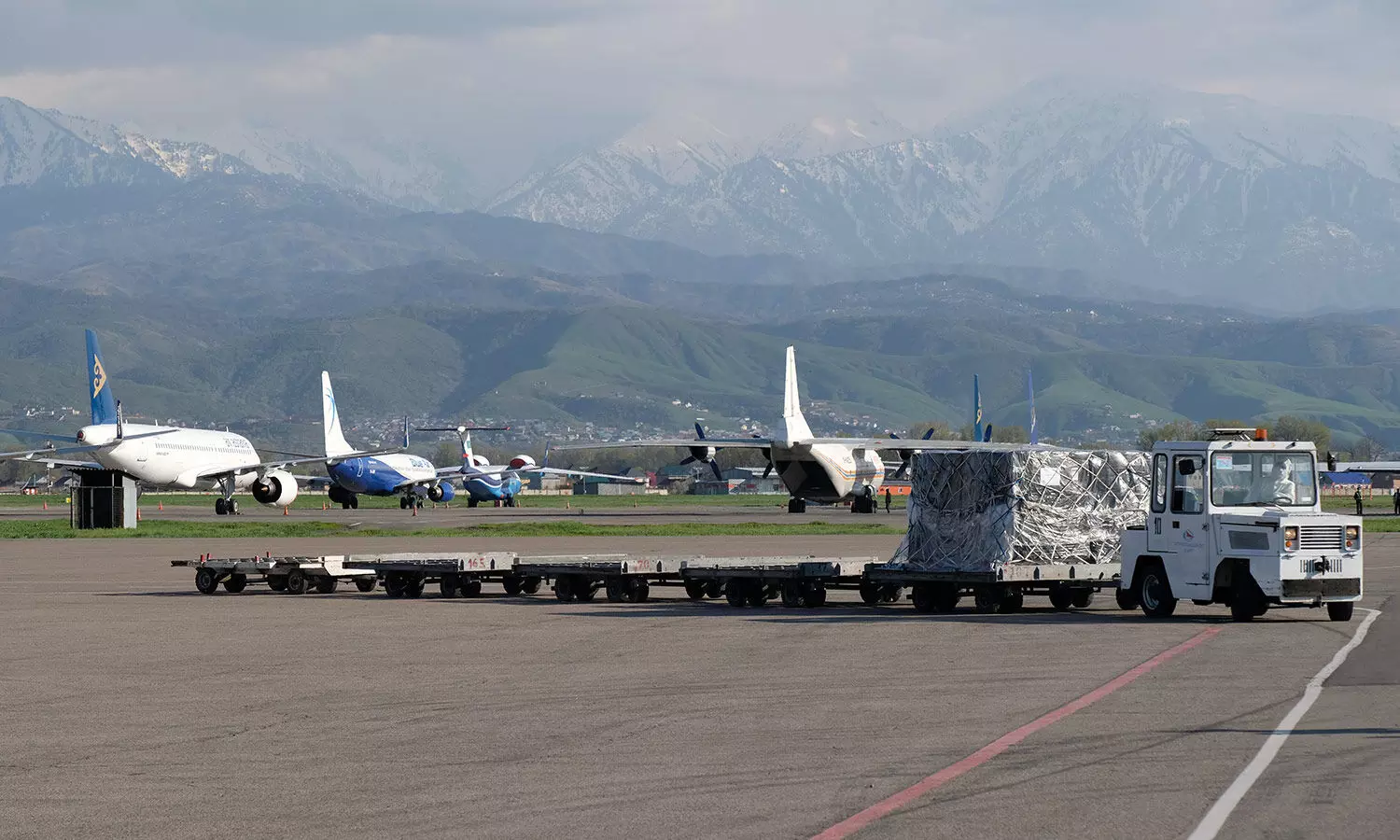
Almaty International Airport
Middle East disruptions are here to stay
For Western European logistics executives and supply chain directors, managing inbound flows from Asia has evolved from a routine exercise in cost optimisation into a continuous challenge of risk mitigation. The ongoing instability across traditional trade routes is no longer a series of isolated, short-term spikes — it represents a permanent structural realignment of Eurasian logistics:
- Middle Eastern airspace closures: Escalating and recurring crises across the Middle East — including volatile regional conflicts and airspace restrictions around the Persian Gulf — have severely impacted the legacy air hubs such as Dubai, Doha, Jeddah and Abu Dhabi, adding flight hours, driving up surcharges, and creating chronic air freight capacity shortages.
- Protracted Red Sea maritime bottlenecks: Ongoing disruptions in Red Sea shipping lanes force container carriers to take lengthy detours around the Cape of Good Hope, adding 10 to 14 days to ocean freight transit times and creating extreme rate volatility for European importers.
- Northern Rail restrictions: The intensifying Russia-Ukraine war continues to restrict access to the Northern Rail Corridor, effectively removing what was once a dependable overland alternative. Furthermore, security risks along the route are growing, as demonstrated by recent Ukrainian strikes targeting logistics infrastructure deep inside Russia.
Forward-thinking supply chain leaders have recognised that waiting for legacy trade routes to return to "normal" is a flawed strategy. Regional instability and airspace constraints are likely to persist in the long term. Industry leaders such as DHL Global Forwarding and CEVA Logistics are turning to the revitalised Silk Road routes of Central Asia to de-risk their China-Europe supply chain, and CargoPoint's Truck+Air product is powering that industry-wide shift.
Capitalising on the Central Asian trade corridor
What does this persistent volatility mean for major hubs like Tashkent and Almaty? Far from serving as temporary emergency backups, Central Asia’s key aviation and multimodal hubs are capitalising on this geopolitical shift to position themselves as a permanent, high-reliability trade bridge between East and West.
Driven by strategic infrastructure investment and operational expansion, air hubs in Uzbekistan and Kazakhstan are absorbing Eurasian transit demand and converting it into a structured, long-term trade corridor. Central Asia is no longer just an alternative route — it has become an essential necessity for resilient China-Europe commerce.
The dual-gateway strategy: Tashkent and Almaty
At the core of this regional evolution is CargoPoint’s integrated dual-gateway road+air operational model across Uzbekistan and Kazakhstan:
- Tashkent, Uzbekistan: Backed by a modernised cargo terminal with an annual throughput capacity of 120,000 tons and an upcoming 1,310-hectare greenfield airport, CargoPoint’s Truck+Air product utilises Tashkent Airport as a high-capacity redistribution node connecting Asian regional feeder networks directly to European destinations.
- Almaty, Kazakhstan: Positioned directly along the border corridor, CargoPoint’s dedicated operational presence in Almaty manages freight moving by road from Chinese manufacturing hubs such as Guangzhou, Shenzhen, Suzhou, Shanghai and Xi’an across the Khorgos border crossing. Cargo is cleared, consolidated, and transferred onto direct flights out of Almaty and Astana airports.
By deploying dedicated local teams in both Tashkent and Almaty airports, CargoPoint retains complete operational control over cargo handling on the ground, transit customs and the airline handover process, eliminating administrative delays.
Truck+Air enterprise maturity and Tier-1 validation
CargoPoint’s signature Truck+Air solution — sometimes referred to as “deferred air freight” in industry circles — is a turnkey multimodal product engineered specifically for European supply chain leaders, freight forwarders, and importers. Blending the cost efficiency of road transport with the speed and security of air freight, the model provides European and UK businesses with a streamlined, high-reliability solution for importing raw materials and finished goods from China within a guaranteed 14-day timeframe. First launched in late 2023, this deferred air freight product has evolved into a fully validated enterprise solution managed end-to-end through a centralised control tower in Tashkent, Uzbekistan, offering European importers a consistent, lower-cost alternative to direct air freight and a faster, more predictable option than ocean or rail transit.
"In today’s geopolitical landscape, European importers cannot afford failures caused by legacy route networks in their supply chains," says Bahtiyar Nomozbaev, CEO of CargoPoint. "Our dual-gateway network across Tashkent and Almaty is engineered to deliver operational certainty. Our Truck+Air product has matured to become an indispensable part of the equation in the East-West trade, rather than a mere “alternative”.
Industry heavyweights — including DHL Global Forwarding, CEVA Logistics, Hellmann Worldwide, YTO International, and Rhenus Intermodal — actively leverage the Tashkent and Almaty multimodal corridors to secure predictable transit schedules for enterprise clients across China, Europe, and global trade networks. This solution has gained significant traction among fashion powerhouses in Italy, Spain, and Portugal, as well as industrial titans in Germany, the UK, and France.
"Geopolitical volatility is the new baseline, but supply chain paralysis doesn't have to be," says Mirzali Mirusmonov, Business Development Director at CargoPoint. "By institutionalising the dual-gateway model across Tashkent and Almaty, we’ve transformed a historical trade route into a high-performance supply chain asset. For tier-one European forwarders, adopting our Truck+Air solution has evolved from a tactical pivot into a core commercial imperative."
New milestones in RFS connectivity
A major breakthrough along the Middle Corridor, the ongoing collaboration between CargoPoint and its key aviation partner, Turkish Cargo, continues to push the boundaries of China-Europe transit logistics. In 2026, CargoPoint and Turkish Cargo pioneered Road Feeder Service (RFS) operations connecting inland China to Central Asia for onward air freight to Turkey — marking the first multimodal product of its kind in the history of the Silk Road.
CargoPoint’s RFS capabilities were validated through two pivotal proof-of-concept movements with Turkish Cargo, demonstrating the scalability of its ground-to-air integration. In July 2026, a major Truck+Air milestone saw 22 tons of cargo move from Luzhou, China, to Almaty International Airport (ALA) in just 8 days, where CargoPoint’s local team managed customs and a seamless handover to Turkish Cargo for final air transport to Ankara.
Building on this momentum, CargoPoint successfully executed a second RFS operation in August, connecting Dongguan, China, with Ankara via Tashkent. This 4-ton shipment utilised CargoPoint’s RFS network from Xi’an Airport to Tashkent, achieving a record total transit time of 10 days from Dongguan to Tashkent before connecting to Turkish Cargo’s global air network to reach Ankara. These consecutive movements underscore the reliability and operational agility of the CargoPoint-engineered Central Asian multimodal corridor for complex, long-distance RFS integrations.
Together, these operations demonstrate that Central Asia functions as a vital bridge for both primary CargoPoint product lines: enabling international airlines to extend their global networks deep into inland China via dedicated Road Feeder Services, while providing enterprise shippers with a seamless, end-to-end Truck+Air solution out of Tashkent and Almaty gateways.
Securing the European supply chain
As Western European businesses move to de-risk their supply lines against permanent geopolitical risks, Central Asia’s role has solidified from a temporary workaround into a primary trade pillar. Through continued infrastructure investment, carrier partnerships, and ground-level execution, CargoPoint’s refined Truck+Air product via Tashkent and Almaty gateways offers European supply chain leaders the reliability and visibility required to navigate a permanently changed global market.
“Over the past three years, we have continuously refined our Truck+Air operations in response to changing trade routes, evolving customer requirements and ongoing disruptions in the China-Europe logistics landscape,” says Bahtiyor Rashidov, Business Development Director at CargoPoint. “What this experience has demonstrated is that Truck+Air is a balanced solution — more cost-effective than air freight while offering a significantly faster and more controlled option than sea or full-land transportation. For European industries dependent on a stable flow of raw materials and finished products, this combination of speed, reliability and resilience can become an important part of a de-risked supply chain.”