
Boeing 777 freighter surpasses 747 to lead global cargo fleet
The 777 freighter has overtaken the 747 to become the world’s most widely operated freighter, carrying 40% of global freighter capacity as Boeing develops its next-generation 777-8F.
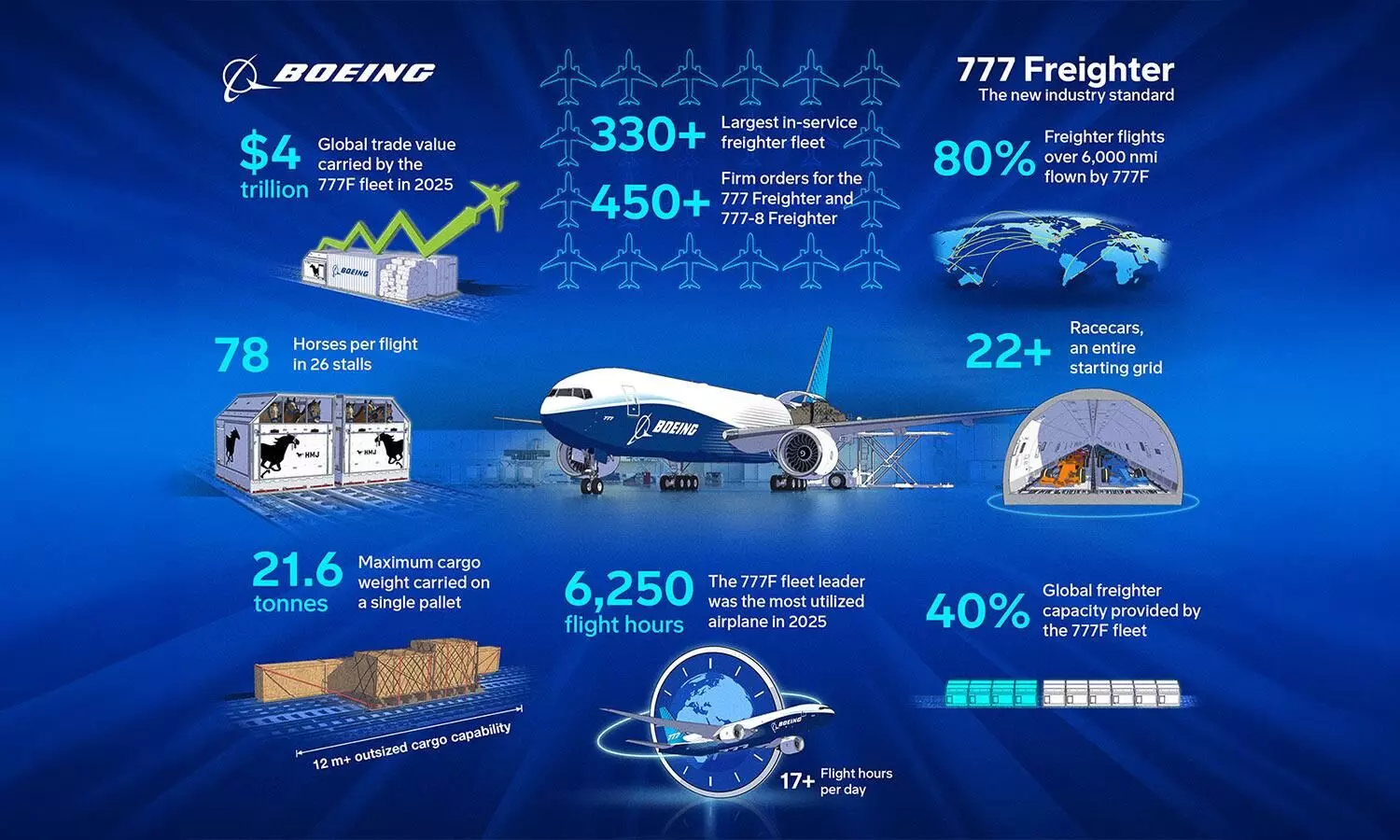
The Boeing 777 freighter (777F) has overtaken the 747 freighter fleet to become the world's most widely operated freighter aircraft, marking a shift in the long-haul air cargo market.
For decades, the Boeing 747, widely known as the ‘Queen of the Skies’, dominated long-haul cargo transportation. Since the first 747-200 freighter was delivered in 1972, the aircraft family has played a significant role in global air freight, providing fast, reliable transport for high-value goods and supporting international trade.
Successive 747 freighter variants introduced performance improvements, culminating in the 747-8 freighter. However, following recent deliveries, the in-service fleet of 777F has surpassed the combined fleet of all 747 freighter variants, establishing the 777 as the leading freighter aircraft in global operations.
The Boeing 747, known as the ‘Queen of the Skies’, has played a pivotal role in global cargo transportation for decades. The 777F is now carrying forward that legacy, becoming the world's most widely operated widebody freighter and emerging as the industry's new benchmark. The next step in this evolution is the upcoming 777-8 freighter, which is expected to build on the aircraft family's established capabilities.
The 777F has taken over the legacy of the 747, establishing itself as the industry's leading freighter in terms of operational use and reputation. With more than 330 aircraft in service, the fleet now transports more air cargo annually than any other freighter type. Its high utilisation on long-haul routes enables it to account for approximately 40% of global freighter capacity. According to Boeing, the value of global trade transported by the 777F fleet was estimated at around $4 trillion last year.
Since its first delivery in 2009, the Boeing 777 Freighter has transported a diverse range of cargo, including mobile phones, pandas, fresh produce, life-saving medicines, helicopters and aircraft engines. The aircraft has played a vital role in supporting global trade and commerce, as well as humanitarian and relief operations that depend on timely deliveries.
Ben Fredrickson, a lead at the 777/777X Fuselage Assembly Center, said, “We get an early look at each 777 Freighter as we build its fuselage sections before final assembly. After working on hundreds of 777s and seeing their performance in service, I’m not surprised the 777F plays such a leading role in air cargo. I’m proud to help build the fleet that is vital to global logistics.”
Boeing is continuing engineering and manufacturing development of its next-generation widebody freighter, the 777-8 Freighter, as deliveries of the 777F continue. The aircraft will become the eighth model in the 777 family.
As part of the Boeing 777X family, the 777-8F will feature a new carbon-fibre composite wing and engines specifically designed for the 777X. According to Boeing, the aircraft is designed to carry 118 tonnes of cargo while delivering 30% lower fuel consumption than previous-generation aircraft and offering greater range than competitors at any payload.
The 777-8F will also retain common features with the existing 777F to support operational efficiency, high utilisation and reliability. The programme has secured 89 firm orders from major cargo operators and airlines, including ANA, Cargolux, China Airlines, China Southern Cargo, Ethiopian Airlines, Lufthansa, MSC Air Cargo, Korean Air Cargo, Qatar Airways and Silk Way West Airlines.