Beyond the cold chain: How data is reshaping pharma logistics
Real-time visibility, predictive analytics and trade uncertainty are changing how pharmaceuticals move, with data becoming central to supply chain decisions.
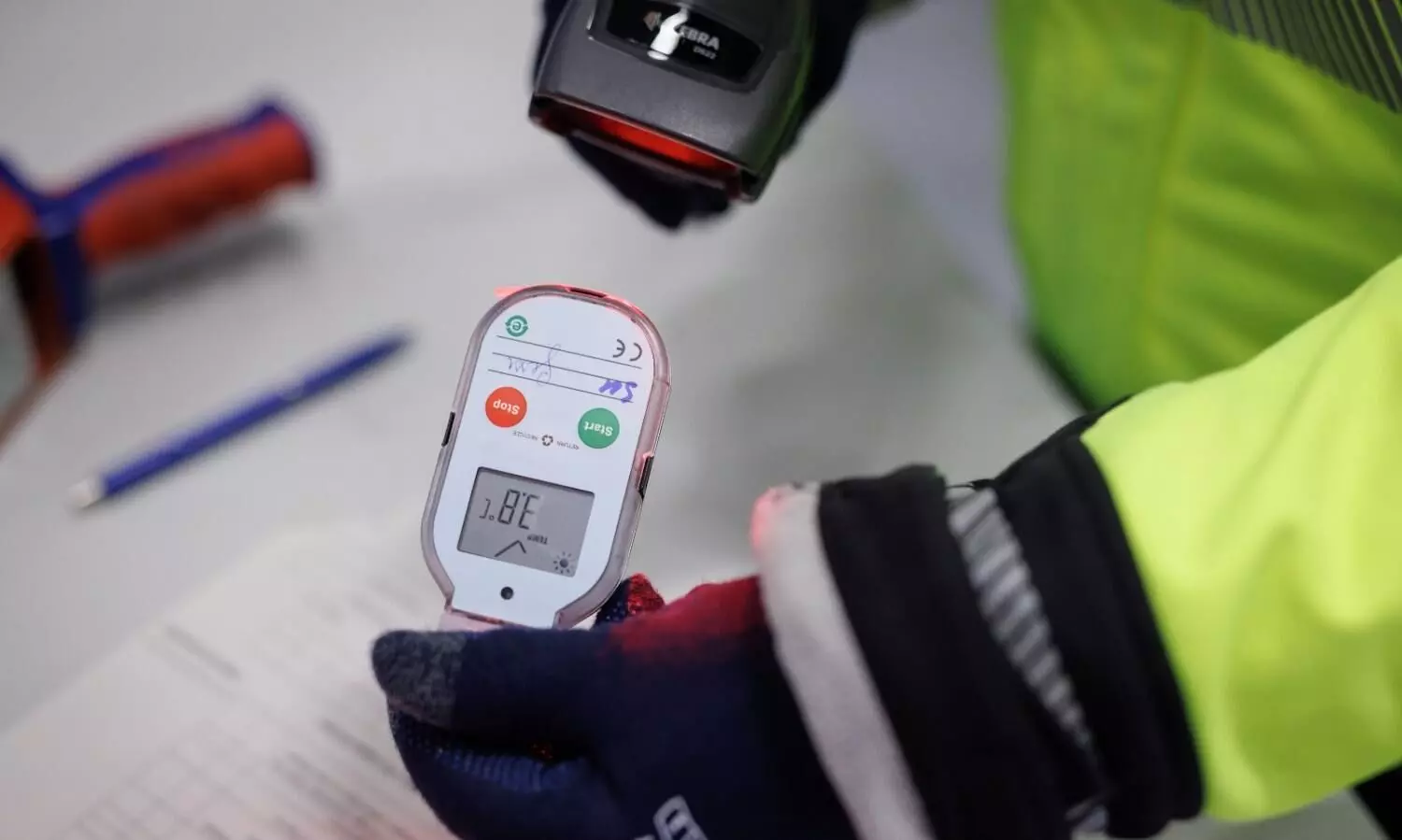
Scanning a temperature data logger to verify compliance at DHL Supply Chain.
Think about a vaccine. It leaves a factory in Germany. It needs to reach a hospital in Mumbai. For the whole journey, it must stay within a narrow temperature range, sometimes as tight as 2 to 8°C. Along the way, it moves from a truck to a warehouse, then to an aircraft, then to another truck. Every handover is a moment where something could go wrong. If the temperature slips, even briefly, the vaccine could stop working. In some cases, it could become unsafe.
For a long time, the industry dealt with this risk in a simple way. You packed the shipment well. You used the right containers. Then you hoped everything held up. That is no longer enough.
Pharmaceutical companies, airlines and logistics firms are now saying the same thing. Data has become just as important as the physical handling itself. Not paperwork filed away after a shipment lands, but live information that shows exactly what is happening while the shipment is still moving.
This did not happen suddenly. It has built up over time, driven by more sensitive medicines, stricter regulators, and now, a world where trade rules can change overnight. To understand where this is heading, it helps to look at how different players in the chain are using data today.
Why visibility is no longer optional
In this industry, visibility simply means knowing where a shipment is and what condition it is in, at any given moment. Not after it lands. While it is still moving.
For years, this was treated as an extra service. Something a customer could pay more for if they wanted it. That has changed.
Daniel Pohl, Spokesperson at DHL Supply Chain, says this shift is shaping how DHL spends its money. The company has committed two billion euros to DHL Health Logistics. It has also brought CRYOPDP, a specialist in temperature-sensitive shipments, into that business. "As healthcare supply chains become more complex and patient-centric, real-time visibility is no longer a value-added service, it is a critical requirement," Pohl says. As healthcare supply chains grow more complex, and more centred on individual patients, real-time visibility stops being a nice extra. It becomes something every shipment needs. He says the investment covers more than cold storage and special transport. It also covers digital systems that let customers see, in real time, exactly what is happening to their shipment and whether it still meets regulations. A tool called DHL LifeTrack is part of this. It gives customers live updates, so they can act fast if something needs attention.
The stakes are exceptionally high: a single deviation can compromise a therapy that has been produced for one individual patient
Daniel Pohl, DHL Supply Chain
The same expectation shows up at Kuehne+Nagel, one of the world's biggest freight forwarders. The company recently expanded its healthcare facility in Hyderabad. You might think better tracking tools are what draw pharma customers to a new site. Anish Kumar Jha, Managing Director of Kuehne+Nagel India, Sri Lanka and the Maldives, says that is not how it works anymore. "Digital visibility is not something that attracts customers to a facility on its own. It is a core part of how healthcare logistics operates today," Jha says. Customers already assume it is there. It has simply become part of how healthcare logistics works.
Jha points to myKN, a platform where customers can track shipments and manage their own data in one place. Alongside this sits HealthChain, a framework that sets one clear standard for monitoring and reporting across the network. For pharma companies sending goods into strict, regulated markets, showing that data is accurate at every step is simply expected. It is not something they need to ask for.
Airlines are part of this story too. To understand their role, it helps to know about CEIV Pharma, an industry certification. It confirms that an airline or airport has the training and facilities to handle pharma shipments properly. Uta Frank, Senior Manager Product, Speed and Service Offer at Lufthansa Cargo, says this certification rests on consistent, high standards across the whole chain. Digital tools make those standards easier to prove and easier to keep up.
She describes Active Temp Control, a service through which Lufthansa Cargo shares digital data on container conditions at key pharma stations. Customers can plug this straight into their own systems through an API, which is simply a way for two computer systems to share information automatically. Alongside this, a service called smartULD tracks location and temperature throughout a shipment's journey on certain containers. Frank says all of this feeds into the airline's Pharma Control Tower, which watches shipments around the clock, so problems get spotted sooner.
What customers ask for now, that they did not ask for before
Ask people who have worked in this field for years what has changed, and the answer usually comes down to two things. How much detail customers want. And how fast they want it.
Jha puts it simply. Pharma companies today want real-time visibility, early warning of possible risks, and far more detail in their tracking data than they did five years ago. To meet this, Kuehne+Nagel uses sensors that track temperature, humidity, location and even physical shocks during transit. If something moves outside an agreed range, an alert goes out at once.
In short, data is no longer just recorded after the fact. It is used actively to monitor shipments, manage risks, and support decisions throughout the journey
Anish Kumar Jha, Kuehne+Nagel
Customers are also asking for something new. A risk check on a shipping route, done before a shipment even leaves. Jha calls this a real change in mindset. Data used to prove what happened after a shipment arrived. Now, it is used while a shipment is still moving, to manage risk and guide decisions on the spot.
Tracking tells you where. Prediction tells you what might happen next
There is a difference between tracking a shipment and predicting what might happen to it. Tracking tells you where something is right now. Prediction tries to warn you, in advance, that a shipment might run into trouble, so someone can step in before it becomes a real problem.
Pohl at DHL says this is exactly what pharma customers now expect. They no longer want to hear about a delay after it has already happened. They want their logistics partner to spot a possible temperature problem, a delay, or a routing issue early enough to fix it. DHL combines data from its transport network, its cold-chain infrastructure and its monitoring tools to do this. Pohl says it matters most for biologics and advanced therapies, where even a small mistake can ruin a product made for one specific patient.
A temperature data logger being placed into a pharmaceutical shipment at DHL Supply Chain.
Jha describes something similar at Kuehne+Nagel, but frames it around decisions rather than monitoring alone. Predictive tools give teams a clearer sense of risk before and during a shipment, instead of relying only on past experience or reacting once something has gone wrong. This shapes real choices. Which route to use. What packaging to choose. When to add a backup plan in case something changes mid-journey.
Khyati Desai, senior manager for global trade compliance at Thermo Fisher Scientific, spoke to The STAT Trade Times in her individual capacity, not representing the company’s views, and connected this perspective to cold-chain shipments. She explains that live sensor data, combined with predictive models, can show when a shipment is likely to be delayed or rerouted. This gives teams a chance to step in before the product itself is harmed. She adds that the same idea applies further back, to sourcing decisions. Predictive insight can show which suppliers, routes or factories are becoming risky, because of political tension, capacity problems or new rules. A company can then adjust early, instead of scrambling once the disruption has already hit.
Not everyone sees this as something entirely new, and that is worth mentioning here, because it keeps the picture honest. Hanoz Tarapore, Country Supply Chain Senior Manager for ASEAN, Korea and ANZ at QuidelOrtho, says close coordination with logistics partners on risk and visibility is nothing new for his company. What has genuinely grown, he says, is how often this happens, and how deep it goes. More conversations. More exception handling. More checks on the risk of a given route.
When trade rules change fast, data becomes the anchor
To see why data has become so urgent lately, it helps to look at global trade. Tariffs and trade rules used to change slowly, often reviewed once a year. Now they can shift with almost no warning. For a pharma company that depends on parts or ingredients from several countries, this is a real problem. A single policy change can suddenly make a supplier, a route, or a whole manufacturing plan too costly or simply unworkable.
Desai explains that in this kind of world, you cannot make decisions using a report that looks back at last quarter. You need live information. She talks about the need for visibility right down to a single product, including where every ingredient and part comes from, so a company knows exactly where it stands if a rule changes. During recent tariff changes, she says many pharma manufacturers moved fast to adjust production and stock levels before new rules came into force. This was only possible, she says, because procurement, manufacturing and logistics teams were all looking at the same real-time information.
A diversified network is only more resilient if you have the data to see and manage all of it
Khyati Desai, Thermo Fisher Scientific
"In today's environment, visibility isn't a dashboard feature, it's the difference between responding early and being caught off guard," Desai says.
This same uncertainty is also pushing pharma companies to spread their manufacturing and sourcing across more countries, instead of depending on just one or two. On the surface, this sounds like it should make a supply chain safer. Desai says it is not that simple. Every new supplier, every new route, every extra border crossing adds one more place where something could go wrong. As she puts it, a spread-out network is only stronger if a company has the data to actually watch and manage all of it.
At QuidelOrtho, Tarapore describes what this looks like in practice. When a distribution network needs to change, the decision usually comes down to cost, volume, demand forecasts, and how transit time and risk compare between air and sea freight. What matters most, he says, is being able to run models that show the impact of each option on cost and service, before a decision gets made, not after something has already gone wrong.
From a logistics tool to a business decision
Perhaps the clearest sign of how far this has come is that data is no longer just a logistics matter. It is starting to shape decisions that used to sit only with senior management, like where a company chooses to manufacture its products.
Desai describes this change clearly. Sourcing strategy used to get reviewed once a year. Now, because tariffs, rules and transport costs can shift so fast, it gets reassessed all the time. She links this to a wider trend of pharma companies announcing new factories at home, decisions she says are backed by detailed supply chain and financial analysis, not a reaction to one single event. As she puts it, data is no longer just measuring supply chain decisions. It is shaping where those decisions get made in the first place.
We also expect analytics and predictive capabilities to play an increasingly important role in enabling proactive supply chain management in the years ahead
Uta Frank, Lufthansa Cargo
Frank at Lufthansa Cargo sees a version of this happening with airlines too, though she is careful not to overstate it. "Reliable transportation remains our core responsibility," Frank says. But transparency and data sharing matter more than they used to, in how the airline works with pharma customers. She expects predictive tools to play a bigger role in the years ahead, not just in pharma, but across cargo in general.
Why the physical side still matters
It would be easy to think data has taken over as the most important part of this business. Tarapore offers a useful counterpoint here, and it is worth taking seriously.
What has increased now is the level & frequency of communication, close coordination, exception-handling and lane-risk-assessment
Hanoz Tarapore, QuidelOrtho
QuidelOrtho already follows strict standards, including GMP, GDP and ISO certification. These are simply proof, recognised around the world, that a company follows proper rules for making, storing and checking its products. "This does not impact us much because we already are a GMP, GDP and ISO compliant organisation," Tarapore says. These standards have always been part of how the company works, so the growing focus on data has not changed things much for QuidelOrtho. In his view, having the right processes, clear documentation, a proper plan for handling temperature problems, and structured corrective actions matter just as much as data, maybe more, when it comes to protecting a product and keeping a customer's trust.
This is a fair point. It stops the story from turning into one where data is treated as a magic fix. The trucks, the trained staff, the years of compliance work, none of that has become less important. What has changed is that none of it means much to customers anymore unless a company can also prove, in real time, that it is actually working the way it should.
That is probably the simplest way to sum up where pharma logistics stands today. The cold trucks, the special containers and the trained handling teams are still doing the hard work. But more and more, it is the data running alongside all of it that tells everyone, the airline, the forwarder, the pharma company, and in the end, the patient, that the medicine moving through the system is exactly as safe as it needs to be.