
Air cargo spot rates soar in October despite global tonnage dip
Global air cargo spot rates jumped 5% in late October to $3.80 per kilo. Capacity constraints and peak season pressure offset a drop in global volumes.
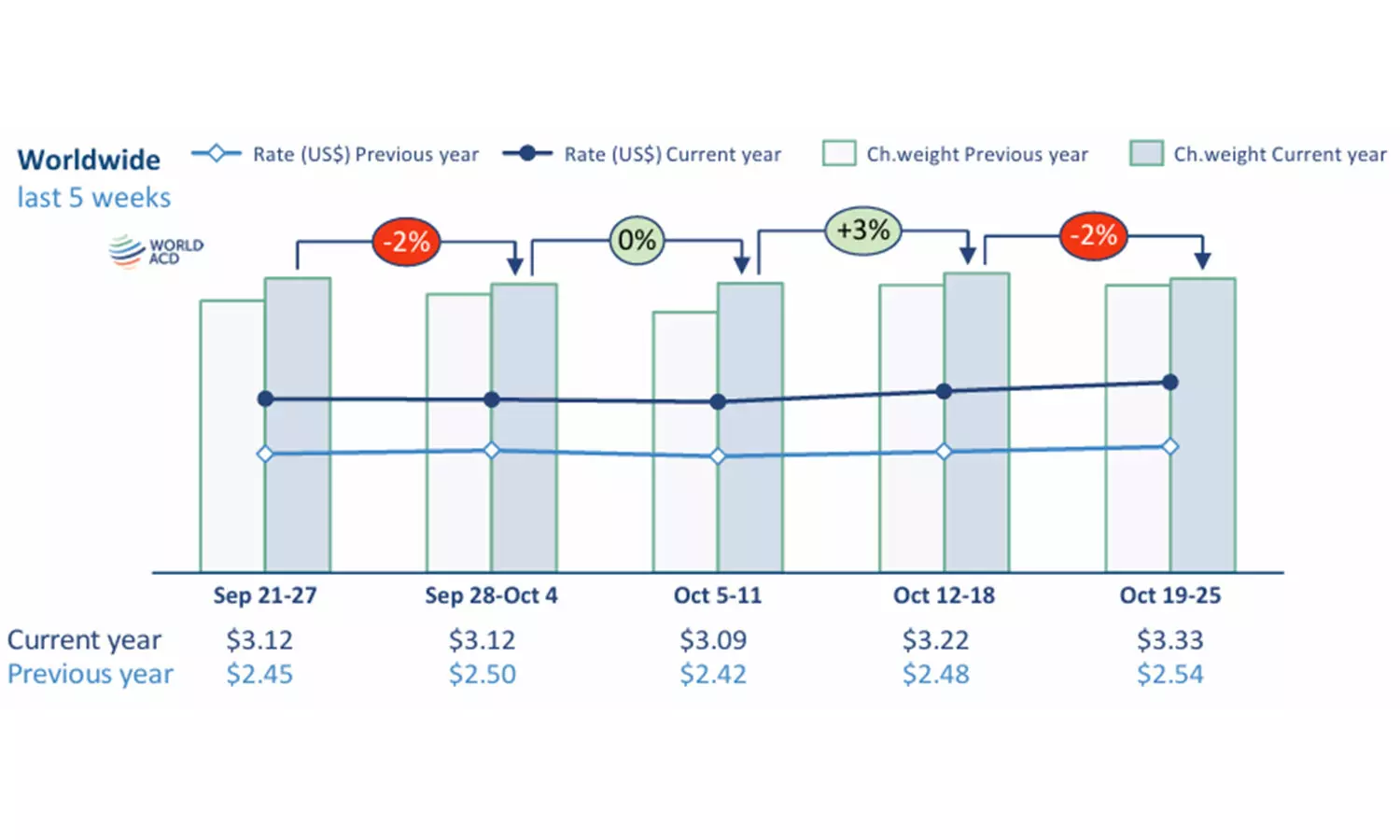
Image source: WorldACD
Worldwide air cargo spot rates have continued their upward trajectory moving into the second half of October. This surge comes despite a slight dip in global tonnages, as the pressure on available capacity intensifies during the traditionally demanding fourth-quarter peak period. Ongoing geopolitical constraints and elevated fuel surcharges are further contributing to this robust pricing environment.
According to the latest weekly figures released by WorldACD Market Data, global spot prices in week 43 (spanning 19 to 25 October) increased by an average of 5%, week on week. This mirrors a similar pattern observed during the equivalent week last year. The recent climb was primarily driven by a 7% rise from Europe, a 6% week-on-week increase from the Asia Pacific region, and a 5% rise originating from Central and South America. These increases follow a 4% week-on-week rise in global spot rates during week 42, propelling average worldwide spot rates to $3.80 per kilo. This figure represents a staggering 38% increase year on year. Furthermore, worldwide full-market rates, which comprise a mixture of spot prices and long-term contract rates, rose by 3% week on week to $3.33 per kilo, reflecting a 31% year-on-year increase.
Conversely, worldwide tonnages experienced a 2% week-on-week drop. Most major global regions saw marginal declines of 1% or 2%, with the notable exception of the Middle East and South Asia (MESA). The MESA region recorded a more significant 6% week-on-week drop in cargo volumes, a downturn attributed chiefly to declines from India and Sri Lanka connected to national holidays. Despite this weekly drop, global volumes in week 43 remained 2% higher than those recorded during the same period last year.
Global air cargo capacity experienced a slight dip of 1% week-on-week during week 43. This included a 1% drop from Asia Pacific origins, largely driven by a typhoon that severely disrupted flight schedules in Taiwan. However, overall worldwide capacity was up by 1% compared with the equivalent week last year, bolstered mainly by strategic increases in freighter services.
Capacity remains heavily constrained by ongoing geopolitical tensions in the Middle East, with Riyadh almost completely closed to international flights during week 43. Capacity originating from MESA in week 43 plummeted by 13% compared with late February (week 7), just prior to the escalation of the US-Israel conflict with Iran. Specifically, capacity from the Arabian Gulf has fallen by 19% since week 7.
A closer examination of demand patterns from the crucial Asia Pacific region reveals a stark contrast between European and US markets. This divergence has become particularly pronounced since the European Union eliminated its ‘de minimis’ exemptions on lower-value items worth less than €150 on 1 July. Consequently, chargeable weight from the Asia Pacific to the EU in week 43 dropped by 16% year on year. In stark contrast, volumes travelling from the Asia Pacific to the US surged by 9% year on year.
Part of this transatlantic discrepancy stems from exceptionally strong and sustained demand within the US for AI-related high-tech air imports, particularly those sourced from Taiwan and various parts of Southeast Asia. However, the other primary factor is the severe drop in volumes entering the EU from Hong Kong and mainland China since the 1 July regulatory change. Tonnages from Hong Kong to the EU in week 43 plummeted by one third (33%) year on year, whilst volumes from mainland China fell by 9%. Meanwhile, tonnages from mainland China and Hong Kong to the US remain slightly elevated year on year. The introduction of an additional EU €2 per item import handling fee, effective 1 November, is anticipated to place further downward pressure on volumes from China and Hong Kong to Europe.
Despite these regional volume shifts, markets originating from the Asia Pacific bound for both the US and the EU are currently commanding premium prices, exacerbated by carriers grappling with high aviation fuel costs. Transpacific spot rates from the Asia Pacific to the US soared by a further 7% week on week in week 43, reaching an average of $7.43 per kilo. This was driven by sharp increases from South Korea (up 26%), mainland China (up 15%), and Japan (up 14%). Compared with last year, average Asia Pacific to US spot rates were 41% higher, featuring dramatic year-on-year jumps from Japan (59%), South Korea (55%), Indonesia (53%), Thailand (47%), and Singapore (46%). Rates from mainland China and Hong Kong also rose by approximately 40% year on year.
Simultaneously, average spot prices from the Asia Pacific to Europe increased by a further 5% week on week, reaching $5.10 per kilo. This included a 10% weekly increase from Vietnam and a 6% rise from mainland Chinese origins. These gains push Asia Pacific to Europe spot prices up by nearly 30% year on year, with Hong Kong and mainland China sitting at the lower end of those increases compared to the broader region.
With robust demand persisting from numerous Asia Pacific and South Asian markets, ongoing instability across the Arabian Gulf, and the impending rush of Diwali, Thanksgiving, Black Friday, and Christmas, air cargo stakeholders are bracing for an exceptionally busy and highly unpredictable peak season. It is widely anticipated by market analysts that the current sustained high rates will climb even further in the coming weeks.