


FedEx's $90 billion machine: data, digital twins and the AI edge
President and CEO Raj Subramaniam reveals how FedEx is reinventing itself — from package mover to intelligent supply chain orchestrator.
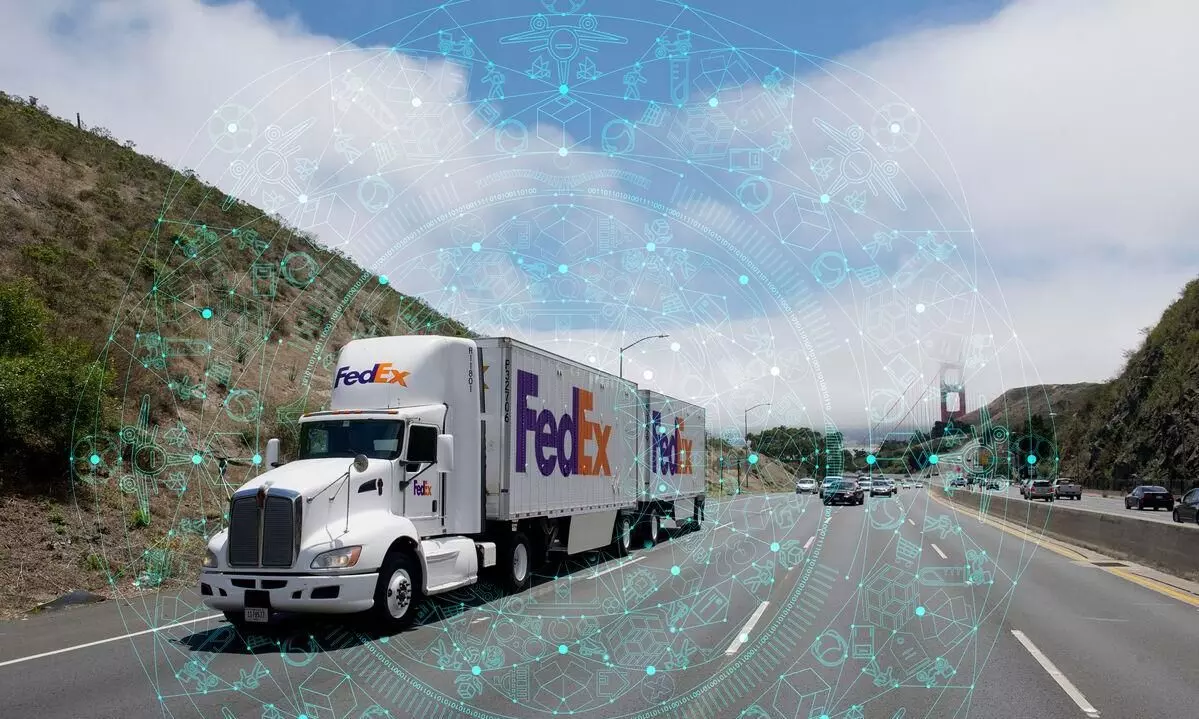
Photo: LinkedIn/FedEx
"The Information About the Package Is Just as Important as the Package Itself.” That famous dictum, uttered by FedEx founder Fred Smith in 1978, is the philosophical bedrock on which the modern FedEx has been built. What sounded radical nearly five decades ago is now the engine of a $90 billion enterprise that moves 18 million packages a day across 700 planes, 200,000 vehicles and a workforce of roughly 800,000 people, including contractors.
"He (Smith) said that in 1978, and that's when tracking and tracing was born. We had tracking and tracing for packages to track internally, and then we said, 'Oh, why don't we externalise this?' That's when people started being able to track the packages,” Raj Subramaniam, President and CEO of FedEx Corporation, told the audience at the Economic Club of Washington recently during an interview with David Rubenstein, Co-founder and Co-chairman of the private equity firm Carly Group. Rubenstein is also the Chairman of the Economic Club of Washington.
Today, every package that moves through the FedEx system is scanned approximately 25 times from origin to destination. The company generates two petabytes of data every single day. "That data is a valuable asset on its own," Subramaniam said.
A digital twin of FedEx
The recognition of data as a strategic asset led to one of the most significant, and least publicised, transformations the company has undertaken. Beginning in 2020, FedEx set about engineering a full digital twin of its global network: a real-time virtual replica of every node, aircraft, vehicle, route and package in its system.
"We had gone about really engineering and creating a platform using our data and creating a digital twin of FedEx," Subramaniam said. "And then comes the revolution in AI, and suddenly we're able to use that AI to now supercharge our data."
The practical applications are already live. FedEx has moved from passive tracking to predictive visibility; telling business customers not just where their package is, but where it will be, and when. "Two or three years ago, we went into a predictive mode," he said. "We can tell where the package is going to be at what time, or when it is going to arrive. And so, if there's a delay because of weather, they can do something about it. They can orchestrate their supply chains better because now they have that information."
Automation inside FedEx's sorting hubs has also accelerated. Subramaniam described the Memphis superhub, where 150 planes land in the dead of night, are unloaded, re-sorted and reloaded, as increasingly driven by automated belt systems and routing technology. "A lot of the package movement through the hub is now automated," he acknowledged.
"We had gone about really engineering and creating a platform using our data and creating a digital twin of FedEx. And then comes the revolution in AI, and suddenly we're able to use that AI to now supercharge our data."
Raj Subramaniam, FedEx
AI as a moat, not just a tool
Subramaniam's most pointed argument about AI was not about efficiency savings; it was about competitive moat. FedEx's data, he argued, cannot be replicated by any technology company precisely because it is a byproduct of irreplaceable physical infrastructure. "It only exists because of the hard physical work that we do every day," he said. "No tech company can own that."
The company is using AI to improve network efficiency, create new value for customers, and explore opportunities in supply chain orchestration. It is helping businesses manage their inventory and logistics flows using FedEx's proprietary insights. "We are looking at how we use the insights from our data to orchestrate global supply chain," Subramaniam said. "There's opportunity to leverage those insights and do different things with it."
On jobs, he pushed back against the narrative that AI displaces workers. "There are no AI delivering packages. Last year, we added about 29,000 jobs in America." Autonomous trucks are also being tested, in partnership with a carrier in Texas, operating facility-to-facility along highway corridors. FedEx has 638 facilities positioned along US highways to support this model.
Revenue and shareholder value
Subramaniam has been CEO for nearly four years. The financial trajectory, while not linear, tells a story of structural discipline. FedEx's revenues stood at approximately $69 billion in 2019, before the pandemic. During the surge years, they climbed to $94 billion. After a pullback to $88 billion, the company has regained ground, growing at roughly 5–6% CAGR since 2019.
Total revenue for the fiscal year 2025 (From June 1, 2024 to May 31, 2025) was $87.9 billion. Of that, Federal Express Corporation generated $75.3B, which was 86% of the total. FedEx Freight generated $8.9B, which was 10% of the total. Other and eliminations generated $3.7B, which was 4% of the total.
At an investor day in February this year, FedEx laid out targets that Subramaniam described as demanding but achievable: 4% revenue growth, 14% bottom-line growth in compound annual terms, and $6 billion in free cash flow, a figure that has been a long-standing frustration for some analysts.
"Some of the investors are frustrated about lack of generation of free cash flow, but you have to have investments in capital to get the network we have built," Subramaniam said. "The fact that we are here, turning a corner, and the investments we need are more incremental at this point; I think that realisation is starting to sink in."
FedEx broke ground in February 2026 on a $250 million fully automated air cargo hub at Navi Mumbai International Airport. The 300,000 sq. ft. facility, developed with Adani Airport Holdings, will serve as a regional hub connecting India to Asia, Europe, and the US, creating 6,000+ jobs and scaling capacity to 3.25 million tonnes.
The transformation has three interlocking pillars: a network consolidation that has collapsed multiple independently operated companies into a single, unified FedEx; an organisational restructuring; and a digital transformation anchored by the AI and digital twin programme. FedEx Freight, the company's less-than-truckload division and America's largest LTL provider, is being spun off separately, a move Subramaniam says will allow it to compete with sharper commercial and technology focus.
Moving high-value, high-stakes cargo
FedEx is not, Subramaniam was careful to emphasise, primarily a parcel delivery company. It is the logistics backbone of the high-value economy. "Last year, we moved roughly $2 trillion worth of goods across the world," he said. "Pharmaceuticals, aerospace, defence, textiles; once the value per pound of something is very high, they usually go in our system."
During the Covid-19 pandemic, FedEx moved close to a billion vaccines. The company operates a major hub in Dubai. Its domestic market share in the United States sits at roughly 40%, matched by UPS. In Asia, FedEx holds 30–40% of the international express market; in Europe, around 20%.
The road ahead
Subramaniam acknowledged the unpredictability of operating a company this kinetically global. "I get up in the morning and say a little prayer before I look at my phone. I don't know what's happening — and the unpredictability of it is the hardest part."
But on the longer arc, he was unambiguously bullish. He sees early signals of a B2B industrial recovery in the US economy; "green shoots," in his words; after more than 35 consecutive months of contraction in the ISM manufacturing index.
The ISM manufacturing index is a monthly economic indicator published by the Institute for Supply Management (ISM) that measures the health of the US manufacturing sector. A reading above 50 signals expansion, while below 50 indicates contraction. The latest April 2026 report showed the index at 52.7.
Subramaniam believes FedEx's position as a global network, capable of moving anything from anywhere to anywhere, is structurally unassailable in ways that even well-resourced rivals cannot easily replicate.
"The physical network that we have in place has taken us 53 years to build," he said. "That is going to be very, very difficult to replicate. Unless someone is inventing a 'beam me up, Scotty' machine and moving through ether — this is going to get very, very difficult to replicate."

Editor at STAT Publishing Group since 2013, I lead a small team of reporters in chasing stories about cargo flows from A to Z—by air, sea, road, and rail. If it moves, we track it. Got a compelling lead? Reach me at reji@statpublishinggroup.com (cargo only, please)


