

Is Taiwan’s AI engine on fire?
AI is reshaping Taiwan’s export economy, with Jan–Aug exports up 44.2% to $574.3 billion, and data-processing machines alone accounting for 33.5%.
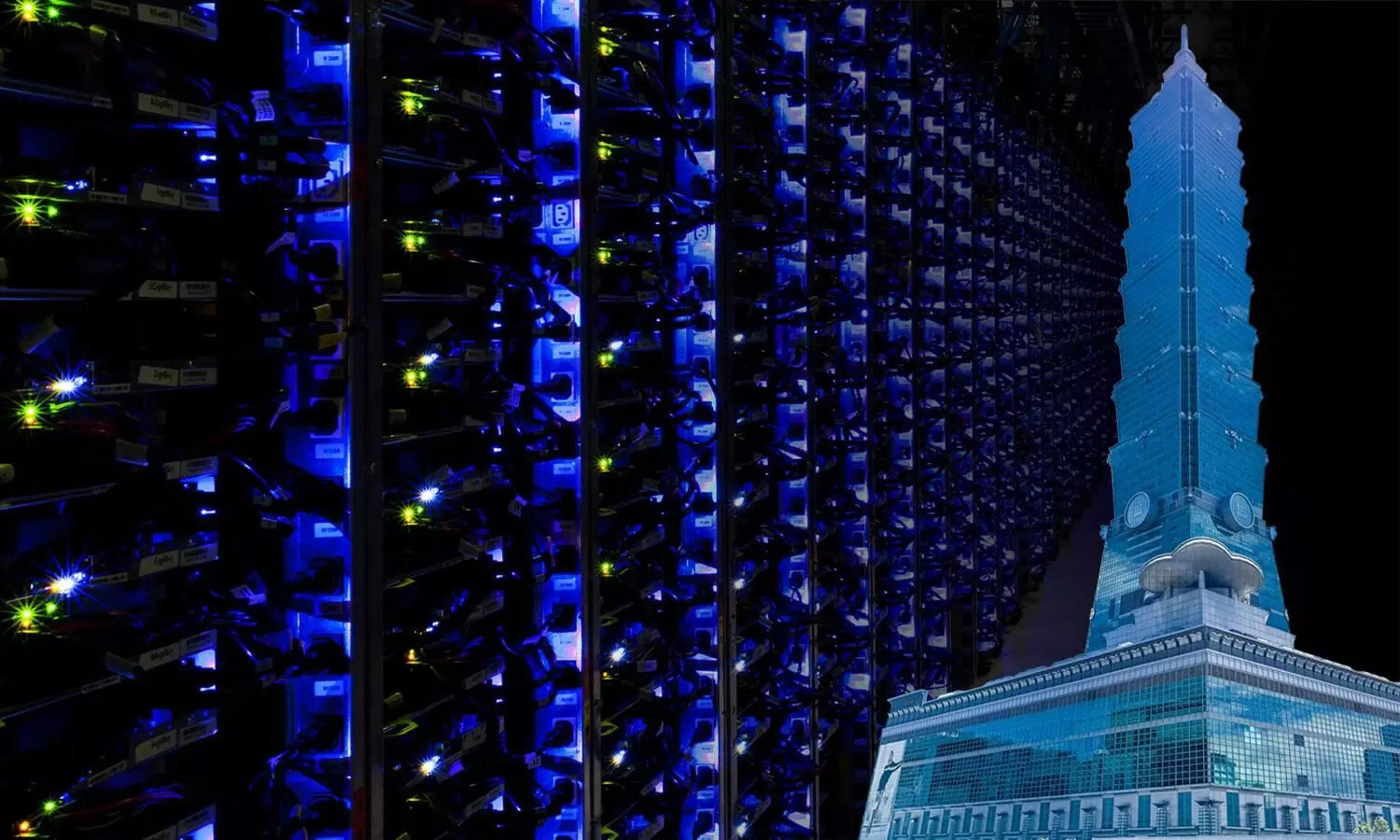
A creative composition juxtaposing Taipei 101 with the interior of an AI data centre
“When we talk about Taiwan and the supply chain, it’s not just about Taiwan. It’s Taiwan’s global supply chain,” said Rick Tsai, Vice Chairman and CEO of MediaTek, during SEMICON Taiwan 2026 that was held in Taipei from September 2-4, capturing a shift that is becoming increasingly visible across Taiwan’s technology industry: the country’s role in AI is extending beyond semiconductor manufacturing into the wider infrastructure needed to build and operate AI systems.
Taiwan’s contribution now runs through chip design, advanced manufacturing, packaging, memory, server architecture, power systems, cooling, networking and the engineering capabilities that connect these layers. The change is already visible in the country’s trade data.
According to the Department of Statistics, Ministry of Finance, Taiwan, automatic data-processing machines and units thereof — a category that includes servers and graphics cards — became Taiwan’s largest export commodity in January-August 2026, accounting for 33.5% of total exports. Electronic integrated circuits followed closely at 33.1%. Together, the two categories represented roughly two-thirds of Taiwan’s exports.
Talking about trends, Asok Kumar, CEO of Morrison Express, said the company handles AI-related shipments from manufacturing hubs including China, Korea, Singapore, Malaysia and Taiwan. Taiwan is a major hub for networking equipment and fully assembled AI racks, reflecting its specialisation in semiconductor fabrication and AI hardware manufacturing. Taiwan’s air cargo volume has also grown by around 17%, according to WorldACD.
That is more than a change in the ranking of export categories. It shows how Taiwan is moving further into the physical infrastructure of AI: not only producing the chips that power computing, but increasingly participating in the systems built around them. And that creates a different logistics problem.
“When we talk about Taiwan and the supply chain, it’s not just about Taiwan. It’s Taiwan’s global supply chain.”
Rick Tsai, MediaTek
Moving a semiconductor from one manufacturing stage to another is one challenge. Coordinating thousands of specialised components into an integrated AI system — and ensuring they arrive at the right location, in the right configuration and at the right time — is another.
From semiconductor hub to AI systems hub
Taiwan’s semiconductor ecosystem provides the foundation for this expansion. “AI is redefining semiconductor competition and driving supply chains toward deeper collaboration. Taiwan’s integrated ecosystem, from chip design and advanced manufacturing to heterogeneous integration and system applications, enables it to contribute to this shift,” said Terry Tsao, Global Chief Marketing Officer and President of Taiwan, SEMI.
AI demand is consequently spreading across almost every layer of the semiconductor value chain. During the SEMICON Taiwan press conference, Clark Tseng, Senior Director of Market Intelligence, SEMI, said, “AI is reshaping semiconductor growth, driving sustained demand for advanced logic, HBM and DRAM, high-layer-count NAND, testing, and advanced packaging equipment. SEMI forecasts the global semiconductor materials market will reach $92 billion in 2027, with Taiwan accounting for approximately 30%. As AI broadens demand across the value chain, deeper global collaboration will be essential to support the industry’s next phase of growth.”
“Taiwan’s integrated ecosystem, from chip design and advanced manufacturing to heterogeneous integration and system applications, enables it to contribute to this shift.
Terry Tsao, SEMI
Taiwan’s significance lies in the density of capabilities that exist around semiconductor manufacturing. The ecosystem connects IC design, foundries, packaging and testing with server manufacturers and suppliers of power, thermal-management and networking technologies. That density is now attracting AI infrastructure engineering as well.
On the other hand, Quantum computing and quantum communications are moving rapidly toward commercialisation, opening new opportunities across the global semiconductor ecosystem, including Taiwan.
Chii-Dong Chen, Distinguished Research Fellow and Executive Officer, Thematic Center for Quantum Computing, Research Center for Critical Issues, Academia Sinica, said, “The quantum era is taking shape. Taiwan’s strengths in supercomputing and semiconductors give it a unique edge in superconducting quantum computing. By integrating hardware, software, and existing GPU and CPU infrastructure, Taiwan can build a strong quantum ecosystem. SEMICON Taiwan 2026 will showcase these capabilities and accelerate quantum-classical integration.”
Google’s Taiwan expansion shows what is changing
Google’s footprint in Taiwan illustrates how the centre of gravity is moving from semiconductors alone towards the wider architecture of AI computing. Google says 2026 marks 20 years of its presence in Taiwan, which has become its largest hardware engineering R&D base outside the US. The company is expanding its AI infrastructure R&D centre in Shilin, Taipei, increasing office space by 60%.
The significance of that expansion goes beyond additional office space. Google’s Taiwanese partner ecosystem extends across advanced 3D packaging, server motherboards, high-efficiency power supply systems and liquid cooling, components that are becoming increasingly important as AI systems scale.
Google's new office in Taiwan, its largest AI infrastructure hardware R&D Center outside the US. Source: Google
“Taiwan is renowned globally not only for its exceptional semiconductor capabilities and talent pool but also for its crucial role in the AI ecosystem, extending far beyond the chips themselves,” said Amin Vahdat, Google’s Chief Technology Officer and Senior Vice President of AI Infrastructure.
A Google spokesperson also said the company has always had teams focused on end-to-end design and supply chain in Taiwan. The latest expansion brings these teams together under one roof in the Google office in Shilin, while the company continues to expand in Taiwan because of the talent available there and the importance of the market. That is significant from a supply-chain perspective. Engineering, sourcing and supply-chain decisions become increasingly interconnected when the product being built is an AI system comprising hundreds or thousands of components.
Vahdat described the challenge during SEMICON Taiwan. “As intelligent architectures evolve, their complexity also increases; as the entire AI ecosystem demands deeper specialisation, the operational efficiency of the supply chain must also be improved accordingly.” He added: “Every link in this supply chain is interdependent; if one link cannot keep up with the others, the principle of system balance, Amdahl's Law, reminds us that the speed of the system depends on the slowest component.”
That has a direct implication for logistics. A shortage or delay involving a relatively small component can hold up an otherwise complete system. “That’s why our hardware and foundry partners in the Asia Pacific region are not just suppliers; they are architects of modern computing, and the world’s infrastructure desperately needs their manufacturing expertise,” Vahdat said.
The message is clear: the supply chain is becoming part of the architecture of the computing system itself.
The export data reveal the AI shift
Taiwan’s trade figures provide a quantitative view of this changing ecosystem. According to the Department of Statistics, Ministry of Finance, Taiwan, exports of automatic data-processing machines and units reached $192.6 billion in January-August 2026, up 87.5% year on year. The US accounted for 62.8% of exports in this category. Electronic integrated circuits generated $190.3 billion during the same period, an increase of 47.5%. Mainland China and Hong Kong accounted for 48.4%, while ASEAN represented another 25%.
The contrast is revealing. Taiwan’s chips continue to feed manufacturing and processing networks across Asia, while servers, graphics cards and other data-processing equipment are increasingly moving towards the US, where large-scale AI computing capacity is being deployed.
“SEMI forecasts the global semiconductor materials market will reach $92 billion in 2027, with Taiwan accounting for approximately 30%.”
Clark Tseng, SEMI
Other technology categories are also expanding rapidly. Exports of smartphones and communication apparatus increased 74.7% to $17.9 billion, while storage media exports jumped 157.8% to $14.7 billion. Semiconductor manufacturing equipment exports rose 44.2% to $4.8 billion, according to the Department of Statistics, Ministry of Finance, Taiwan. The pattern suggests that AI is influencing not just demand for leading-edge processors but a much broader collection of hardware and capital equipment.
A global Taiwan supply chain
For Taiwanese technology companies, that expansion is happening across borders. Tsai’s description of “Taiwan’s global supply chain” reflects a model in which Taiwanese companies are extending investment, talent and capabilities beyond the island while continuing to deepen their domestic technology base. For MediaTek, that includes building engineering capabilities and hiring talent in the US to strengthen collaboration with customers and partners.
The emphasis on human capital is important because the AI supply chain is increasingly dependent on specialised engineering capabilities, not simply manufacturing capacity. Taiwanese companies are simultaneously deepening their domestic capabilities and building relationships with customers, suppliers and engineering teams overseas. Tsai also pointed to the pressure running through the technology supply chain. Against that backdrop, he stressed the importance of customer and partner confidence as companies expand factories, capabilities and talent. The result is a supply chain that is Taiwanese in expertise but increasingly international in footprint.
The complexity starts several tiers below the server
The challenge is not confined to the movement of finished AI systems. Skip Wong, VP, Global Sourcing & Procurement, Solidigm, described how quickly a seemingly straightforward change in a storage product can ripple through its supply chain. Using different storage-capacity configurations as an example, Wong explained that changing a customer order can require changes across the entire bill of materials.
A move from a 122-terabyte drive to a 300-terabyte configuration, for example, can require a different combination of components. Wong noted that a bill of materials can contain around 100 components, with the two configurations potentially differing in around 15 unique components. That means a change in the specification of one finished product can affect purchasing, inventory and production planning across multiple suppliers.
Wong said this level of complexity makes it difficult to change an order and expect the revised product to be shipped immediately because the impact extends through the component supply chain. That complexity is amplified in AI infrastructure, where GPUs, memory, storage, networking, power and cooling systems need to be integrated into a functioning architecture. It also increases the importance of information.
Wong highlighted fragmented cross-company data as a challenge and stressed the importance of data quality and security. His succinct description was: “Garbage in, garbage out.” For supply-chain managers, visibility is therefore becoming an operational requirement rather than simply a technology feature. Without accurate information flowing between companies, changes in specifications, demand or delivery schedules can quickly become physical bottlenecks.
Trade friction adds another layer. The physical complexity of the supply chain is being accompanied by changes in trade conditions and sourcing economics. Wong pointed to tariffs as another complication, explaining that sourcing from certain manufacturing locations can significantly alter the cost of serving customers.
For companies operating across multiple manufacturing locations, decisions on where to source, assemble and ship components can therefore have consequences well beyond production cost. The result is a supply chain being redesigned simultaneously around technology requirements, customer demand, tariffs, capacity, talent and geography. That is one reason Taiwan’s role cannot be assessed simply by measuring semiconductor production within the island.
Korea-Taiwan: The supply chain moves before the final shipment
One clear example of Taiwan’s interconnected AI ecosystem is the growing movement of components between South Korea and Taiwan. In a previous interview, Dimerco highlighted increasing flows of HBM and DRAM from Samsung and SK Hynix into Taiwan, where memory is integrated by server manufacturers before finished AI infrastructure is exported.
“The trend highlights that AI-related logistics demand is not only reflected in outbound shipments from Asia to North America, but also in the increasing movement of components within Asia, particularly between Korea and Taiwan, before final assembly and export,” said Kathy Liu, Vice President, Global Sales & Marketing, Dimerco.
A shipment leaving Taiwan can therefore represent only the final leg of a much longer industrial journey. Memory may move from South Korea to Taiwan, while other components arrive from different Asian production centres before systems are assembled, tested and exported.
According to Kumar, "The United States remains the primary destination for AI and semiconductor freight originating in Taiwan, complemented by major trade flows into Europe and Intra-Asia destinations. Within the region, there is substantial equipment movement between Taiwan and hubs such as Japan, Korea, Singapore and Penang, the latter also seeing strong growth in AI and semiconductor shipments.”
"The United States remains the primary destination for AI and semiconductor freight originating in Taiwan, complemented by major trade flows into Europe and Intra-Asia destinations."
Asok Kumar, Morrison Express
“On the market side, growth across the Taiwan to the U.S./Europe/Asia corridors remains consistently strong, at around 16.5% to 18.4% according to publicly available market data, with the strongest growth going to Europe," added Kumar.
AI is tightening the air cargo equation
That complexity is feeding directly into freight demand. Dimerco’s consolidated revenue reached NT$3.415 billion in August 2026, up 39.1% year on year, with airfreight revenue rising 34.3%. Ocean freight and contract logistics revenue increased 48.4% and 37.8%, respectively. For January-August, revenue reached NT$23.268 billion, up 20.9%.
Dimerco has reported tight airfreight capacity on major Taiwan routes, with AI, semiconductor and high-tech exports absorbing transpacific capacity and Asia-US load factors approaching 90%. AI infrastructure cargo is also high-value and time-sensitive: a fully outfitted AI server rack can approach $4 million, according to Dimerco, with its size and weight requiring specialised planning and handling.
The semiconductor supply chain illustrates this fragmentation. According to Dimerco, semiconductor production can take up to 100 days, including transit, and cross international borders as many as 70 times. AI infrastructure adds further complexity as components have different production cycles, storage requirements and trade controls.
A fireside chat at the CEO Summit during SEMICON Taiwan in Taipei
Dimerco’s bonded warehouse facilities in the Taoyuan International Airport Free Trade Zone allow inventory to be stored without duties and taxes until shipment, while logistics and trade-compliance services are coordinated. The US accounted for 62.8% of Taiwan’s exports of automatic data-processing machines and units in Jan-Aug 2026, according to Taiwan’s Ministry of Finance, which linked the category’s growth to expanded production capacity and rising data-centre demand. Taiwan is therefore connecting two overlapping networks: components moving through Asia’s manufacturing ecosystem and computing infrastructure moving towards North American data centres.
Capacity is becoming a supply-chain variable
AI exports are tightening transport capacity across Asia. Taiwan and South Korea are seeing constrained capacity on major North American routes, while Southeast Asia is gaining importance in electronics and AI infrastructure production. This is not simply a shift in manufacturing, but a more distributed network. Logistics providers are managing more origins, intermediate movements and routing decisions. Air freight remains critical for high-value, time-sensitive components, while ocean freight serves larger, less time-critical shipments. Multimodal and contract logistics are increasingly needed to consolidate, store, configure and move components before final export.
Taiwan’s export basket is becoming more concentrated even as its supply chain spreads geographically. The Department of Statistics, Ministry of Finance, Taiwan, said the top 10 export commodities accounted for 80.5% of total exports in January-August 2026, with automatic data-processing machines and electronic integrated circuits together representing roughly two-thirds of exports. At the four-digit HS level, the share of the top 10 has risen from more than half in 2019 to over 60% in 2023, more than 70% in 2025 and over 80% in the first eight months of 2026.
“Taiwan’s strengths in supercomputing and semiconductors give it a unique edge in superconducting quantum computing.”
Chii-Dong Chen, Thematic Center for Quantum Computing
Yet a server exported from Taiwan may contain memory from South Korea and components from across Asia before reaching a US data centre. The AI build-out is also driving semiconductor investment. SEMI reported global semiconductor manufacturing equipment sales of $135.1 billion in 2025, up 15%, while semiconductor materials revenue reached $73.2 billion, up 6.8%. Taiwan’s semiconductor manufacturing equipment exports rose 44.2% to $4.8 billion in January-August 2026, with Europe, ASEAN, Japan, South Korea, the US and Mainland China and Hong Kong among the markets.
For AI infrastructure projects, the choice of transport mode is largely determined by customers’ cost and transit-time requirements, according to Asok Kumar, CEO, Morrison Express. With US AI infrastructure projects driving more localised demand, air freight is seeing sustained demand on key intra-Asia and Asia-US lanes, particularly from Korea, Taiwan, Singapore, Japan, Thailand and Vietnam. Data centre manufacturers and suppliers are also seeking dedicated capacity and shorter transit times. McKinsey projects nearly $7 trillion in global data centre investment by 2030, with more than $4 trillion allocated to computing hardware.
The next Taiwan supply chain is global
Taiwan’s technology relationship with the US is becoming more two-way. Taiwan Semiconductor Industry Association President Wu Chih-i has projected semiconductor industry revenue could approach $300 billion in 2026, with growth of more than 40% driven by AI demand. Taiwanese companies are expanding capabilities and partnerships in the US, creating flows of components, capital equipment, engineering samples and finished systems in both directions.
The ecosystem is also moving beyond conventional semiconductors. SEMICON Taiwan 2026 introduced a Quantum Technology Zone alongside areas covering smart fabs and chiplets. For now, quantum computing remains at an earlier stage than AI infrastructure, but its emergence at a semiconductor-focused event illustrates the ecosystem’s move towards increasingly specialised computing architectures.
“Taiwan is renowned globally not only for its exceptional semiconductor capabilities and talent pool but also for its crucial role in the AI ecosystem, extending far beyond the chips themselves.”Amin Vahdat, Google
Taiwan’s AI story is therefore about more than chips. Servers, memory, packaging, networking, power and cooling are becoming part of the same infrastructure stack. As Google’s Amin Vahdat put it, “Every link in this supply chain is interdependent.”
That interdependence also creates logistics risks. Kumar highlighted cargo theft as a growing concern for high-value electronics. In the US, electronics accounted for 23% of reported cargo theft cases in Q2, while CargoNet reported $304 million in cargo theft losses during the same quarter. California and Texas were among the most targeted states.
Taiwan’s AI opportunity is unfolding across the chain — from chip and server architecture to factory floor and data centre — connecting Taiwanese production nodes to an increasingly global supply network.

Rajarshi is an editorial professional with nearly a decade of experience in writing content for print and online publications. He has hosted numerous entrepreneurship events and moderated sessions at various events, including Flower Logistics Africa. He has previously worked with reputable organizations such as YourStory, YouGov, Inc42, and Sportskeeda and has catered to a diverse range of clients, including Google, PhonePe, the Karnataka State Government, and the Rajasthan State Government. In addition to writing, he enjoys watching films, cooking, and exploring offbeat locations in India.


