
E-commerce at scale: Unlocking the China–Europe corridor
Frankfurt and Shanghai formalise strategic cargo partnership as cross-border e-commerce reshapes air freight fundamentals.
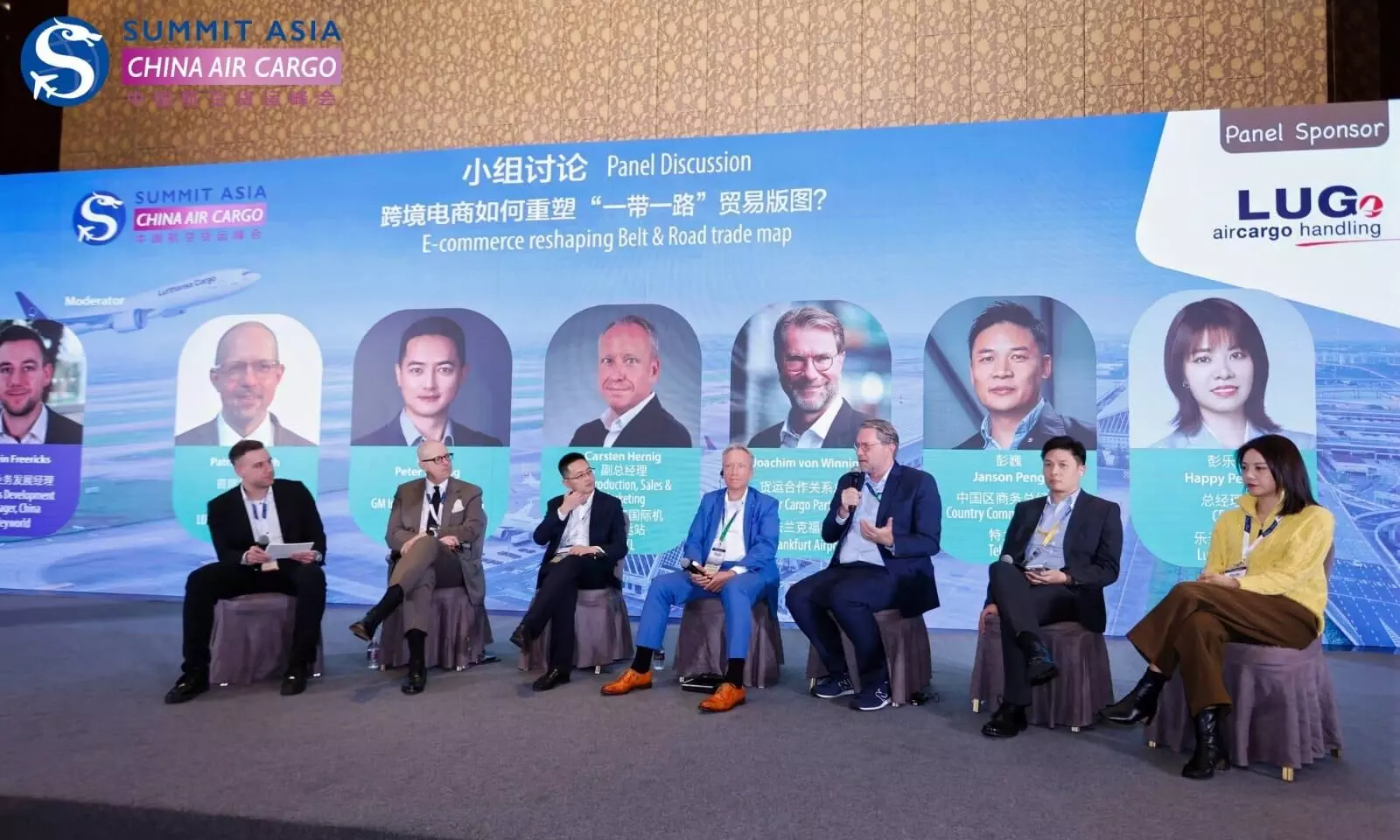
Joachim von Winning (Fraport AG) in a panel alongside representatives from airlines, airports, handlers, and logistics providers at the China Air Cargo Summit.
When Alexander Laukenmann took the stage at the China Air Cargo Summit in Shanghai this November, he opened with a Mandarin greeting, a small gesture that drew warm applause, but also reflected the significance of the moment. Just hours earlier, Frankfurt Airport and Shanghai Pudong International Airport had signed their first strategic cargo partnership, a move that goes well beyond diplomatic pageantry.
"I am especially pleased to highlight that we signed our first-ever official airport partnership for cargo, and it was with Shanghai Airport," Laukenmann, Senior Executive Vice President Aviation at Fraport AG, told the summit audience.
The partnership comes as the China-Europe corridor undergoes fundamental transformation. Frankfurt's cargo from China increased 32.3% to around 214,500 tons in the first nine months of 2025, setting a new record. Apart from traditional air freight, what's driving that growth are parcels, millions of them, bringing new challenges for the systems, which must adapt to higher volumes and shorter turnaround times.
"Our joint initiatives aim to build a resilient and strong cargo ecosystem, strengthen connectivity and create sustainable growth for both regions."
Alexander Laukenmann, Fraport AG
The e-commerce surge
Frankfurt doesn't publish e-commerce-specific statistics, but internal estimates suggest roughly 35% of China-origin tonnage falls into the e-commerce category. That translates to somewhere between 60,000 and 75,000 tonnes through the first nine months of 2025, which accounts for about 10% of all cargo unloaded at Frankfurt, measured by weight alone.
The airport now processes roughly eight million e-commerce shipments monthly, each one smaller, faster, and more fragmented than traditional air freight. To handle these volumes, Frankfurt abandoned individual parcel scanning in favour of consolidated "mother boxes" that move through customs as units. Boxes not requiring inspection go straight to last-mile providers, no warehouse dwelling, no processing delays.
Chinese logistics operators like EDT and Shaoke have stationed management teams at Frankfurt while outsourcing physical handling to local firms including CHI, Sovereign, Georgi, and WFS. It's a split model: Chinese oversight, German execution. The approach has driven demand for infrastructure tailored to rapid consolidation and deconsolidation, with warehousing positioned close to last-mile networks.
If robust e-commerce growth continues in Frankfurt, the airport is well-positioned to set new benchmarks in e-commerce volumes by 2030.
Alexander Laukenmann (Fraport AG) and Lyu Yaodong (Shanghai Airport Authority) formalise a landmark FRA–PVG cargo partnership in Shanghai
What the partnership delivers
The Frankfurt-Shanghai MoU establishes coordinated rapid-response mechanisms for customs and regulatory processes, commits both airports to joint roadshows deepening cargo community ties, and formalises expert exchanges on digitalisation and operational innovation.
"Our cooperation focuses on different areas," Laukenmann explained in his keynote. "We want to have a vital exchange between our airports hosting joint roadshows, establish expert exchanges and improve process times and frequencies. Our joint initiatives aim to build a resilient and strong cargo ecosystem, strengthen connectivity and create sustainable growth for both regions."
Strip away diplomatic framing and it's about reducing friction at points where it costs time and money. Aligned customs procedures. Coordinated handling protocols. Faster problem resolution when high-value shipments, pharmaceuticals, electronics, perishables, hit unexpected delays.
It's also strategic positioning. "Frankfurt Airport is strategically enhancing trade lanes between China and Europe to capture the fastest-growing segment of global air cargo," Laukenmann told the Shanghai audience. "China accounts for over 30% of global manufacturing exports, and Europe remains its largest trading partner."
Infrastructure and digital foundation
SF Airlines and JD Logistics maintain scheduled freighter services to Frankfurt, complemented by local e-commerce logistics providers and Lufthansa Group subsidiaries heyworld and CB Customs Broker. Freighters carry 81% of tonnage on China-Frankfurt routes – a level of dedicated lift capacity that secondary hubs struggle to match.
Lufthansa Cargo is expanding automated handling and streamlined customs clearance. WFS recently took over a warehouse dedicated to e-commerce and freight forwarder handling. Additional warehousing capacity has been made available to facilitate rapid sorting.
Frankfurt has room to grow physically. CargoCity South offers 55,000 square meters of expansion space, where DHL opened new facilities in 2025. Logistics Hub West will add another 150,000 square meters starting in 2028, purpose-built infrastructure for modern e-commerce logistics with potential trimodal connectivity linking rail, air, and road.
"Frankfurt Airport will develop air cargo-friendly logistic facilities in two rows on an area of 250,000 square meters with a hall area of 150,000 square meters," Laukenmann outlined in his keynote presentation.
On the digital front, Laukenmann spent considerable time discussing Frankfurt's cargo community platform, FAIR@Link, operated through joint venture allivate GmbH. The platform projects processing 8.2 million House Air Waybills in 2025, up from 400,000 in 2024, a twenty-fold jump enabled by integration with German customs and adoption by Chinese e-commerce operators.
"This exponential growth trajectory has been enabled by strategic trust from the Chinese e-commerce ecosystem in Frankfurt and our collaborative alignment with German Customs," Laukenmann told the summit.
The platform connects airlines, forwarders, handlers, and authorities in real-time through automated status updates and data exchange. Frankfurt's new Cargo Dashboard, which Laukenmann highlighted as an innovation he's "particularly proud of," provides real-time visibility from airport operations down to the house airwaybill level, tracking by commodity, temperature corridors, or shipment type across any time period.
"Imagine having the entire inbound cargo flow at your fingertips, from pharmaceuticals at 2-8°C to e-commerce volumes by origin and carrier," he explained.
"The exponential growth trajectory has been enabled by strategic trust from the Chinese e-commerce ecosystem in Frankfurt and our collaborative alignment with German Customs."
Alexander Laukenmann, Fraport AG
Competitive positioning
Secondary European hubs would happily take Frankfurt's China traffic. The airport's defense rests on fundamentals smaller competitors can't easily replicate: unmatched flight frequencies from major Chinese origins, a mix of belly capacity and dedicated freighters that only primary hubs can offer, and geographical proximity enabling delivery times at least one day faster than competitors.
Frankfurt has also developed compliance processes alongside German customs authorities that position it better to weather EU regulatory tightening. Highly compliant processes developed in close cooperation with customs authorities make Frankfurt more resilient to regulatory changes within the European Union.
The Shanghai partnership amplifies these strengths. Joint roadshows aim to deepen ties between cargo communities. Expert exchanges will share best practices on temperature-controlled logistics and regulatory compliance. Coordinated mechanisms should smooth customs bottlenecks that slow shipments and drive traffic elsewhere.
"China is one of Frankfurt's most significant cargo markets today, and it will continue to grow in the future," Laukenmann emphasized. "Shanghai and Frankfurt together form a logistics bridge that is essential for global trade, supply chain resilience, and economic cooperation."
Looking forward
Frankfurt's strategy is deeply rooted in what Laukenmann outlined as the "Masterplan CargoHub", a comprehensive roadmap for the next decade built on two strategic pillars.
The first: more capacity and highly efficient processes. "Digitalisation and automation are no longer options, they are necessities," he said. "To strengthen our competitive position, we are transforming the entire cargo ecosystem into a high-performance, data-driven environment."
The second: international collaboration to develop cargo growth. "We are committed to maximum cooperation and collaboration with our partners with the aim of developing high-performance trade lanes for relevant industries," Laukenmann explained.
Looking ahead, Lufthansa Cargo continues expanding e-commerce infrastructure at Frankfurt, focusing on automated handling and customs clearance capabilities.
Whether Frankfurt can handle what's coming depends on variables beyond its control: EU regulatory direction, capacity constraints, how aggressively secondary hubs invest in competing capabilities. But the Shanghai partnership signals where Frankfurt believes the industry is heading, toward integrated corridors where speed and compliance work together rather than against each other.
"This partnership marks the beginning of a new chapter," Laukenmann shared. "A chapter defined by joint innovation, shared vision, and mutual growth."
The China-Europe air freight market will only grow more complex as e-commerce fragments into specialized niches demanding different infrastructure, different handling capabilities, different regulatory expertise. Frankfurt's bet is that being Europe's largest cargo hub still matters, that scale and institutional knowledge can hold off challengers, that collaboration with Shanghai strengthens both partners rather than simply dividing existing traffic.
The Frankfurt-Shanghai MoU represents coordinated movement aimed at the world's most important trade corridor. For now, Frankfurt is building: infrastructure, digital systems, partnerships. Eight million e-commerce shipments monthly flow through systems redesigned to handle fragmentation. As markets evolve faster than ever, Frankfurt’s ongoing efforts to stay ahead of these changes are both necessary and crucial for maintaining its role in China-Europe trade.